If you only want the short answer: the biggest Lugia money is in top-grade vintage cards, led by Neo Genesis 1st Edition and Aquapolis Crystal Lugia.
I’d sum the article up like this: scarcity, grade, and collector demand decide Lugia prices. A PSA 10 Neo Genesis 1st Edition Lugia can reach $150,000–$200,000, while Aquapolis Crystal Lugia #149/147 sits around $41,500 in PSA 10. Newer cards like Lugia V Alternate Art still sell well, but the gap between raw and graded copies is much smaller.
If I were using this list to buy or grade, I’d focus on four checks first:
- Set and card number
- 1st Edition stamp
- Secret Rare numbering
- Condition issues like print lines, centering, and whitening
This list covers all 10 cards below:
- Lugia Aquapolis #149/147 (Crystal Type)
- Lugia Neo Genesis #9 1st Edition Holo
- Lugia ex Unseen Forces #105
- Lugia-EX Plasma Storm #134 Secret Rare
- Lugia V Silver Tempest #186 Alternate Art
- Lugia Call of Legends #SL7
- Shadow Lugia XD Gale of Darkness Promo
- Lugia LEGEND HeartGold & SoulSilver Top/Bottom
- Lugia-GX Lost Thunder #227 Rainbow Rare
- Lugia-EX Ancient Origins #94 Full Art
Quick take: older Lugias have the biggest upside, modern Lugias are easier to price, and grade can change value by 5x, 10x, or far more.
Top 20 RAREST Lugia Pokemon Cards 💦
sbb-itb-905f8ad
Quick Comparison
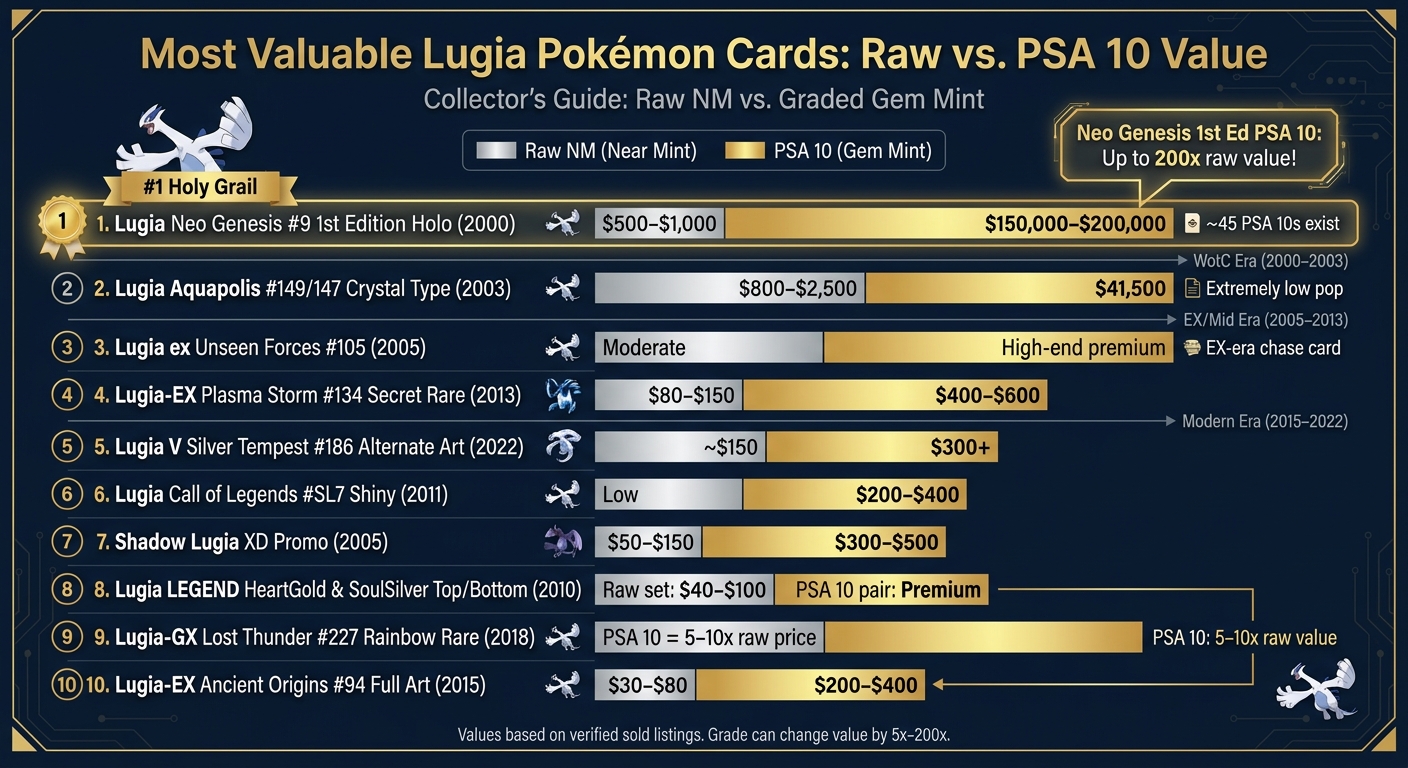
Most Valuable Lugia Cards: Raw vs. PSA 10 Prices Compared
| Card | Year | Key trait | Top-end range |
|---|---|---|---|
| Lugia Aquapolis #149/147 | 2003 | Crystal Type / Secret Rare | $41,500 PSA 10 |
| Lugia Neo Genesis #9 1st Edition | 2000 | 1st Edition vintage holo | $150,000–$200,000 PSA 10 |
| Lugia ex Unseen Forces #105 | 2005 | EX-era chase card | High-end graded premium |
| Lugia-EX Plasma Storm #134 | 2013 | Secret Rare | $400–$600 PSA 10 |
| Lugia V Silver Tempest #186 | 2022 | Alternate Art | $300+ PSA 10 |
| Lugia Call of Legends #SL7 | 2011 | Shiny subset card | $200–$400 PSA 10 |
| Shadow Lugia Promo | 2005 | Promo-only release | $300–$500 PSA 10 |
| Lugia LEGEND Top/Bottom | 2010 | Two-card set | High-grade pair premium |
| Lugia-GX Lost Thunder #227 | 2018 | Rainbow Rare | PSA 10 can be 5x–10x raw |
| Lugia-EX Ancient Origins #94 | 2015 | Full Art | $200–$400 PSA 10 |
So before you pay up, I’d make sure you’re looking at the right version and not just the right artwork.
What Makes a Lugia Card Valuable
Lugia prices usually come down to three things: scarcity, condition, and nostalgia. Those are the same factors that separate an ordinary Lugia from the kind of card people chase for years.
Population reports are one of the clearest ways to judge scarcity. PSA and BGS publish reports that show how many copies hit each grade. For example, out of thousands of 1st Edition Neo Genesis Lugias sent to PSA, only around 45 have earned a PSA 10 Gem Mint grade. That kind of low supply, paired with strong demand, is how a card ends up with a sky-high price.
The 1st Edition stamp matters too. It marks the earliest print run, and those copies usually sell for more than Unlimited versions. The same goes for secret rares. Aquapolis Lugia #149/147 stands out because its number sits beyond the main set, which tends to push prices higher.
Vintage WotC-era Lugias from 1999–2003 tend to hold the highest price floors because mint copies are hard to find. Neo Genesis is a big part of that story. It's known for print lines and centering issues, which make top grades tough to get. Aquapolis also sells at a premium because of its low population and its e-Reader border design. On the modern side, alternate arts like Lugia V from Silver Tempest lean more on pull rates and the big price gap between raw copies and PSA 10s.
Then there's nostalgia. Lugia is one of the standout Gen II Pokémon, and that pull is strong for collectors coming back into the hobby. When you're checking listings, these are the signals worth watching before you get into specific Lugia cards.
How to Identify the Right Lugia Before You Buy
Before you compare prices, check the card details first. Start with the set, card number, and stamp.
Look at the card number in the bottom-right corner. If the first number is higher than the second, like 149/147 on the Aquapolis Crystal Type, you’re looking at a Secret Rare. That one detail is what separates Secret Rare #149/147 from the standard Holo Rare #H20.
For Neo Genesis Lugia, the 1st Edition stamp matters most. Look for a small circled "1" on the left side of the card, just under the artwork frame. If that stamp isn’t there, the card is Unlimited.
Lugia LEGEND needs one more check: both halves. Lugia LEGEND comes as a two-card set: Top and Bottom. Before you buy, make sure the listing includes both halves.
Use this checklist to confirm the exact Lugia version:
| Lugia Version | Key Identifier | Where to Look |
|---|---|---|
| Neo Genesis 1st Edition | Circled "1" stamp | Left side, below artwork |
| Aquapolis Crystal Type | Card # exceeds set total (149/147) | Bottom right corner |
| Aquapolis Holo Rare | "H" prefix in card number (#H20) | Bottom right corner |
| Lugia LEGEND | Two-card set (Top + Bottom) | Card text and artwork split |
These checks help you spot the exact card before comparing prices. Use these identifiers to sort the cards below.
1. Lugia Aquapolis #149 (Crystal Type/Secret Rare, 2003)
Now that the main Lugia variants are on the table, Aquapolis #149/147 stands out as an early heavy hitter. The Aquapolis Crystal Lugia is one of the most expensive Lugia cards from the e-Reader era. A short print run, plus the Crystal Type mechanic, gives it that old-school pull collectors still chase. For people coming back to the hobby, this card is one of the clearest cases of scarcity and nostalgia pushing prices up.
As of February 2026, raw Near Mint copies were selling for about $2,500, while a PSA 10 had climbed to $41,500.
The premium over the standard Aquapolis Holo (#H20) is hard to miss. That regular holo has hit about $8,000 in PSA 10, while the Crystal Type Secret Rare has sold for more than five times that in the same grade.
| Grade / Condition | Estimated Value |
|---|---|
| Raw NM | $800 – $2,500 |
| PSA 9 | $12,450 – $24,900 |
| PSA 10 | $41,500 |
| CGC 10 | $33,000 – $37,000 |
That price spread keeps Aquapolis #149 near the top of almost any Lugia value list.
2. Lugia Neo Genesis #9 1st Edition Holo (2000)
If Aquapolis is the e-Reader grail, Neo Genesis #9 is the vintage standard. This is the Gen 2 Lugia most collectors think of first: iconic artwork, first-print scarcity, and a card stock/print profile that makes top grades very hard to get.
Early copies are notoriously difficult to grade in top condition, and only about 45 PSA 10s are known. That’s why the gap between grades is so dramatic.
| Grade | Estimated Value | Notes |
|---|---|---|
| PSA 9 (Mint) | $3,000 – $6,000 | Much higher population than PSA 10 |
| BGS 10 (Pristine) | $144,300+ | Only 3 known as of 2021 |
| PSA 10 (Gem Mint) | $150,000 – $200,000 | ~45 copies in existence |
Put simply, this card’s grade gap is one of the widest on the list.
3. Lugia ex Unseen Forces #105 (2005)
After the vintage WotC-era grails, Lugia ex #105 shows how EX-era cards became the next big chase. It’s a 2005 EX-era pull and one of the key Lugia cards in Unseen Forces. Put that together with the era, the artwork, and the low supply of clean copies, and it’s easy to see why collectors go after it.
Its Ultra Rare label and standout artwork are two of the main reasons collectors want it.
Finding a clean copy isn’t easy. A lot of these cards were played hard or stored badly. On top of that, print lines and centering problems make top grades tougher to get.
4. Lugia-EX Plasma Storm #134 Secret Rare (2013)
Plasma Storm represents a later-wave Lugia chase card, where Secret Rares and tough gem-mint populations still shape demand. Lugia-EX #134 is the set’s Secret Rare headliner, finished with gold-accented foil that gives it a standout look compared with other modern Lugia cards. And because Lugia remains one of the most sought-after Pokémon in the TCG, this card tends to sit well above most other Plasma Storm pulls in both floor and ceiling price.
At the high end, PSA 10 and BGS 10 copies bring the biggest premium. Raw Near Mint copies usually sell in the $80–$150 range, while PSA 10s can hit $400–$600. That mix of Secret Rare status, eye-catching finish, and scarcity in top grades keeps it near the top of modern-era Lugia values.
5. Lugia V Silver Tempest #186 Alternate Art (2022)
After the vintage and EX-era grails, Silver Tempest shows where modern Lugia demand is focused: alternate arts.
Lugia V Alternate Art is the set’s top chase and one of the most expensive modern Lugia cards. As Secret Rare #186/195, it was printed in much lower numbers than standard hits. The artwork is a big reason people want it so badly. Instead of the usual posed design, the card uses a full illustrated scene, which gives it a very different feel.
This card’s price doesn’t come from age like the older Lugias above. It comes from modern chase demand and the fact that high-grade copies are tough to get. Raw copies sell for around $150, while PSA 10 copies go for $300+. Print lines and centering issues make 10s hard to find.
That’s why it ranks so high: strong modern demand pushed an already tough pull into premium-grade territory. And that sets up the next Lugia chase, where rarity comes from a completely different angle.
6. Lugia Call of Legends #SL7 Shiny Legendary (2011)
After the more recent chase cards, Call of Legends moves Lugia into a much rarer shiny subset. Lugia #SL7 is one of the big chase cards in that SL subset, and its price is driven more by low supply than by Lugia’s general fan appeal.
The main reason is simple: the SL subset was printed in much smaller numbers than the main set. That’s why PSA 10 copies tend to sell in the $200–$400 range, while raw Near Mint copies stay far lower. But that price gap only holds if the card is clean enough to grade well.
This card also has a reputation for print lines and centering problems, which keeps the PSA 10 population lower and makes the spread between raw and graded copies much bigger. If you’re buying one, check it in person and look closely for print lines, centering, and whitening before you commit.
7. Shadow Lugia XD Gale of Darkness Promo (2005)
If Call of Legends is scarce because of print run, Shadow Lugia is scarce because of how it was handed out. This is a promo-only Lugia. It was released as a promo, not pulled from packs, which keeps supply tight.
What pulls collectors in is pretty simple: the dark artwork and the promo-only release. No other Lugia card looks like it. That alone gives it a lot of appeal.
Raw copies usually sell for $50–$150, while PSA 10 copies can hit $300–$500. That gap mostly comes down to one thing: clean copies are hard to find.
Condition is the big deal here. Mid-2000s promos were often handled a lot, and stamp flaws can drag the grade down. A clean stamp can be the difference between a strong copy and a problem copy.
Check the stamp first. It’s the weak point most often.
8. Lugia LEGEND HeartGold & SoulSilver Top/Bottom Set (2010)
Lugia LEGEND comes as a two-card combo: Top and Bottom. And that changes the whole game.
This Lugia stands out because collectors don't just want one card. They need both halves, and both need to be in strong shape. A complete pair in high grade is much tougher to find than a single Lugia card. Each half has to grade well on its own, so the grading hurdle is basically doubled. One crease, one scratch, or one rough edge can cut the price fast.
That’s a big reason strong sets stay expensive.
Raw complete sets usually sell for $40–$100, while high-grade PSA 10 pairs go for much more. The split-art design and limited supply help keep Lugia LEGEND in demand, especially for collectors who care about completeness and strict grading standards.
9. Lugia-GX Lost Thunder #227 Rainbow Rare (2018)
After the older chase cards, this one makes a simple point: Lugia still has pull in modern sets. Lugia-GX #227 is a Secret Rare Rainbow Rare from Lost Thunder, and the full-card rainbow foil gives it a very different look from the standard Full Art.
Rainbow Rares from this era often have print lines and centering problems. That makes PSA 10s tough to get. A copy can look clean at first glance and still miss the grade once it’s under grading light. That’s a big part of why top-grade copies sell for so much.
You can see it in the pricing. A PSA 10 copy can sell for about 5–10 times the raw, ungraded price. That gap also helps explain why raw copies still sell fast.
What keeps this card near the top of modern Lugia sales is pretty clear: strong collector demand and a hard road to PSA 10. If you’re checking one before grading, look closely at centering and the surface under bright LED light.
10. Lugia-EX Ancient Origins #94 Full Art (2015)
Lugia-EX Ancient Origins #94 Full Art lands at No. 10 thanks to its standout artwork and its wide spread across grades. The gap between raw and graded prices is hard to miss. Raw copies usually sell for $30–$80, while PSA 10 copies can hit $200–$400. That kind of jump tells you one thing fast: clean copies are tough to come by.
Part of the draw comes from timing. As a 2015 Lugia card, it gets a solid push from mid-era collector demand, and the number of sharp, pack-fresh copies is smaller than many buyers would like. Pull rates can be as low as 1 in 60+ packs, so supply starts off tight.
The card itself also works against high grades. The full-art finish makes edge wear and surface scratches stand out more than you'd want, and micro-scratches may only show up under raking light. So a card that looks fine at first glance can still miss PSA 10. That's a big reason the raw-to-grade price gap is so wide, and it sets up the side-by-side value breakdown below.
Raw vs. Graded Value at a Glance
This table makes one thing clear: condition can change a Lugia card's price by a LOT. And the older the card, the bigger that spread tends to get.
| Card | Set & Year | Rarity | Raw NM | PSA 10 | Value Driver |
|---|---|---|---|---|---|
| Lugia Neo Genesis #9 1st Edition Holo | Neo Genesis, 2000 | 1st Edition Holo Rare | $500–$1,000 | $150,000–$200,000 | Iconic Gen II debut; only about 45 PSA 10s exist |
| Lugia #149 Crystal Type | Aquapolis, 2003 | Crystal/Secret Rare | $2,500 | $41,500 | Rare Crystal Type mechanic; extremely low pop |
| Lugia V Silver Tempest #186 Alternate Art | Silver Tempest, 2022 | Alternate Art | ~$150 | $300+ | Modern chase card; strong artistic demand |
Only cards with verified raw and PSA 10 ranges appear here.
The biggest jump shows up with Neo Genesis 1st Edition. Raw near-mint copies sell for about $500 to $1,000, while a PSA 10 can hit $150,000 to $200,000. That's about a 150x to 200x jump, and it comes down mostly to how hard it is to find a clean copy.
Modern cards tell a different story. Lugia V Silver Tempest #186 Alternate Art still gets strong demand, but the raw-to-graded spread is much smaller. That usually means less upside from grading, unless your copy has a real shot at a top grade.
A simple way to use this: if the gap between raw and PSA 10 is huge, grading may be worth a close look. If the gap is tight, the card needs to be VERY clean for the math to work in your favor.
What to Check Before You Buy, Sell, or Grade
Use this checklist to judge the Lugias in this list before you buy or send one in for grading.
Check the edges, holo surface, borders, and centering. Whitening is a common clue that a played copy has edge wear, so look at every edge under a bright LED light. Then tilt the card to spot micro-scratches, print lines, and crazing on the holo surface. Bad off-centering can drag down both grade potential and eye appeal.
Before you pay premium prices, make sure you have the exact Lugia version. The fastest way to verify it is to check:
- the card number
- the set symbol
- the edition stamp
When you're pricing a card, use sold listings for that exact Lugia variant. Asking prices often make a card look worth more than it is.
Only grade a card when the likely jump in value clearly covers grading fees and shipping. It also helps to check the PSA Population Report. Lower pop often supports stronger upside. Clean condition, strong centering, and low population are the main things that push Lugia prices higher, so use those checks before you compare raw and graded prices above.
Where Returning Collectors Can Learn More
Once you've pinned down the exact Lugia version, the next step is checking scarcity and market value. And if you're getting back into the hobby after a long break, a lot of the old reference points don't hold up anymore.
Use the PSA Population Report to see how many copies exist at each grade. That gives you a better read on how scarce a card actually is, not just how scarce it sounds.
For pricing, look at sold listings for raw cards and mid-grade slabs. Then check auction archives for verified high-end sales and provenance. That helps you separate asking prices from what people have actually paid.
Before you buy a slab, verify the certification number in the issuer's database. It's a small step, but it can save you from a big mistake.
Off Center (offcenter.cards) is also worth checking. It covers set history, grading, print runs, and card variations for collectors coming back to the hobby. Go through those guides before you put serious money into any card on this list.
Conclusion
Looking across these ten cards, the same pattern shows up again and again: rarity, condition, and demand drive the highest prices. The most expensive Lugia cards are still the rare copies in top grades that collectors keep chasing.
These rankings can move over time as new submissions change population counts and grading standards shift. When the market cools, buyers often lean toward the best cards, which is why current pop reports matter.
Use this list as a pricing and grading filter, not a fixed rule. Know the card, check the grade, and base your price on sold listings, not asking prices.
FAQs
Why is Lugia so collectible?
Lugia is highly collectible because it’s one of the most loved Legendary Pokémon and a defining icon of Pokémon Gold and Silver. For a lot of collectors, that link brings back strong nostalgia.
Its most famous cards - especially the 1st Edition Neo Genesis Holo - are also tough to find in pristine condition. Print lines, centering problems, and edge wear show up often. That low supply, paired with Lugia’s fan-favorite status, helps push demand and value higher.
Is grading a Lugia card worth it?
Often, yes - especially for high-value or vintage Lugia cards.
Grading can push the price up in a big way. With cards like 1st Edition Neo Genesis Lugia, grading helps draw a sharp line between a normal raw copy and a Gem Mint 10 that can sell for $150,000 to $200,000.
That said, grading isn't automatic profit. Before you send a card in, compare recent sales against grading fees. Then look over the card closely for:
- scratches
- print lines
- edge whitening
- centering issues
Regrading a PSA 8 or higher usually adds risk you don't need, unless there's a strong chance the card was undergraded.
How can I tell which Lugia version I have?
Check the set symbol and card number first. A 1st Edition stamp on the left, just below the artwork, marks the earliest print run. If there’s no stamp and no drop shadow behind the artwork, the card is Shadowless.
You can also inspect the stamp with a jeweler’s loupe. Fake cards often look fuzzy or dotted. And if the card number is higher than the set total, it’s a secret rare.