If you’re pricing a Mewtwo card, the print and grade matter more than the name on the card. A Base Set 1st Edition holo can sell for $50,000+ in PSA 10, while a similar-looking Unlimited copy can be a small fraction of that.
Here’s the short version:
- I’d check the exact version first: 1st Edition, Shadowless, Unlimited, promo, No Rarity, Gold Star, Shining, or Secret Rare.
- Then I’d check the grade: the jump from PSA 9 to PSA 10 is often the biggest price gap.
- The top Mewtwo cards in this list come from early WotC holos, Japanese early prints, EX-era chase cards, and modern alt art or Secret Rare cards.
- Small print details can change the price by thousands of dollars.
This list covers these 10 cards:
- Mewtwo Base Set 1st Edition Holo
- 1996 Japanese Base Set No Rarity Symbol Mewtwo
- Mewtwo Gold Star EX Holon Phantoms #103
- Shining Mewtwo Neo Destiny
- Mewtwo GX Shining Legends Secret Rare #76/73
- Rocket’s Mewtwo ex EX Team Rocket Returns
- Mewtwo Expedition Base Set Holo
- Mewtwo Wizards Black Star Promo #3
- 1999 Japanese CD Promo Glossy Mewtwo #150
- Mewtwo & Mew GX Unified Minds Alternate Art #242/236
Top 10 Expensive Mewtwo Pokémon Cards!
sbb-itb-905f8ad
Quick Comparison
| Card | Era | What to check first | Main price driver |
|---|---|---|---|
| Base Set 1st Edition Holo | 1999 | 1st Edition stamp + no shadow | Low PSA 10 supply |
| Japanese No Rarity Mewtwo | 1996 | Blank rarity spot | Earliest Japanese print |
| Gold Star Mewtwo #103 | 2006 | Gold Star mark + condition | Gold Star chase status |
| Shining Mewtwo | 2000 | Shining layout + wear | Low high-grade supply |
| Mewtwo GX #76/73 | 2017 | Secret Rare number | Modern chase demand |
| Rocket’s Mewtwo ex | 2004 | EX-era layout | EX-era supply |
| Expedition Holo | 2002 | Expedition set look | Tough grade in top shape |
| Black Star Promo #3 | 1999 | Promo number/logo | Early promo demand |
| Japanese CD Promo Glossy #150 | 1999 | Glossy finish | Huge PSA 9 vs. PSA 10 gap |
| Mewtwo & Mew GX Alt Art #242/236 | 2019 | Alt art number | Modern art-driven demand |
Bottom line: if you want a fast read on price, start with print, then grade, then compare recent sold listings. That simple order will keep you from mixing up a grail-level Mewtwo with a much lower-priced version.
What Returning Collectors Should Check Before Pricing a Mewtwo
Before pricing a Mewtwo, make sure you know exactly which version you have. With English Base Set cards, small print details can change the price by a lot.
A 1st Edition copy has a small black "Edition 1" circular stamp below the left side of the artwork box. It also has no drop shadow on the right side of the artwork box. A Shadowless copy has no stamp and no shadow. An Unlimited print has no stamp, but it does have that shadow. That one detail is often what separates the top Base Set Mewtwo printings from more common copies.
| Identifier | 1st Edition | Shadowless | Unlimited |
|---|---|---|---|
| "Edition 1" Stamp | Yes | No | No |
| Artwork Drop Shadow | No | No | Yes |
For later-era cards, the set number is usually the fastest way to check value. If the card number goes past the set total - like Mewtwo GX #76/73 - it’s a Secret Rare. If the card has a promo marker, a stamp, or a promo-only logo, it’s a promo release.
Once you confirm the print, condition usually becomes the main price driver. Tilt the card under bright light and look for holo scratches or surface wear. Then check the corners, edges, and centering. A card can look clean at first glance and still fall into the PSA 7–8 range because of off-center borders or a factory print line.
For raw cards, only think PSA 10-level if the corners are razor-sharp, the holo looks clean, and the centering is close to perfect. To check market value, use sold listings and compare recent comps.
1. Mewtwo Base Set 1st Edition Holo
The 1st Edition Base Set holo is the original English Mewtwo grail. It comes from the 1999 Wizards of the Coast Base Set, which was the first English printing of Mewtwo. Its 1st Edition status, plus how hard it is to find in top grade, is what pushes the price so high. That mix of history and scarcity is why it sits at the top of the list.
A lot of the value comes down to the small 1st Edition print run and steady demand over time. High-grade copies are tough to find, with fewer than 10 copies ever earning a PSA 10 Gem Mint grade. PSA has tracked more than $733,000 in realized prices across documented auction sales of this card.
And this is where things get wild: the jump from a PSA 8 to a PSA 9 can change the price by $10,000 or more on this card alone. Holo scratches, print lines, centering issues, and corner whitening are the main reasons a card falls short of PSA 10. Those flaws help explain the huge gap between grades.
| Grade | Estimated Value |
|---|---|
| PSA 10 (Gem Mint) | $5,000 – $50,000+ |
| PSA 9 (Mint) | $800 – $40,000 |
| PSA 8 (NM-MT) | $300 – $28,000 |
| PSA 7 (NM) | $150 – $5,000 |
| PSA 6 (EX-MT) | $80 – $3,000 |
The 1st Edition stamp makes up roughly 90%–95% of this card's total value when you compare it with an Unlimited copy. If you're pricing a raw copy, get it graded before taking the number too seriously. Counterfeit copies are out there, and a weak or off-center stamp is a major warning sign when buying raw. This is the benchmark that every other high-end Mewtwo gets measured against.
2. 1996 Japanese Base Set No Rarity Symbol Mewtwo
Japanese Base Set has its own first-print grail: the No Rarity Symbol Mewtwo. This version comes from the first Japanese Base Set print run, making it the Japanese counterpart to an early-print Mewtwo grail.
The telltale sign is simple: look at the lower-right corner. If that corner is blank, you’re looking at the No Rarity Symbol version. Later printings added a set symbol there.
High-grade copies are hard to find because many of these cards were played, handled often, or tossed out long before grading became common.
3. Mewtwo Gold Star EX Holon Phantoms #103
The Mewtwo Gold Star from EX Holon Phantoms is one of the top Mewtwo grails in the hobby. It comes from the Gold Star era, a period known for low-print shiny Pokémon and artwork that breaks past the usual card frame. For returning collectors, the big thing to watch is the Gold Star label and the low population in top grade. That mix of era appeal and scarcity is a big reason this card ranks so high.
Pull rates were roughly 1 in 72 packs, which helps explain the price. Near-mint raw copies sit around $4,000, while PSA 10 copies reach about $8,000 to $12,000.
Condition matters a lot here. Gold Stars show print lines, surface scratches, and edge wear pretty easily, so centering and a clean holo make a huge difference.
If you're buying raw, inspect it closely. Look for sharp print, the right texture, and a normal card stock feel. That same chase-driven demand carries into the next major Mewtwo grail.
4. Shining Mewtwo Neo Destiny
After Gold Star Mewtwo, the next vintage grail is Shining Mewtwo from Neo Destiny. It came out on February 28, 2002, and that WOTC-era release still carries weight with serious collectors. As a Shining card, it was made to be a chase card from the start, which helps keep demand high for top-grade copies.
For buyers, condition is the big sticking point. Shining Mewtwo is very sensitive to wear: surface scratches, holo wear, and off-centering can drag a grade down fast. And on this card, those flaws show up almost right away.
That combination of an iconic Pokémon, low supply, and tough grading is why Shining Mewtwo stays near the top of the vintage Mewtwo market.
5. Mewtwo GX Shining Legends Secret Rare #76/73
After the vintage chase cards, the market shifts to a more modern Mewtwo standout. Mewtwo GX Shining Legends #76/73 is a textured Secret Rare chase card, and high-grade copies still get strong buyer interest.
As a full-art Secret Rare from Shining Legends, the textured foil surface is what makes the card pop. It’s also the part that causes the most trouble at grading time. Texture issues and foil scratches are the main things that keep this card from landing a Gem Mint grade, and they’re easy to miss if you only give it a quick glance.
Before you price a copy like it could hit PSA 10, check the textured surface under angled light. That small step can save you from overvaluing a card that looks clean at first but has surface flaws once the light hits it.
That same demand pattern shows up in older promo releases and other low-print Mewtwo cards.
6. Rocket's Mewtwo ex EX Team Rocket Returns
After the vintage holos and shinies, the list shifts to EX-era Mewtwo cards. This is where lower print runs and tough grading help keep prices high. Rocket's Mewtwo ex from EX Team Rocket Returns stands out as the main EX-era Mewtwo chase card, thanks to its Team Rocket tie-in, low supply, and strong nostalgia.
The big drivers here are pretty simple: scarcity in high grade and steady demand for EX-era Mewtwo cards. That combo keeps this card near the top of the pile.
Like most EX-era ex cards, condition can make or break the price. Surface wear and print flaws often create a sharp gap between raw copies and high-grade slabs. Start with centering and edge wear. A card can look clean at first glance and still fall short of Gem Mint by a hair.
That same mix of scarcity and collector demand shows up again in the next promo-era Mewtwo.
7. Mewtwo Expedition Base Set Holo
Mewtwo Expedition Base Set Holo is a late WotC-era chase card that still commands a high price, mostly because top-grade copies are tough to come by. Once collectors move past the Neo and EX-era grails, this late WotC holo often stays near the top of the list for people chasing one of the last vintage Mewtwo prints.
With late-vintage holos, price jumps tend to happen only when the card stays very clean. Condition is what drives the premium. Check the border alignment, holo scratches, print lines, edge wear, and corner whitening under angled light. A front that looks clean at first glance can still hide flaws that limit the grade.
8. Mewtwo Wizards Black Star Promo #3
After the later WotC holos, the next big jump in value comes from promo-only Mewtwo cards. Mewtwo Wizards Black Star Promo #3 wasn't pulled from a booster pack, and that alone makes it stand out from most vintage Mewtwo releases. Its promo-only distribution, paired with its age and steady collector demand, is a big part of why high-grade copies sell for more.
With this card, condition is everything. The main grading trouble spots are centering and ink quality. Even a copy that looks clean at first glance can still fall short of a PSA 9 or PSA 10. Ink flaws can drag the grade down too.
That’s why a high-grade slab carries so much weight. It confirms the card is genuine and locks in its condition, which matters a lot for a promo this old and heavily collected. You see that same pattern again with the Japanese CD promo.
9. 1999 Japanese CD Promo Glossy Mewtwo #150
The 1999 Japanese CD Promo Glossy Mewtwo #150 is one of those cards where condition changes everything. Like the other promo-era Mewtwo cards in this list, it tends to live or die by grade. And because the card has a glossy finish, wear shows up fast. Surface scratches are much easier to see on glossy cards, so even tiny flaws can hit the grade hard. That’s why grade is the main thing buyers look at.
The price gap between grades can be huge. PSA 9 copies usually sell for $800 to $1,500, while PSA 10 copies can hit $5,000 to $12,000+. That kind of jump tells you a lot. High-grade copies aren’t easy to find, partly because many were handled heavily over the years.
10. Mewtwo & Mew GX Unified Minds Alternate Art #242/236
The list ends with a modern Tag Team-era chase card.
Mewtwo & Mew GX Unified Minds Alternate Art #242/236 is the Tag Team-era standout here. Its full-art alternate illustration looks great, but it also makes scratches, edge wear, and centering issues easier to spot than a standard layout. Because of that, condition plays the biggest role in high-end value.
Raw copies tend to move up fastest when the surface is clean and the centering looks strong. If you're buying raw, check those two things first.
Quick Value Comparison: The Top Mewtwo Grails at a Glance
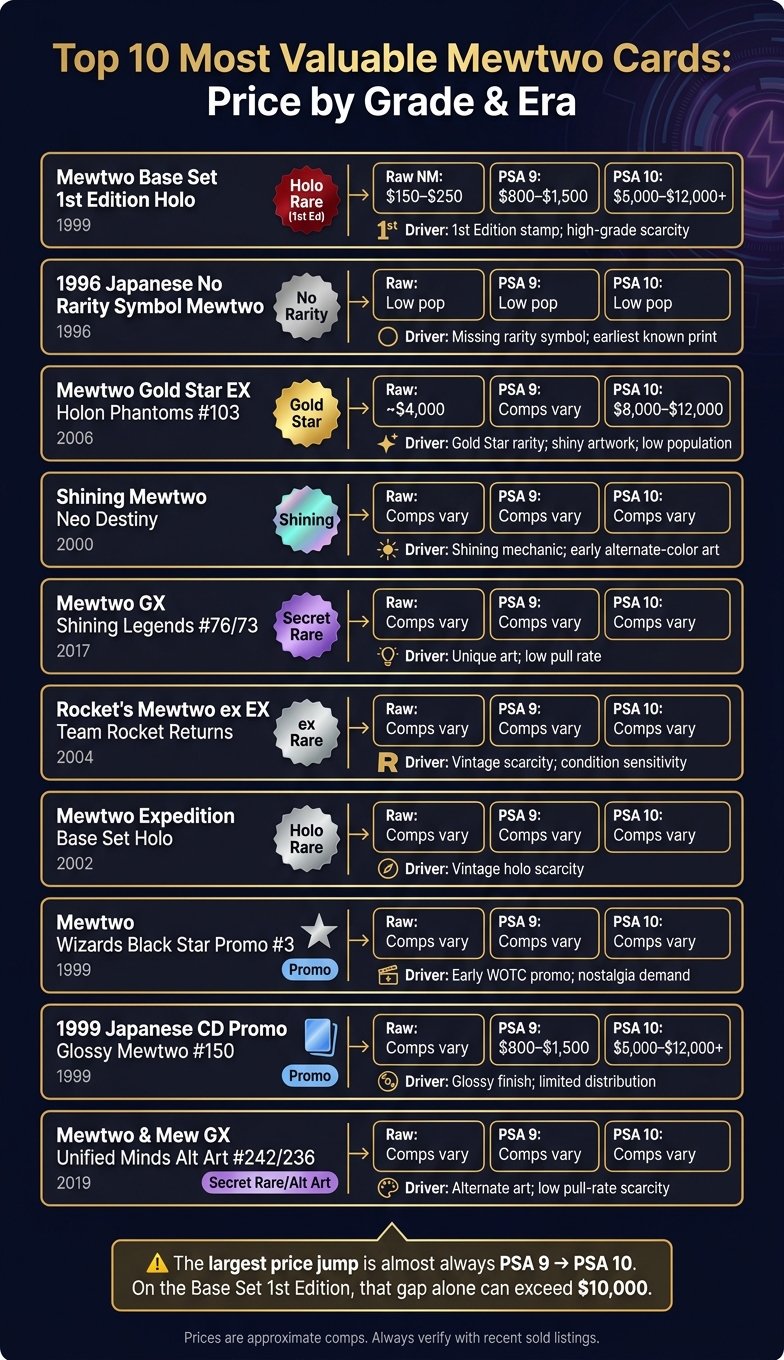
Top 10 Most Valuable Mewtwo Cards: Price by Grade & Era
The prices below are rough near-mint comps. Small details like centering, surface wear, and current demand can swing prices in a hurry. Think of this as a side-by-side snapshot of the biggest Mewtwo grails by set, era, and what pushes the price.
| Card | Set | Year | Rarity Type | Raw NM (Approx.) | PSA 9 (Approx.) | PSA 10 (Approx.) | Main Value Driver |
|---|---|---|---|---|---|---|---|
| Mewtwo Base Set 1st Edition Holo | Base Set | 1999 | Holo Rare | $150–$250 | $800–$1,500 | $5,000–$12,000+ | 1st Edition stamp; high-grade scarcity |
| 1996 Japanese Base Set No Rarity Symbol | Japanese Base Set | 1996 | No Rarity | Low pop; comps vary | Low pop; comps vary | Low pop; comps vary | Missing rarity symbol; earliest known print |
| Mewtwo Gold Star EX Holon Phantoms #103 | EX Holon Phantoms | 2006 | Gold Star | ~$4,000 | Comps vary | $8,000–$12,000 | Gold Star rarity; shiny artwork; low population |
| Shining Mewtwo Neo Destiny | Neo Destiny | 2000 | Shining | Comps vary | Comps vary | Comps vary | Shining mechanic; early alternate-color art |
| Mewtwo GX Shining Legends Secret Rare #76/73 | Shining Legends | 2017 | Secret Rare | Comps vary | Comps vary | Comps vary | Unique art and low pull rate |
| Rocket's Mewtwo ex EX Team Rocket Returns | EX Team Rocket Returns | 2004 | ex Rare | Comps vary | Comps vary | Comps vary | Vintage scarcity and condition sensitivity |
| Mewtwo Expedition Base Set Holo | Expedition Base Set | 2002 | Holo Rare | Comps vary | Comps vary | Comps vary | Vintage holo scarcity |
| Mewtwo Wizards Black Star Promo #3 | WOTC Black Star Promos | 1999 | Promo | Comps vary | Comps vary | Comps vary | Early WOTC promo origin; nostalgia demand |
| 1999 Japanese CD Promo Glossy Mewtwo #150 | Japanese CD Promo | 1999 | Promo | Comps vary | $800–$1,500 | $5,000–$12,000+ | Glossy promo finish; limited distribution |
| Mewtwo & Mew GX Unified Minds Alternate Art #242/236 | Unified Minds | 2019 | Secret Rare / Alt Art | Comps vary | Comps vary | Comps vary | Alternate art illustration; low pull-rate scarcity |
One thing jumps off the page: the largest price jump is usually from PSA 9 to PSA 10. That gap can be brutal, especially on cards that already have low high-grade supply.
The reason a card gets expensive also shifts depending on the era. With 1999 cards, the big hook is often the stamp. With Gold Star cards, it comes down to the special rarity and low population. With newer cards, the main pull is usually the art plus the pull rate.
So while grade is still the biggest factor, the why behind the value changes from one era to the next: stamp, special rarity, or pull rate.
Next, it helps to look at the small print details that separate these cards from similar-looking versions.
How to Tell Similar High-End Mewtwos Apart
Once you’ve looked at the price snapshot, the next step is simple: check a few visual markers. That matters because some Mewtwo cards look almost the same at first glance, yet sell for very different amounts.
The toughest Base Set versions to sort out are 1st Edition, Shadowless, and Unlimited. You can tell them apart by looking at two physical details: the small black "Edition 1" stamp on the left side below the artwork frame, and the shadow printed along the right and bottom edges of the artwork frame.
| Marker | 1st Edition | Shadowless | Unlimited |
|---|---|---|---|
| 1st Edition Stamp | Yes | No | No |
| Art Box Shadow | No | No | Yes |
| Relative Value | Highest | About 30–40% of 1st Ed. | Lowest |
Base Set 2 cards are easier to spot. They have a "2" set symbol on the right side. Original Base Set cards do not have a set symbol there.
For No Rarity Mewtwo, look at the bottom-right corner. A standard Japanese Base Set Mewtwo has a star rarity symbol in that spot. The No Rarity version leaves it blank.
Shining Mewtwo from Neo Destiny stands out because the holo pattern appears on the Pokémon itself, and the card has a triple-star rarity marker. Gold Star Mewtwo from Holon Phantoms has a gold star next to the name, and the artwork pushes past the frame.
Rocket's Mewtwo ex uses the EX-era card layout and uppercase "EX." That helps separate it from later Mewtwo ex releases.
For deeper set history and grading context, use the sources below.
Where to Learn More About Variants, Grading, and Set History
Use these guides when a Mewtwo's version, grade, or value is still unclear.
After you identify the card, turn to these guides to check the details that move the price. Off Center publishes practical guides on print runs, how to read rarity symbols, grading reports, and price gaps between lookalike cards. That matters most when tiny print differences can change a card's value fast.
If you're still comparing versions, grading is the next step. Study grading standards before you buy a raw card or submit one yourself. Mewtwo's holo surface makes scratches and print lines easy to miss without reference images.
Once a Mewtwo moves into a high-value range, grading and population data become the last checks. For high-value Mewtwo cards, PSA or BGS grading helps confirm authenticity and can improve resale value. Use the grading and population-report guides before buying or submitting expensive copies.
Conclusion
The top Mewtwo cards come down to three things: print, rarity, and grade. A PSA 10 Gem Mint 1st Edition Base Set Mewtwo has sold for more than $50,000 at auction, and that premium exists for a simple reason: most early cards were played, not stored away, so high-grade copies are hard to find. That’s why tiny print details can swing the price so much.
With old Mewtwo cards, the exact version matters more than the card’s surface appeal alone. If you don’t start with the right version, the price doesn’t mean much. Use this list to sort old Mewtwo cards fast. If a card matches one of these ten, check the print first, then look at condition. For returning collectors, the safest move is simple: identify the version, confirm the grade, then compare sold prices.
FAQs
Should I grade my Mewtwo card before selling it?
Usually, yes - grading can help you get more from the card, verify that it’s legit, and make buyers feel more comfortable, especially with high-value or vintage Mewtwo cards.
The smart move is to compare the raw card price with the card’s expected graded price, then subtract grading fees and the chance of getting a lower grade than you hoped for. For cards worth more than $5,000, grading is often the standard move.
Before you send a card in, check it closely for:
- corner whitening
- edge wear
- surface scratches
- centering issues
How can I tell if my Mewtwo is 1st Edition, Shadowless, or Unlimited?
Check the left side of the card and the right edge of the artwork frame.
- 1st Edition: a small black 1st Edition stamp appears on the left side, just below the artwork.
- Shadowless: there’s no 1st Edition stamp, and the right side of the artwork frame has no shadow.
- Unlimited: there’s no 1st Edition stamp, and the right side of the artwork frame does have a shadow.
Why is the price jump from PSA 9 to PSA 10 so big?
The big price gap mostly comes down to rarity.
A PSA 10 means Gem Mint condition. In plain English, that usually means near-perfect centering, clean surfaces, and sharp corners. A PSA 9, on the other hand, can have one small flaw.
And that small difference matters a lot.
Very few cards meet the PSA 10 standard, so PSA 10s are much harder to find than PSA 9s. That lower supply, combined with the trust collectors place in the grade, is why PSA 10 cards often sell for a much bigger premium.