If you want the short answer, the biggest Umbreon cards are led by the two Gold Stars, with top PSA 10 sales reaching $50,000 to $80,000 and one Japanese PLAY Promo sale at $78,000. After that, vintage e-Reader holos like Skyridge and Aquapolis, plus modern cards like Moonbreon, make up the rest of the list.
Here’s what I’d keep in mind right away:
- Top spot: Umbreon Gold Star #17 (POP Series 5)
- Hardest Japanese grail: Umbreon Gold Star PLAY Promo
- Top vintage set cards: Skyridge H30/H32, Neo Discovery 1st Edition Holo, Aquapolis H29/H32
- Top modern chase: Umbreon VMAX #215/203, also called Moonbreon
- Main price drivers: grade, print supply, and Umbreon demand
- Big grade gap example: Aquapolis raw at about $650 vs. PSA 10 near $14,000
- Big caution: similar Umbreon cards can have very different prices based on set, stamp, language, and holo type
If you’re coming back to Pokémon cards, the main thing is simple: check the exact card number, check whether it is the right print, and check sold prices instead of asking prices. A raw Umbreon and a PSA 10 Umbreon can be thousands of dollars apart.
Top 10 Best Umbreon Pokemon Cards To Collect In 2025
sbb-itb-905f8ad
Quick Comparison
| Rank | Card | Set | Main market level |
|---|---|---|---|
| 1 | Umbreon Gold Star #17 | POP Series 5 | Highest English Umbreon tier |
| 2 | Umbreon Gold Star PLAY Promo | Japanese PLAY Promo | Top Japanese grail tier |
| 3 | Umbreon H30/H32 Holo | Skyridge | Top vintage e-Reader tier |
| 4 | Umbreon #13 1st Edition Holo | Neo Discovery | Top early vintage tier |
| 5 | Umbreon H29/H32 Holo | Aquapolis | High-end e-Reader tier |
| 6 | Umbreon ex #112/115 | EX Unseen Forces | High-end ex-era tier |
| 7 | Umbreon Prime #86/90 | HS - Undaunted | High-end Prime-era tier |
| 8 | Umbreon VMAX #215/203 | Evolving Skies | Top modern alt-art tier |
| 9 | Umbreon ex #161 | Prismatic Evolutions | Top recent modern tier |
| 10 | Umbreon Gold Star #17 | Celebrations Classic Collection | Lower-cost Gold Star-style entry |
Bottom line: this list is less about age alone and more about scarcity + grade + collector demand. That’s why some old raw cards sell for a few hundred dollars, while top graded copies jump into the five-figure range.
What Returning Collectors Should Know Before Reading the Rankings
Before you get into the list, it helps to lock down a few basics. They explain why two Umbreon cards that look almost the same can end up miles apart in price.
Edition and print origin matter more than most people think. Japanese Umbreon cards often earn better grades because print quality and centering tend to be stronger. Some Umbreon versions, including certain Gold Star promos, were only released in Japan. That smaller global supply is a big reason prices run higher.
First Edition vs. Unlimited is one of the biggest price splits in vintage sets. With cards like Neo Discovery Umbreon, the 1st Edition stamp can change the value in a big way. Unlimited copies from the same set sell for far less, even when condition is the same. So before you compare prices, make sure you're looking at the right version.
Grading also creates huge price gaps. A PSA 10 is "Gem Mint", which means almost no wear. A PSA 9 is "Mint", with slight wear that usually shows up only under close inspection. That jump in price comes from scarcity. On vintage cards, edge whitening and centering issues make PSA 10 copies hard to find, so populations stay very small. That's why the rankings below focus on the exact versions that bring in the top prices.
If you want a simple walkthrough of grading, population reports, and card condition checks, Off Center has a collector-focused guide.
One quick example: Aquapolis has holo, reverse holo, and non-holo Umbreon versions. Only the H29 holo carries the premium used in this list.
1. Umbreon Gold Star #17 (POP Series 5)
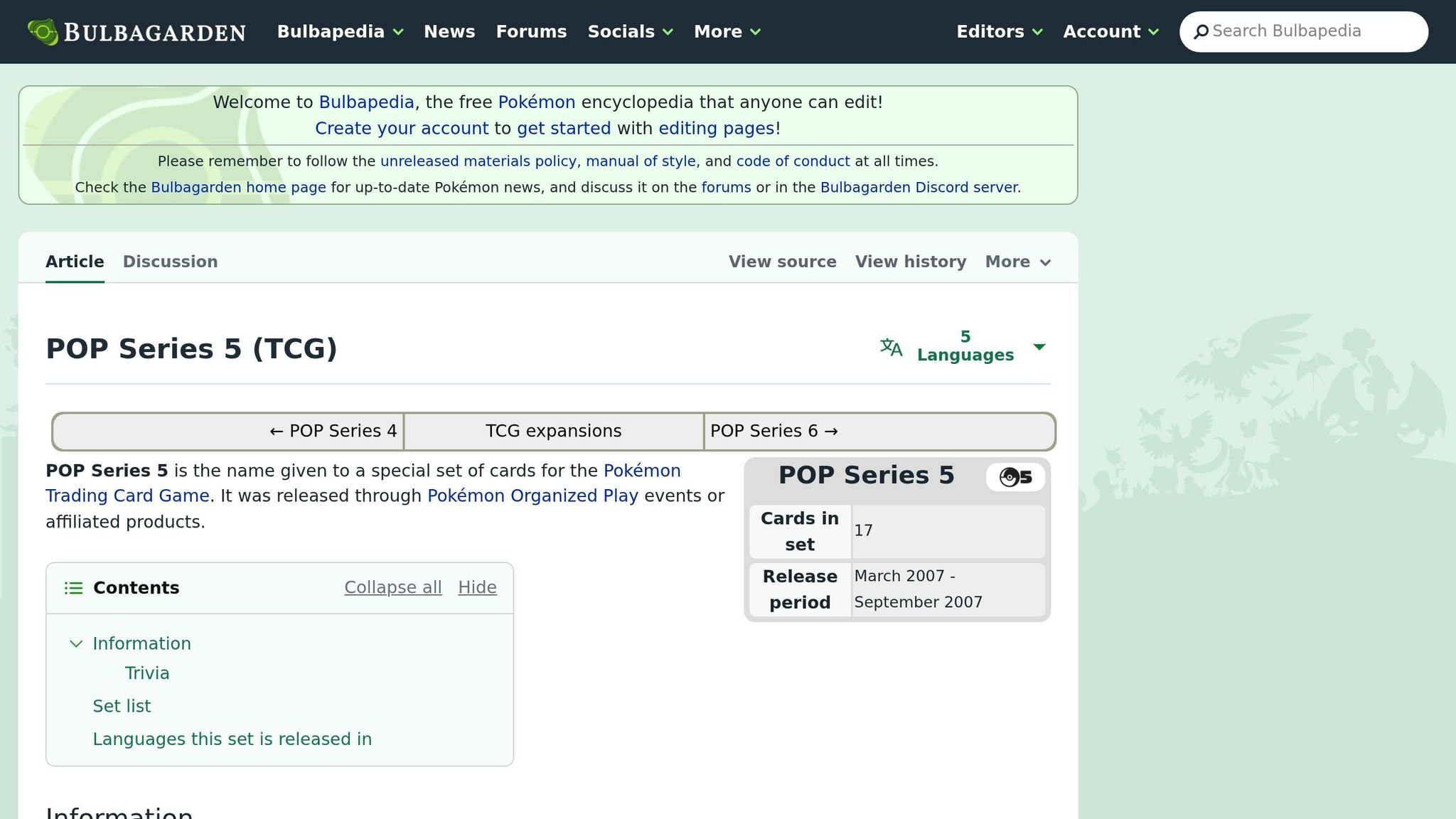
Among English-language Umbreon cards, this is the clearest case of how scarcity and grade shape high-end prices. Umbreon Gold Star #17 from POP Series 5 sits at the top of the wish list for a lot of collectors. The reason is pretty simple: it brings together promo distribution, Gold Star rarity, and strong Umbreon demand.
In PSA 10, the card sells for $50,000–$80,000, while raw Near Mint copies usually land around $2,000–$3,500. That gap is huge, and it shows how much grade matters here. In fact, PSA 10s can sell for 50%–70% more than PSA 9s.
Part of the appeal comes from supply. POP Series 5 was a promo release, not a normal retail set, so there simply aren't many copies out there. On top of that, EX-era Gold Stars were ultra-rare pulls, at about 1 in 72 packs.
Getting a clean copy is also tougher than it sounds. PSA 10s are hard to find because the card's dark borders, reflective foil, and centering issues make flaws stand out fast. Even small problems can knock the grade down. Promo packaging didn't help either, since it often led to corner dings and surface scuffs.
Then there's Umbreon itself. The character has a strong collector base, and that pushes this card into another price tier. Compared with similar Gold Stars from the same era, Umbreon carries a 2–3x premium. Next up is the Japanese Gold Star promo, which is even scarcer in a different market.
2. Umbreon Gold Star PLAY Promo (Japanese 70,000 Points Reward)
Even harder to get than the POP Series 5 card, the Japanese Umbreon Gold Star PLAY Promo (26/PLAY) came through the Daisuki Pokémon Fan Club. To earn it, collectors needed 70,000 points. Almost nobody got there, which made this card far scarcer than any pack-pulled Umbreon card.
That huge point hurdle kept supply tiny, so PSA 10 copies are hard to find. One confirmed PSA 10 sale through PWCC hit $78,000, and a BGS 9.5 copy had earlier sold for about $70,000. This card was earned, not pulled, and that’s a big part of the appeal. For many collectors, it’s a true Umbreon grail. Next up is a vintage holo with a very different collector premium.
3. Umbreon H30/H32 Holo (Skyridge)
Umbreon H30/H32 is the holo from Skyridge, the final E-Series set before the TCG shifted to a new card design style.
Collectors spend more on this card for two big reasons: Skyridge is one of the key E-Series sets, and clean Umbreon holo copies aren't easy to find again once they're gone. That scarcity pushes prices up.
From here, the focus shifts to the 1st Edition Neo Discovery holo, where edition status becomes the next big factor behind price.
4. Umbreon #13 First Edition Holo (Neo Discovery)
Neo Discovery is the other big vintage Umbreon benchmark, and the 1st Edition holo is the copy collectors want most. Umbreon #13 from Neo Discovery stands out as one of the main vintage Umbreon holos, and it still serves as a key benchmark for early-era collectors.
You can spot the 1st Edition version by the stamp below the artwork on the left side of the card. The holo is the premium version. Non-1st Edition copies don't get the same price bump.
Condition is where things get tough. Vintage Umbreon cards often have edge whitening, silvering, and centering problems, which can knock a card out of PSA 10 range. If you're checking raw copies, use bright light and look closely for foil lines, whitening, and centering issues.
Price ranges below reflect reported comp data:
| Grade | Estimated Price Range |
|---|---|
| Raw / Low Grade (TAG 3) | $100 – $300 |
| PSA 9 (1st Edition) | ~$1,000 |
| PSA 9 (TAG 4, 1st Edition) | ~$1,200 |
A PSA 9 with a TAG 4 designation can sell for about 5% to 15% more than a standard PSA 9. Low-grade copies in the BGS 3 and SGC 6.5 range usually land between $150 and $700, depending on the grading company and the exact copy.
Collectors keep circling back to this card because Umbreon is a fan-favorite Pokémon, and the 1st Edition holo has real vintage pull. High-grade copies still sell at a premium because the supply of true 1st Edition cards is thin.
Next is Aquapolis, where scarcity shifts from edition status to set-specific supply.
5. Umbreon H29/H32 Holo (Aquapolis)
Aquapolis Umbreon Holo is the main Umbreon chase card from the set. Released in 2003, it stands out as one of Aquapolis’s biggest targets for collectors.
The key detail is simple: you want the holo version. Not the reverse holo. Not the non-holo. And there is no 1st Edition version to hunt down. The English Aquapolis set never had a 1st Edition print run, so every English copy is Unlimited. If you're buying this card, target H29/H32 holo (#H29/147), because the other Aquapolis print variants sell for much less.
Condition is where things get serious. This card’s holo surface scratches easily, and edge wear, print spots, and centering issues show up often on older copies. Even small flaws can knock a card out of PSA 10 territory. That’s why the price spread is so steep:
| Grade | Estimated Price |
|---|---|
| PSA 10 (Gem Mint) | ~$14,000 |
| Raw | ~$650 |
| Heavily Played (Recorded Low) | ~$98.97 |
That means a PSA 10 can sell for about a 2,000% premium over a typical raw copy. Before you buy, inspect the card closely with a jeweler's loupe and look hard at the edges and holo surface for whitening and scratches.
Demand stays high for a reason. Umbreon usually gets a 2–3x price premium over other Eeveelutions from the same sets, and this Aquapolis artwork has a lot of pull with both art-first buyers and set-completion collectors. High-grade copies are also getting treated more and more like long-term portfolio pieces, which helps keep prices firm even when the rest of the market cools.
From here, the pricing story shifts from vintage holo scarcity to the ex-era Umbreon cards.
6. Umbreon ex #112/115 (EX Unseen Forces)
The EX era pushes this list past vintage holos, and Umbreon ex #112/115 from EX Unseen Forces is the big Umbreon card from the set.
High-grade copies stay expensive for a simple reason: they're tough to find in clean shape. The holo surface scratches easily, the edges wear down fast, and centering can be off. So while raw copies do show up, Gem Mint copies are much harder to come by because the foil and edges mark up so easily.
Umbreon also tends to sell for more than similar Eeveelutions from the same era, which helps keep demand strong for this ex card.
If you're buying, graded copies should come first. Check for:
- clean holo surfaces
- sharp corners
- strong centering
Next comes Umbreon Prime, where HeartGold & SoulSilver demand keeps the post-ex era going strong.
7. Umbreon Prime #86/90 (HS - Undaunted)
After the EX era, HeartGold & SoulSilver keeps Umbreon firmly in the high-end chase group. Umbreon Prime #86/90 from HS - Undaunted stands out as the set’s main Umbreon pull, and its price comes down to Prime-era demand, eye-catching artwork, and a thin supply of top-grade copies.
If you’re checking condition, pay close attention to texture, centering, and edge wear. Those small issues can knock a card out of gem-mint territory fast.
8. Umbreon VMAX #215/203 Alternate Art Secret Rare (Evolving Skies)
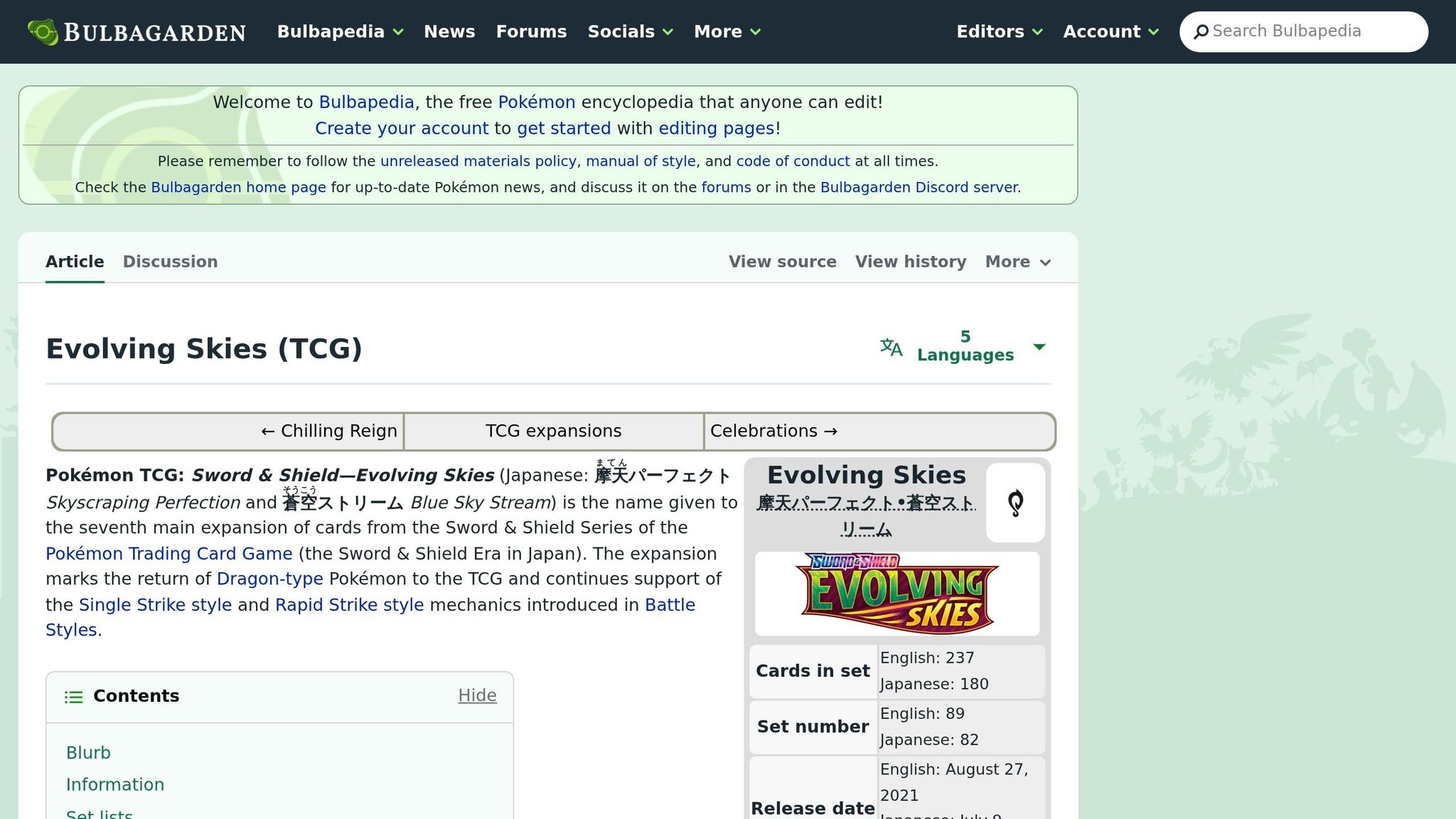
After the vintage and EX-era grails, the list moves into the modern chase-card period. Known as Moonbreon, this Sword & Shield - Evolving Skies hit shows Umbreon reaching toward the moon in a moonlit forest. It’s one of the set’s best-known artworks.
The card came from standard booster packs, but alternate arts like this show up only about once every 100 to 200 packs. And there’s another catch: Evolving Skies is known for centering issues, whitening, and print flaws, which makes PSA 10 copies much harder to get than many people expect.
Grade is where the money stacks up. PSA 9 copies usually sell for just 20% to 40% of PSA 10 prices.
| Condition | 2026 Market Value |
|---|---|
| Raw Near Mint (NM) | $940 – $1,738 |
| PSA 9 Mint | $500 – $1,000 |
| PSA 10 Gem Mint | $2,500 – $5,000 |
Since 2021, the card has appreciated 728% and kept a raw floor above $900 for more than two years. That kind of demand has kept Moonbreon near the top of the modern Umbreon market. Add in the hard pull rate and the nostalgia tied to the Sword & Shield era, and it’s easy to see why this card sits among the most expensive Umbreon cards ever.
9. Umbreon ex #161 Special Illustration Rare (Prismatic Evolutions)
Released in January 2025 as #161/131, this Special Illustration Rare became the card everyone was hunting in Prismatic Evolutions. Illustrated by 5ban Graphics, it shows Umbreon in a surreal, gem-framed cosmic scene, set against a star-filled void with ribbon accents. It didn't take long for this to become the card people tied to the set.
Price-wise, the ride has been anything but flat. The card hit about $1,550 raw in April 2025, then dropped to around $882 before turning back up in early 2026. By April 2026, it was selling in the $1,257 to $1,500 range, with some help from Pokémon's 30th-anniversary buzz.
| Condition | 2026 Market Value |
|---|---|
| Raw Near Mint (NM) | $800 – $1,500 |
| PSA 10 Gem Mint | $1,800 – $3,500 |
| Peak Historical Raw | ~$1,550 (April 2025) |
One big reason the card keeps such a high ceiling is supply at the top grade. As of February 2026, the PSA 10 population was only about 150 copies. That low count isn't random. Centering and surface flaws have made gem-mint submissions tough, so PSA 10 copies stay scarce. As a result, PSA 10 prices sit at about 2x to 3.5x raw Near Mint value.
Inside Prismatic Evolutions, Umbreon ex isn't just the top Eeveelution card. It's way out in front. It sells for roughly 3x the price of Sylveon ex, which is the next most expensive card in the set. In plain English: this is the flagship chase of Prismatic Evolutions.
Next comes the Celebrations Classic Collection reprint, which keeps Umbreon demand high through a version that's easier to get.
10. Umbreon Gold Star #17 Classic Collection (Celebrations)
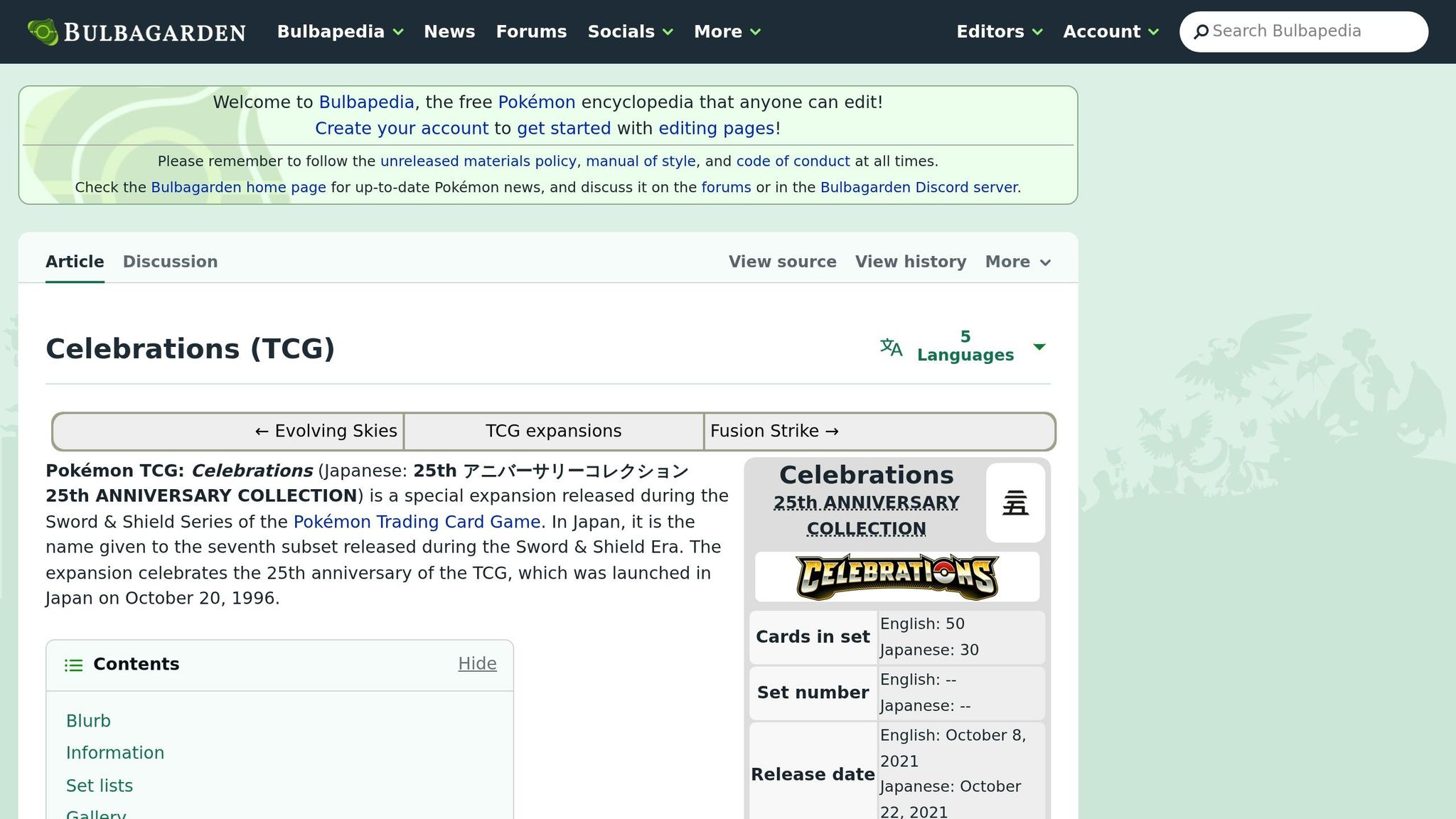
Closing out the list is the Celebrations reprint. Released in 2021 as part of Celebrations' Classic Collection, this card is a modern reprint of the 2007 POP Series 5 Umbreon Gold Star.
The easiest way to spot it is the gold-stamped Pikachu head logo on the right side. That stamp is the clear tell that separates it from the older original.
It ranks below the original Gold Star because it's a reprint. Even so, PSA 10 copies are tough to come by, which helps keep prices high. Collectors still go after it because it offers that Gold Star look at a lower buy-in than the 2007 version. Put simply, its price is tied to demand for the original-era style in a modern card that's easier to find.
Price Snapshot and Ranking Notes
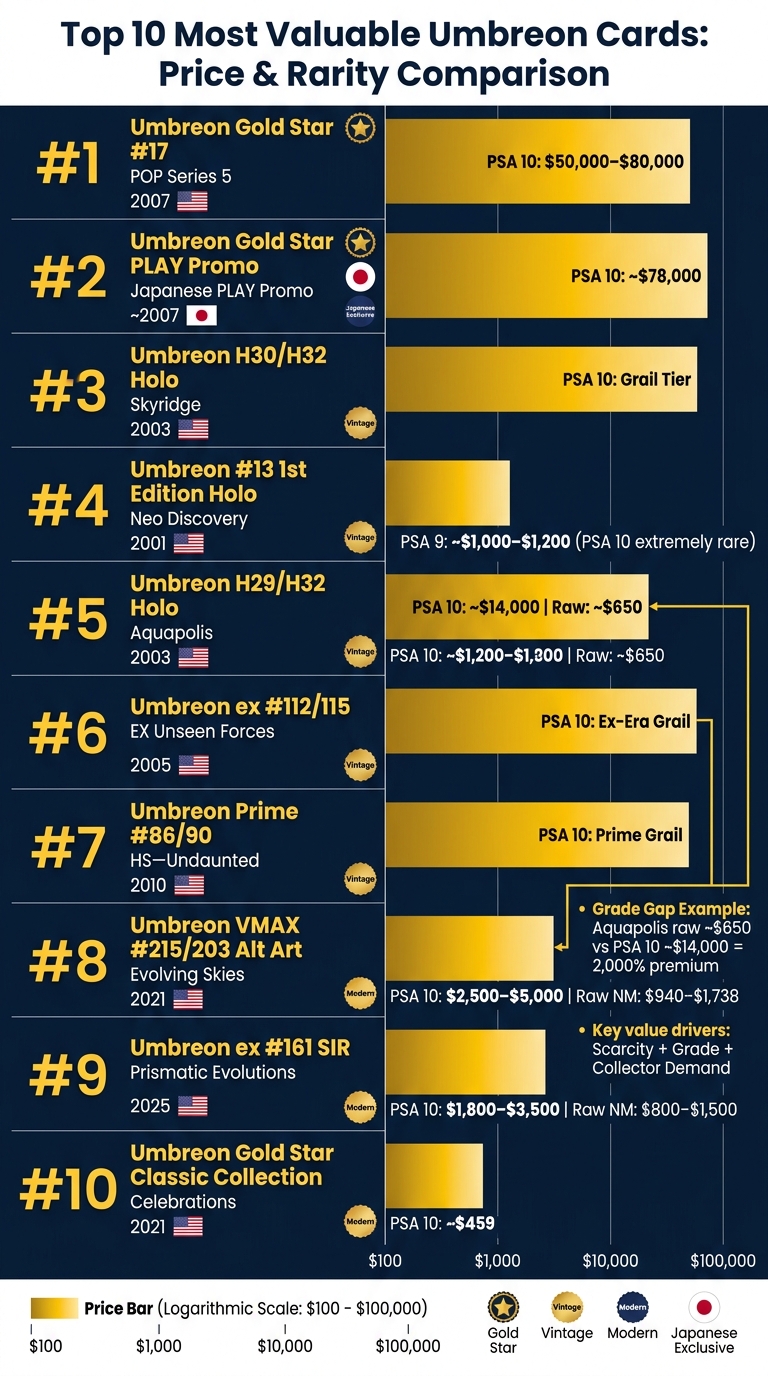
Top 10 Most Valuable Umbreon Cards: Price & Rarity Comparison
Use this as a quick market check on the cards above. Rankings can move when new sales hit the market.
Only the cards with the clearest public comps are included here.
Quick snapshot: the cards below have the clearest public price data.
| Card | Set | Year | Language | Rarity / Status | Recent PSA 10 Comps (USD) | Key Value Driver |
|---|---|---|---|---|---|---|
| Umbreon Gold Star #17 | POP Series 5 | 2007 | English | Gold Star | $15,000–$35,000+ | Very low supply and tough PSA 10 condition standards |
| Umbreon H29/H32 Holo | Aquapolis | 2003 | English | Holo Rare | ~$14,000 | Condition sensitivity; raw copies average about $650 |
| Umbreon VMAX #215/203 Alternate Art Secret Rare | Evolving Skies | 2021 | English | Secret Rare Alt Art | $2,500–$2,875 | Moonbreon status; raw NM floor above $900 |
| Umbreon ex #161 Special Illustration Rare | Prismatic Evolutions | 2025 | English | Special Illustration Rare | $1,800–$2,200 | Top modern chase; climbed from about $882 in February 2026 to around $1,500 by April 2026 |
| Umbreon Gold Star #17 Classic Collection | Celebrations | 2021 | English | Reprint / Classic Collection | ~$459 | Modern reprint with a lower entry price |
At the high end, grading matters more than anything else. A tiny print line, edge nick, or centering issue can change PSA 10 prices in a hurry.
For lower grades, check recent sold comps instead of headline asking prices. The slab, centering, and sale timing can all shift Neo Discovery and modern chase values fast. Those same factors help explain the premiums in the next section.
Why These Umbreon Cards Cost So Much
This list is about price, but the reasons are pretty straightforward. These ten cards cost a lot for three main reasons: scarce distribution, grading sensitivity, and heavy Umbreon demand.
For vintage cards, scarcity starts at the source. Aquapolis is a good example. Raw copies average about $650, while PSA 10 copies climb to about $14,000. That gap tells you a lot. e-Reader holos scratch easily, and Neo/e-Reader centering was often inconsistent, so Gem Mint copies are hard to come by.
Promo cards add another twist. The Japanese Umbreon Gold Star PLAY promo wasn't something collectors could just pull from packs. Members of the Daisuki Pokémon Fan Club had to rack up 70,000 points through tournament placements and event attendance to qualify. The window to do that was short, and the number of cards out there was tiny. As a result, very few copies ended up staying in collector hands.
Modern alternate-art and Special Illustration Rare Umbreon cards work a little differently. Print runs are bigger, but pull rates are still extremely low. On top of that, Umbreon usually gets a 2–3x price premium over other Eeveelutions in the same set. So even when more copies exist overall, demand still pushes prices up. And once a set goes out of print, that's it - the supply stops.
That split is what matters. Vintage Umbreon cards get expensive because top-grade copies barely exist. Modern Umbreon cards get expensive because demand keeps outrunning supply. Those same pressures also shape what buyers need to check before picking one up, which is why edition, condition, and authenticity matter so much when you buy these cards.
How to Buy and Identify These Cards
Use the rankings as a buying filter. The priciest Umbreons usually cost more for one simple reason: buyers mix up the exact version.
That happens all the time. Someone thinks they’re buying the big one, but the card number says otherwise. So start there.
- #215/203 = Moonbreon
- #26/PLAY = the Japanese promo
- Celebrations Umbreon Gold Star = has the 25th-anniversary Pikachu head stamp
That Pikachu head stamp matters. It marks the Celebrations reprint, not the original POP Series 5 Gold Star.
Condition problems also change by era. Older cards tend to show whitening, silvering, and centering issues. Newer cards usually run into centering problems, whitening, and surface scuffs. A jeweler's loupe under bright LED light can help a lot here. It will show print lines and tiny scratches that you won’t see with the naked eye.
After you lock down the version and condition, look at actual sales. Not listing prices. Sold comps tell you what people paid, which is what counts before you buy.
For grail-level cards like the POP Series 5 Gold Star or the Japanese PLAY Promo, older sales from auction houses like Goldin, Heritage, and Fanatics Collect can give you a solid price check. You should also check PSA or BGS population reports to see how many high-grade copies exist. Low population counts often push grading premiums higher.
The table below sums up the versions that buyers most often confuse:
| Card | High-Value Version | How to Spot It |
|---|---|---|
| Umbreon VMAX (Evolving Skies) | Alternate art #215/203 | Card number ends in /203 |
| Umbreon Gold Star #17 (POP Series 5) | POP Series 5 original | No 25th-anniversary stamp on the artwork |
| Umbreon Gold Star (Celebrations) | Classic Collection reprint | 25th-anniversary Pikachu head stamp on the right side of the artwork |
| Umbreon Gold Star (Japanese) | PLAY Promo | Card number is 26/PLAY |
| Umbreon H29/H32 Holo (Aquapolis) | H-prefix holographic version | H prefix before the card number, such as H29 |
Buy the exact card. Check the slab or raw condition closely. Then match it against recent sold comps.
Conclusion
Taken together, these ten cards show that Umbreon value comes down to rarity, grade, and demand. The two Umbreon Gold Stars - the English POP Series 5 and the Japanese PLAY Promo - sit at the top because they’re the hardest to find and the most wanted. They pair extreme scarcity with major historical importance and strong grading premiums.
Just below them, the vintage e-Reader holos from Aquapolis and Skyridge still hold grail status. Low print runs, unreprinted artwork, and cards that are tough to find in top condition keep supply tight.
That same pattern shows up in modern chase cards too. Moonbreon and the Prismatic Evolutions Umbreon ex #161 Special Illustration Rare make the list because demand still outpaces supply. At this point, modern Umbreon chase cards belong in the same conversation as vintage grails.
Even lower-grade vintage copies can still be worth a close look. For returning collectors, the play is pretty simple: identify the exact version, then judge the grade and how easy it is to find.
FAQs
How do I tell the original Umbreon Gold Star from the Celebrations reprint?
Check the set number: the original Japanese Umbreon Gold Star is 26/PLAY. It was a promotional card earned through the Daisuki Pokémon Fan Club.
It was later released in POP Series 5, but the original Japanese promo is identified by that exact set number.
For high-value cards, inspect the print quality, texture, centering, and cardstock weight with care. Small details can make a big difference when you're trying to confirm what you have.
Why is the PSA 10 price much higher than raw or PSA 9?
Because PSA 9 and PSA 10 sit in different parts of the market.
A PSA 9 is mint, which means it can still have small flaws. A PSA 10 is gem mint, so buyers expect a card that’s as close to perfect as possible.
For serious collectors, PSA 10 is the gold standard for condition and authenticity. That’s why it often sells for a much higher premium. Buyers are paying for stronger confidence, easier resale, and better eye appeal.
Which Umbreon cards are safest to buy for long-term value?
For safer long-term value, put the Umbreon VMAX Alt Art from Evolving Skies at the top of your list. Most collectors know it as Moonbreon. It has held above $900 raw for over two years, which says a lot. The card also has a lot going for it: iconic artwork, strong demand, and a firm spot in the market.
If you want something from a newer set, the Umbreon ex SIR from Prismatic Evolutions is still a flagship card. That said, newer cards can swing more after launch, so post-release price corrections are still on the table.
To cut risk, stick with professionally graded PSA 10 copies from reputable sellers. And go in with a long view. These are better treated as multi-year holds, not short flips.