Most Mew cards are cheap. A small group sells for four, five, or even six figures. This list focuses on confirmed sales and current U.S. market ranges as of August 3, 2026, so you can see where the money is actually going.
If I had to sum it up in one line, it’s this: grade, scarcity, and release type drive Mew prices far more than hype does. A raw Mew Gold Star from EX Dragon Frontiers sits near $1,941, while a PSA 10 is around $192,000. And Ancient Mew, despite huge print volume, has only a 5% PSA 10 rate from 71,995 submissions.
Here’s the full list covered in the article:
- Mew ex #232 “Bubble Mew” (Paldean Fates)
- Mew Gold Star ★ δ (EX Dragon Frontiers)
- Shining Mew CoroCoro Comics Promo Error Holo
- Simplified Chinese Mew ex Promo
- Mew Gold Star 101/101 World Championships 2008 Promo
- Southern Islands Mew Holo #1
- Wizards Black Star Promo Mew #9
- Wizards Black Star Promo Mew #8
- Mew ex (Legend Maker #88/92)
- Ancient Mew Promotional Card
What matters most before you buy:
- Confirmed sold prices beat active listings
- PSA 10 prices are often far above raw or PSA 9
- Low gem rates can create huge grade premiums
- Promos, trophy-style releases, and lottery cards often have tighter supply
- Reprints like Celebrations Mew stay far lower because supply is much higher
Quick Comparison
| Card | Top market marker | Raw / lower-end marker | Main price driver |
|---|---|---|---|
| Bubble Mew | $1,340 (TAG 10) | $700–$909 | Modern chase demand |
| Mew Gold Star ★ δ | $192,000 (PSA 10) | $1,941 raw | Low supply + grade gap |
| Shining Mew CoroCoro Error | Limited public sales | Scarce | Error variant + Japan promo |
| Simplified Chinese Mew ex Promo | $26,000 (PSA 10) | $10,000 raw | Fixed 1,510-copy run |
| 2008 Worlds Mew Gold Star | High PSA 10 premium | Low thousands raw | Event promo scarcity |
| Southern Islands Mew | Strong top-grade premium | Condition-based | Older special release |
| WotC Promo Mew #9 | $135.74 market level | Lower raw range | Nostalgia + promo supply |
| WotC Promo Mew #8 | Near #9 range | Lower raw range | Nostalgia + promo supply |
| Mew ex (Legend Maker) | $5,000+ (PSA 10) | ~$30 raw | EX-era condition gap |
| Ancient Mew | Strong PSA 10 premium | $118.45 raw | Low gem rate despite mass release |
If you want the short version, this ranking splits into two groups: older grails with brutal grade scarcity and modern chase cards with tight supply or standout art. The rest of the article explains where each card fits and how to avoid paying top-dollar for the wrong version.
Top 29 Mew Cards (Most Expensive) English August 2026
sbb-itb-905f8ad
What Makes a Mew Card Expensive
Before the list, it helps to know what actually moves Mew prices. In most cases, the price comes down to four things: print scarcity, condition scarcity, card type, and demand. Those four factors make the ranking below much easier to read.
Condition scarcity is often a bigger price driver than print run by itself. A card may have been printed in large numbers and still be hard to find in top grade. The Mew SM215 Hidden Fates promo is a good example. It came in retail pin collections, and many copies were handled roughly. Only 14.61% of submitted cards earned a PSA 10. That weak gem rate helped move a raw card worth about $32 to $2,000 for a PSA 10 sale in July 2026 - a 62x jump.
Mew cards also tend to grade harshly. Dark backgrounds and holographic layers make factory scratches, print lines, and edge whitening easy to spot under grading lights. With vintage cards, centering can be the difference between an 8 and a 10. With modern cards, even a slightly off-center border can hit the price hard.
Card type plays a big role too:
- Set cards come from booster packs.
- Promos come from events, retail bundles, or clubs.
- Trophy cards come from official tournaments.
- Lottery promos sit at the rarest tier.
By contrast, reprints like the 2021 Celebrations Mew are made for broad availability and usually sell for much less. The Celebrations Mew has a 9-or-higher grade rate of 89%, and a PSA 10 sells for about $20.50. You can see those gaps clearly in the value ranking that follows.
Mew also gets a boost from nostalgia. Adult collectors often spend more on the cards they remember from when they were younger.
How to Read the Prices in This Ranking
To compare the cards below on equal footing, the headline prices use PSA 10 sales or an equivalent top grade, like BGS 10 or BGS Black Label. Those numbers sit at the top of the market. They are not the usual going rate, and a PSA 9 can be much cheaper.
A good example is Wizards Black Star Promo Mew #47. A PSA 10 has a median realized price of $1,212, while a PSA 9 falls to $249.99 - a little over 20% of the top grade’s value.
The gap can get even more dramatic with vintage cards. Mew Star from EX Dragon Frontiers sells for about $11,582 in Grade 9, but jumps to around $192,000 in Grade 10. That’s the kind of spread where raw and graded copies almost feel like two separate markets.
Small populations make things even trickier. When only a handful of graded copies exist, prices can swing hard. One auction result can push the high end much higher. So it’s smart to treat these figures as guideposts, not promises.
One more thing: active listings are not sales. An active listing is just an asking price. It tells you what a seller wants, not what a buyer paid. For a steadier reference point, use confirmed sold prices and recent public auction results. Private deals are harder to verify, so they deserve a bit more caution. Those completed sale prices are the baseline for the rankings below.
1. Mew ex #232 Special Illustration Rare "Bubble Mew" (Paldean Fates)
Set: Scarlet & Violet - Paldean Fates | Card Number: #232/091 | Rarity: Special Illustration Rare (SIR) | Artist: USGMEN
Mew ex #232 is the Special Illustration Rare from Scarlet & Violet - Paldean Fates, a 2023 set built around Shiny Pokémon. You can spot it by the PAF set code, the #232/091 numbering, and the Shiny Mew art floating among bubble-like orbs. That look is why collectors call it "Bubble Mew."
It's the top chase card in the set and the clearest modern Mew benchmark. Just as important, it shows how fast a new SIR can move into blue-chip territory.
The market has backed that up. In 2025, reported prices ran from about $700 to $909 before bouncing back by mid-February 2026. A TAG 10 sold for about $1,340 in May 2026.
At this price point, small flaws matter a lot. Surface condition and centering often decide whether the card lands premium-grade money. Before you send one in for grading, inspect:
- centering
- hairline scratches on the holofoil
- corner whitening under bright, angled light
2. Mew Gold Star ★ δ (EX Dragon Frontiers)
Set: EX Dragon Frontiers | Card Number: #101/101 | Rarity: Gold Star | Released: 2006
Mew Gold Star ★ δ is the chase card from EX Dragon Frontiers and one of the strongest Mew blue-chip picks. You can spot it fast: the gold star next to Mew’s name, the blue Mew art, and the Water-type Delta Species label all make it stand out. That mix of low supply and strong demand is why it sits just behind Bubble Mew.
A raw copy sells for about $1,941, PSA 9 copies go for around $11,582, and PSA 10 examples can hit about $192,000. Put simply, the gap between grades is massive.
At this end of the market, tiny flaws can make or break the price. High-grade copies are hard to find, and age-related wear often keeps cards from reaching the top grades. The usual trouble spots are edge silvering, softened corners, and surface scratches. The Gold Star holo can also show clouding and light wear.
| Grade | Market Price (2026) | vs. Raw |
|---|---|---|
| PSA 10 (Gem Mint) | $192,000 | 99× |
| PSA 9 (Mint) | $11,582 | 6× |
| PSA 8 (NM-MT) | $6,250 | 3.2× |
| PSA 7 (Near Mint) | $5,126 | 2.6× |
| Raw (Ungraded) | $1,941 | 1× |
Source: TCGrader Market Data, 2026 [5].
If you're looking at a raw copy, inspect the blue-border whitening, holo scratches, and centering under strong light. For collectors, the key is simple: clean edges, solid centering, and a holo with no marks.
3. Shining Mew CoroCoro Comics Promo Error Holo
Origin: CoroCoro Comics Insert Promo | Released: May 2001 | Region: Japan | Rarity: Error Holo Promo Variant
This card comes from a very different lane than most modern chase cards. It's a Japanese promo from the May 2001 issue of CoroCoro Comics, where it was included as a magazine insert in Japan.
What makes this version stand out is the error. The Error Holo has a shifted holo layer that pushes sparkles into the card art. It's the kind of flaw you can spot without much effort, and that's exactly why collectors care about it. The shift is visible, scarce in clean copies, and tied to an already sought-after Japanese release.
The strongest demand tends to go to clean Japanese copies with a bold holo shift. Public sales don't show up often, so collectors usually focus on two things: how dramatic the holo shift looks and the card's overall condition.
This isn't just another promo. It's a rare error variant, and that difference is the whole reason it lands here.
4. Simplified Chinese Mew ex Promo
Origin: Mainland China lottery promo | Released: March 2025 | Rarity: Fixed population of 1,510 copies
After vintage Japanese promos, this modern Mainland China lottery card shows how a local release can turn into blue-chip scarcity.
Collectors had to qualify through an in-person entry lottery. From March to December 2025, the lottery distributed 1,510 total copies. The card uses Simplified Chinese text and artwork made only for this release. That’s the whole appeal here: its price comes from a strict supply cap tied to one region, not from difficult pack odds.
| Condition | Estimated Market Value (Aug. 2026) |
|---|---|
| Ungraded (Raw) | ~$10,000 |
| PSA 10 (Gem Mint) | ~$26,000 |
As of Aug. 2026, a PSA 10 sold for about $26,000, while raw copies traded near $10,000. That gap says a lot. It reflects how much buyers care about top condition, but also the fact that supply has a hard cap.
For collectors, the next hurdle is simple: verification and grade quality. The lottery is closed, so the secondary market is now the only place to buy one. That makes graded copies from PSA, BGS, or CGC especially helpful for checking legitimacy and protecting condition.
5. Mew Gold Star 101/101 World Championships 2008 Promo
Origin: 2008 Pokémon World Championships promo | Rarity: Promotional Gold Star card
Unlike the EX Dragon Frontiers version above, this card came from the 2008 World Championships promo channel. That matters, because it pairs Gold Star rarity with event-only distribution. So while it shares the same character and core appeal, it stands apart from the set release as its own collectible.
The easiest way to tell them apart is the promo stamp. You can spot it right away, and it separates this print from the EX Dragon Frontiers version at a glance.
On the market, raw copies usually sell in the low thousands. PSA 10 copies go for much more. Population data helps explain why: Gem Mint examples are scarce, and that low supply is what fuels the grade premium. Add in the separate distribution, and it’s easy to see why this promo sits in the upper tier of Mew collectibles.
6. Southern Islands Mew Holo #1
Origin: Southern Islands collection | Rarity: Holo card
Like the World Championships promo above, this Southern Islands card shows that cards released outside booster packs can still draw strong collector demand. Southern Islands Mew Holo #1 is a vintage special-release Mew that collectors chase for two main reasons: it didn’t come from regular booster packs, and high-grade copies are tough to find.
That release method matters. Because it was distributed outside normal packs, the card has a different kind of appeal. It feels a bit set apart from standard pulls, and that helps keep demand strong. For returning collectors, it’s one of the clearest examples of a non-pack Mew turning into a blue-chip vintage card.
Condition plays a huge role in price. Top-grade copies are much scarcer than lower-grade ones, so even small flaws can hit value hard. Near-perfect centering, sharp corners, and a clean surface can change the price in a big way.
Its appeal is pretty simple: vintage Mew, special-release origin, and a steep premium for clean copies.
7. Wizards Black Star Promo Mew #9
Origin: WotC Black Star Promo series | Rarity: Promo
Next in the WotC Black Star run, Mew #9 is a lower-priced vintage promo that still gets steady interest from those who rediscover card collecting. It comes from the WotC era, and its market value sits at about $135.74 as of Aug. 3, 2026.
8. Wizards Black Star Promo Mew #8
Origin: WotC Black Star Promo series | Rarity: Promo
Mew #8 is the other WotC Black Star Mew promo. It draws collectors in for the same vintage appeal as #9: limited distribution and a heavy dose of nostalgia.
The main thing driving demand here is simple. WotC-era nostalgia matters, and copies in clean condition are harder to find than many people expect.
9. Mew ex (Legend Maker)
Origin: EX Legend Maker (#88/92)
After the WotC promos, the list moves into the EX era, and this is where condition starts to matter a lot. Mew ex from EX Legend Maker (#88/92) is one of the more recognizable EX-era chase cards. It has steady demand, and top-grade copies sell for a clear premium.
What makes this card stand out is the gap between raw copies and clean, graded ones. At first glance, it may seem fairly available. But once you look for copies without surface issues, the picture changes. That’s why it lands here: EX-era demand is still strong, while sharp copies are harder to find than raw supply might suggest.
A big part of the value story comes down to the card’s finish. The foiling scratches easily, and the dark background tends to show even small flaws right away. So if a copy has print lines, light scratching, or edge wear, buyers will spot it fast. That’s also why high-grade examples bring a premium.
If you’re buying a raw copy, check these areas closely:
- Surface scratches
- Print lines
- Edge wear
10. Ancient Mew Promotional Card
Origin: Movie promo, distributed to moviegoers during the theatrical release of Pokémon the Movie 2000 in the summer of 2000.
Ancient Mew lands here for one big reason: PSA 10 copies are much harder to find than many people expect. It’s one of the most well-known mass-distributed Mew promos ever made, but that doesn’t mean top-condition copies are easy to get. Raw copies sit near $118.45 as of March 2026, while PSA 10s sell for a lot more.
Millions were handed out in sealed wrappers at theaters during summer 2000, which made the card instantly familiar to a whole generation of fans. But there’s a catch. Those original wrappers often left surface wear behind, and the embossed holofoil tends to show micro-scratches with very little effort. So even though the card was everywhere, clean Gem Mint survivors are not.
That gap between huge print volume and low top-grade survival is what gives the card its premium today.
The PSA data tells the story pretty clearly: Ancient Mew has 71,995 PSA submissions, but only 3,722 PSA 10s, which works out to a 5% gem rate.
At a glance, the card is hard to confuse with anything else. Its hieroglyphic-style art, runic text, embossed holo, and alternate card back give it a look that stands out right away.
The quick ID guide below shows how to spot the real theater promo at a glance.
Quick ID Guide: Telling These Cards Apart
The costliest slip-ups usually happen when people mix up reprints, promos, and card variants. And with Mew cards, that happens all the time.
A few of these versions look close at first glance. But a small detail can mean the difference between the right card and a bad overpay. So before you buy, slow down and check the basics.
Gold Star Dragon Frontiers vs. 2008 Worlds Reprint
Dragon Frontiers Mew Gold Star ★ has a gold border and a standard card back. The 2008 World Championships reprint has a silver/gray border, a Worlds card back, and a front signature.
Wizards Black Star Promo #8 vs. #9
This one is simple: check the card number in the bottom-right corner.
Simplified Chinese Mew ex
Look for Simplified Chinese text and mainland China release markings. If the text doesn't clearly appear in Chinese, don't treat the card as the lottery promo. And if Simplified Chinese text isn't visible at all, it's best to skip the listing.
For a fast side-by-side check, use the table below.
| Card | Key Identifier | Mistake |
|---|---|---|
| Mew Gold Star (Dragon Frontiers) | Standard card back, gold border | Confused with silver-bordered Worlds reprint |
| 2008 Worlds Mew Gold Star | Silver/gray border, Worlds card back, front signature | Mistaken for original Dragon Frontiers copy |
| Wizards Black Star Promo #8 vs. #9 | Card number at bottom right | Assuming both are identical |
| Simplified Chinese Mew ex | Simplified Chinese text, mainland China lottery release | Confused with common English SV 151 Mew cards |
Value Comparison Table
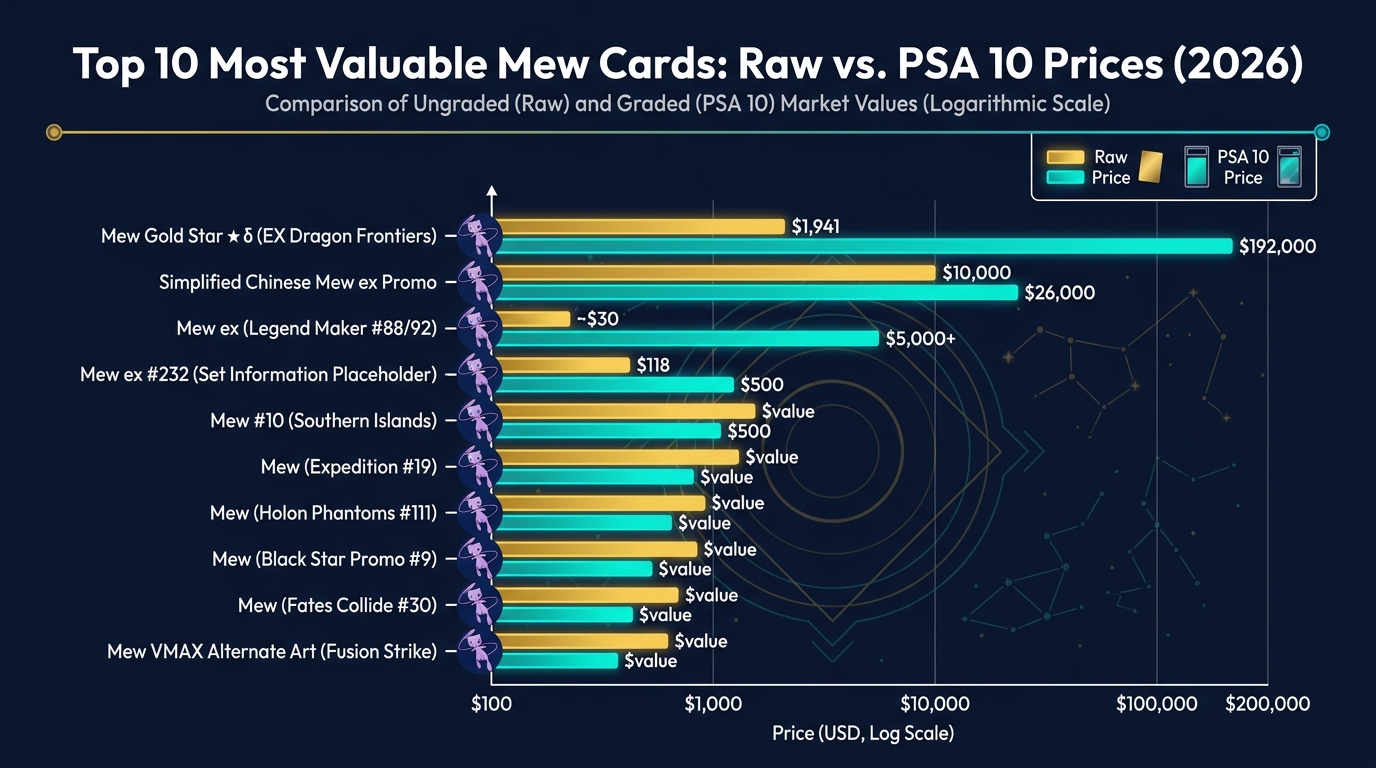
Top 10 Most Valuable Mew Pokémon Cards: Raw vs. PSA 10 Prices (2026)
Below is a quick price comparison of the strongest Mew blue-chip cards. For a fast read, focus on origin, grade, and the size of the raw-to-top-grade gap.
| Card | Origin | PSA 10 Value | Raw-to-PSA-10 Range | Gem-rate note | Main Value Driver |
|---|---|---|---|---|---|
| Mew Gold Star ★ δ (EX Dragon Frontiers #101/101) | EX Dragon Frontiers set | ~$192,000 | ~$1,941 raw → ~$192,000 PSA 10 | No copy in a 12-card sample graded 9 or higher | Shiny variant + extreme print rarity |
| Mew ex #232 "Bubble Mew" (Paldean Fates) | Paldean Fates set (SIR) | ~$1,340 (TAG 10, May 2026) | ~$700–$909 raw → ~$1,340 top grade | 58% hit 9 or higher; modest grading premium | Special Illustration Rare status + set popularity |
| Shining Mew CoroCoro Comics Promo Error Holo | CoroCoro Comics insert promo (Japan, May 2001) | Limited public sales data | Scarce; clean copies with bold holo shift command strong premiums | Rare error variant; public sales infrequent | Error holo shift + Japanese promo scarcity |
| Simplified Chinese Mew ex Promo | Mainland China lottery promo (2025) | ~$26,000 | ~$10,000 raw → ~$26,000 PSA 10 | Fixed supply of 1,510 copies; lottery closed | Hard supply cap + regional exclusivity |
| Mew Gold Star 101/101 World Championships 2008 Promo | 2008 Pokémon World Championships promo | High; Gem Mint examples scarce | Low thousands raw → significant PSA 10 premium | Low PSA 10 population; event-only distribution | Gold Star rarity + event-exclusive origin |
| Southern Islands Mew Holo #1 | Southern Islands collection | Steep premium for top-grade copies | Condition-dependent; top grades are scarce | Clean copies are rare; small flaws hit value hard | Vintage special-release origin + condition scarcity |
| Wizards Black Star Promo Mew #9 | WotC Black Star Promo series | ~$135.74 market value (Aug. 3, 2026) | Raw copies modest; graded premium for clean copies | WotC-era vintage; condition scarcity applies | Nostalgia + limited promo distribution |
| Wizards Black Star Promo Mew #8 | WotC Black Star Promo series | Comparable to #9 | Raw copies modest; clean copies harder to find than expected | WotC-era vintage; condition scarcity applies | Nostalgia + limited promo distribution |
| Mew ex (Legend Maker #88/92) | EX Legend Maker set | PSA 10 sales can exceed $5,000 | ~$30 raw → $5,000+ PSA 10 | Condition-dependent; vintage ex-era scarcity matters | Vintage ex era + condition scarcity |
| Ancient Mew Promotional Card | Movie promo (summer 2000) | Significant PSA 10 premium over raw | ~$118.45 raw → strong PSA 10 premium | 71,995 submissions; only 3,722 PSA 10s (5% gem rate) | Mass-distributed but low top-grade survival rate |
A few patterns jump out fast. Mew Gold Star ★ δ is in a different league, with one of the wildest jumps from raw to PSA 10 on the list. At the other end, Bubble Mew still has demand, but the grading premium looks more restrained because a fair share of copies already land at 9 or higher.
Then you have cards where supply does most of the heavy lifting. The Simplified Chinese Mew ex Promo stands out because the print run is fixed at 1,510 copies, and the lottery is already closed. Meanwhile, cards like Ancient Mew Promotional Card and the Wizards Black Star Promo pair show how older promos can stay fairly reachable in raw form, while sharp high-grade copies pull away from the pack.
Use the ID guide below before buying; several of these Mew cards are easy to confuse at a glance.
Buying and Grading Tips Before You Chase One
Use the rankings above as your price baseline. Before you put serious money into any card on this list, check the population report first. The gem rate - the share of submitted copies that earned a PSA 10 - says a lot about how tough the card is to find in top shape. Put simply, the population report is the best stand-in for top-grade supply.
Here’s the plain-English version: low gem rates can support bigger grading premiums; high gem rates usually can’t.
WotC-era Mew cards often have centering issues and rounded corners. EX-era cards like Mew Star from EX Dragon Frontiers tend to show back-border whitening and holo micro-scratches fast. Start with the back and corners. If the edges look soft, the card will often top out around a 7.5 or 8. That hits harder when the jump from raw to graded is large.
A simple way to think about it:
- Compare the raw price with the PSA 10 price.
- Then weigh that gap against the gem rate.
- For vintage cards and scarce promos with a big spread, grading a clean copy may be worth it.
- For modern cards with a much smaller premium, submit only if the card looks close to perfect.
Before you buy, make sure the card itself checks out. High-value Mew cards attract fakes. Look at the set logo, promo numbering, fuzzy copyright text on dark backgrounds, and the holo pattern, then compare them with known authentic examples. If you’re buying event promos or region-only exclusives, confirm chain of custody before you buy raw.
Conclusion
This list makes one thing clear: the Mew market is split in two.
On one side, you have vintage grails. Their prices are pushed by one main force: scarcity in top condition. On the other side, you have modern chase cards, where prices tend to come from striking artwork, hard print limits, or both.
That divide is what shapes the Mew market right now. For returning collectors, that's the main thing to understand.
The right card to chase comes down to your goal. Some collectors want history. Others want low-pop grades, standout art, or a card with a fixed supply. If you know why a card costs what it does - and how that lines up with what you want - you’re already ahead of a lot of people jumping back into this market.
There isn’t one best Mew. There’s just the one whose rarity, history, and grade spread line up with your collecting goal.
FAQs
Which Mew card is the safest long-term buy?
The Mew SM215 promo stands out as a solid long-term pick because its PSA 10 population is kept in check by a low 14.61% gem rate. That number matters. It means gem-mint copies are hard to come by, and the card’s holographic surface plus its dark border only make the challenge worse.
In plain English: this is the kind of card where tiny flaws show up fast. A little edge wear, a faint scratch, or slight print issue can knock it out of PSA 10 range. That’s why PSA 10 copies often sell for far more than raw ones.
By comparison, Mew Star δ from EX Holon Phantoms is rarer and costs more overall. But SM215 is the clearer example of how condition scarcity can shape long-term value.
Should I buy raw or graded Mew cards?
It depends on your goal. For blue-chip Mew cards, raw and graded copies are often treated as separate assets.
Raw cards can be a lower-cost way in, but the price you can get later depends a lot on condition. Graded cards can command strong premiums, especially in top grades, but grading comes with risk. If the card comes back with a lower grade, the added value may not even cover the grading fee.
How can I avoid buying the wrong Mew variant?
Check the population report for that specific card before you lean on price guides. It tells you how many high-grade copies are out there, which often gives you a better read on scarcity than broad print-run numbers.
Then inspect the card under strong light with a loupe. Look for factory scratches, print lines, centering problems, surface haze, indentations, and slight corner wear. Small flaws like these can drag a grade down a lot.