The short answer: the biggest Pikachu cards are mostly prize cards, not pack pulls. The top sale is Pikachu Illustrator at $16,492,000, sold in February 2026. After that come the 1997–1998 Trophy Pikachu cards, then scarce contest and event promos, and then a few top chase cards like Pikachu ★ Gold Star.
If you want the full picture fast, here it is:
- No. 1 is Pikachu Illustrator because only about 39 copies were awarded.
- Trophy Pikachu No. 1, No. 2, and No. 3 Trainer sit near the top due to tiny award counts.
- Contest and event promos like Snap, Art Academy, Tropical Mega Battle, and Victory Ring stay high because supply was fixed from day one.
- Poncho Pikachu promos and Pikachu ★ Gold Star show how much price can change by grade.
- Before you buy, check the cert number, exact variant, grade pop, and sold listings.
In other words: if you’re looking at the most expensive Pikachu cards, you’re mostly looking at cards that were won, not opened.
The Pikachu Trophy Cards - Rarest & Most Valuable Pikachu Cards!
sbb-itb-905f8ad
Quick Comparison
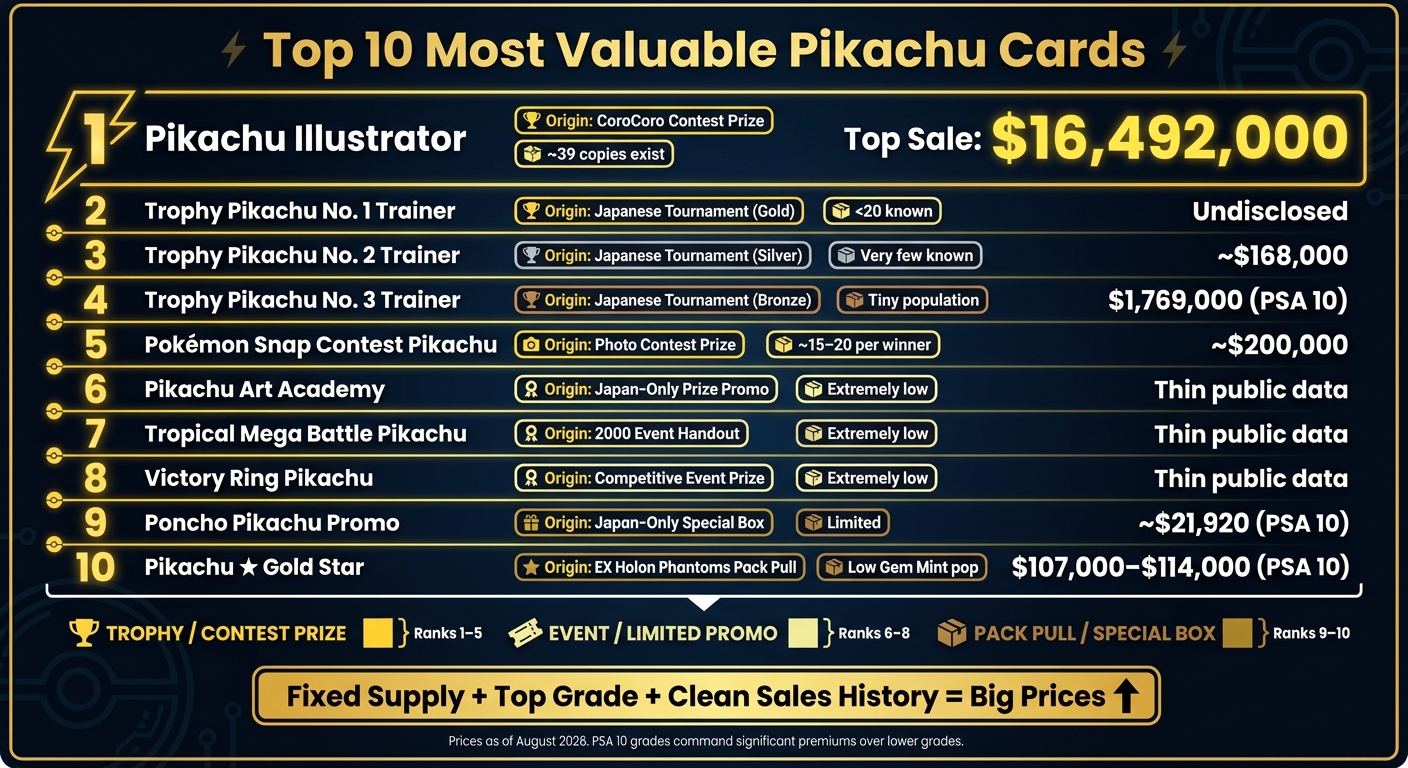
Top 10 Most Valuable Pikachu Cards: Prices, Rarity & Origins
| Rank | Card | Why it’s so expensive | Price point mentioned |
|---|---|---|---|
| 1 | Pikachu Illustrator | Contest prize, about 39 copies | $16,492,000 |
| 2 | Trophy Pikachu No. 1 Trainer | Top tournament award | Top tier, few public sales |
| 3 | Trophy Pikachu No. 2 Trainer | Second-place tournament award | About $168,000 |
| 4 | Trophy Pikachu No. 3 Trainer | Third-place tournament award | $1,769,000 in PSA 10 |
| 5 | Pokémon Snap Contest Pikachu | Contest-only handout | Estimated near $200,000 tier |
| 6 | Pikachu Art Academy | Japan-only prize promo | Thin public data |
| 7 | Tropical Mega Battle Pikachu | Event handout, low supply | Thin public data |
| 8 | Victory Ring Pikachu | Prize-only event card | Thin public data |
| 9 | Poncho Pikachu Promo | Japan-only promo set, big PSA 10 premium | Up to about $21,920 for top copies mentioned |
| 10 | Pikachu ★ Gold Star | Hard pull, sharp PSA 10 jump | $107,000–$114,000 recent PSA 10 sales |
What I like about this list is how clear the pattern is: fixed supply + top grade + clean sales history = big prices. And in some cases, one grade point can change the card from a few hundred dollars to five figures.
So if you’re using this guide to buy, sell, or just see where the market stands in August 2026, start with the card’s release type, then check condition, then compare recent sold prices.
Why Some Pikachu Cards Are Worth So Much
Most of Pikachu’s highest-value cards didn’t come from booster packs. They were handed out as trophies, contest prizes, or event promos in very small, fixed quantities. The Pikachu Illustrator is the clearest example: only 39 copies exist, and all were awarded through a CoroCoro Comic illustration contest in 1997–1998. That strict limit on supply puts these cards in a different league from even rare set pulls.
But low supply isn’t the whole picture. Condition can swing prices in a big way, and that’s where grading matters. Vintage cards from the Wizards of the Coast era are hard to find in pristine shape after more than 25 years of handling. A Birthday Pikachu in PSA 9 sells for about $420, while the same card in PSA 10 goes for about $10,800 - a 25x jump for just one grade point.
Japanese exclusives add yet another layer to the price. Many of the top Pikachu cards were released only in Japan, often as one-time distributions, and never printed again in other markets.
There’s also the issue of fakes. Pikachu is the most recognizable character in the hobby, so it’s also the one counterfeiters target most often. For expensive cards, a graded slab from PSA, BGS, or CGC with a verified certification number is one of the main things buyers check.
Those are the main factors driving the values of the cards below.
1. Pikachu Illustrator
At No. 1, Pikachu Illustrator is the high-water mark for Pikachu card prices. This card was given only to winners of CoroCoro Comic's illustration contests in Japan in 1997–98. It was never sold in booster packs, and only about 39 copies were handed out. Around 24 PSA-graded copies are known, and just one has earned a PSA 10. That tiny supply explains the massive jump in price from one grade to the next.
That single PSA 10 sold on Feb. 16, 2026, for $16,492,000, which set the all-time record for any trading card.
PSA 9 copies are estimated at $840,000 to $1,275,000, while PSA 8 copies have sold for about $360,000.
If you're checking whether a copy is genuine, there are two easy details to look for:
- It says "Illustrator" at the top instead of "Trainer"
- It has a pen icon in the lower-right corner
The artwork was done by Atsuko Nishida, the original designer of Pikachu.
2. Trophy Pikachu No. 1 Trainer
Next up is the Gold trophy from that same tournament prize tier. Trophy Pikachu No. 1 Trainer was the Gold award in a three-card Japanese trophy set: No. 1 Gold, No. 2 Silver, and No. 3 Bronze. These were given to top finishers at official Japanese tournaments in 1997 and 1998.
Unlike Illustrator, this card came from tournament results. That matters. You couldn't just be in the room - you had to place. Fewer than 20 copies are estimated across all three ranks.
Vintage Japanese trophy cards are brutal in top grade. Centering issues, edge whitening on dark borders, print lines on the holo, and surface scratches can drag a grade down in a hurry. That grade pressure shows up in the market. A PSA 10 copy of the Bronze No. 3 Trainer sold for $1,769,000 in May 2026, which puts Gold No. 1 at the very top of this set's market.
Verified copies sit in the blue-chip tier, and the best grades pull the strongest demand. The card's price comes down to a simple mix: fixed distribution, extreme scarcity, and heavy grade sensitivity.
3. Trophy Pikachu No. 2 Trainer
Just below the Gold award sits Trophy Pikachu No. 2 Trainer, also called Trophy Pikachu Silver. It was given to second-place finishers in Japanese tournaments in 1997 and 1998. Like the No. 1 and No. 3 versions, its price is tied to a fixed trophy distribution. There were only so many awarded, and that hard cap is a big part of why collectors care so much about it.
Print numbers were tiny, and only a small number of copies are known to still exist.
Public sales have reached about $168,000. As with most trophy cards, condition and authenticated grade make a huge difference. It sits below No. 1 in price, but it’s still one of the hardest Pikachu trophy cards to find in top grade.
4. Trophy Pikachu No. 3 Trainer
The Bronze Trophy Pikachu No. 3 Trainer rounds out the 1997–98 trophy trio. It was given to third-place finishers at official Japanese tournaments in 1997 and 1998. Like the Gold and Silver versions, it was never sold in stores or included in packs. The only way to get one was to place at those early events. And because only a handful are known to exist, supply is fixed at an EXTREMELY low level.
Price swings hard based on condition. A PSA 10 sold for $1,769,000 in May 2026. That matters even more with a card this scarce, because high-grade copies are tighter still. Public sales don't happen often, so the May 2026 PSA 10 result stands as the clearest benchmark for top-grade Bronze copies. Put simply, collectors pay a huge premium for perfect condition when it comes to trophy cards.
That sale locked in the card's place among the highest-value Pikachu trophies.
5. Pokémon Snap Contest Pikachu
After trophy cards, contest promos sit in the next big scarcity tier.
In 1999, Nintendo and CoroCoro Comic held Japan's "64 Pokémon Snap Best Photo Contest" for Pokémon Snap. Players sent in in-game photos through CoroCoro Comic and the TV show 64 Mario Stadium, and winners received contest-specific Pikachu promos tied to the contest results. Each winner received only 15 to 20 copies of their specific card, which is a fixed print amount that collectors care about a lot.
For scarce contest Pikachus, grading matters mostly for authentication and condition. That contest-only distribution, paired with such a tiny copy count, is what puts this card in the top tier of Pikachu promos.
6. Pikachu Art Academy
Next up are the limited Japanese promos, where distribution and grade matter even more than public sales history.
Pikachu Art Academy is a Japan-only promo with limited distribution, so supply stays tight and prices can swing quite a bit. The highest-grade copies get the biggest premiums because this promo was handed out as a prize-style release, and Gem Mint examples are hard to find. That makes Art Academy a good example of how a limited promo can hold its price even when auction data is thin.
7. Tropical Mega Battle Pikachu
After the contest promos, the Tropical Mega Battle Pikachu - officially named the Tropical Wind promo - was given out at the 2000 Tropical Mega Battle. It’s one of the hardest Pikachu promos to find. What throws a lot of collectors off is that it’s a Trainer card, not a standard Pikachu card, and the artwork shows Pikachu alongside Psyduck. That odd setup is a big reason collectors keep a close eye on it.
High-grade copies are even tougher to find because tournament cards were often handled a lot during the event.
There aren’t many documented sales, so each verified auction can shift the market. Grade plays a huge role in price, and its scarcity keeps it firmly in the top tier of Pikachu promos by value.
8. Victory Ring Pikachu
Like the other event-only Pikachu promos, Victory Ring Pikachu was never a normal pack card. That alone keeps the supply tight.
It’s a scarce event prize card, and much of its price comes down to two things: limited distribution and strong grade premiums. The big thing that separates it from the other promos on this list is how it was released. It was handed out only as a prize at a specific competitive event, which makes it one of the more narrowly distributed Pikachu cards out there.
Public sales are scarce, so pricing data is thin. When a copy does show up, buyers tend to zero in on authenticity, surface quality, and grade. In plain English: with this card, verification and condition matter more than almost anything else.
9. Poncho Pikachu Promo
Next up are Japan-only special-box promos. This is where playful card art meets big price tags, and where gem-mint copies can jump in value fast.
Poncho Pikachu, also called Pretend Pikachu in Japan, is a Japan-only promo series where Pikachu dresses up as other Pokémon. A lot of these cards never came out in English, which helps keep demand high.
The main chase is Mega Charizard X (#207/XY-P). Raw copies trade at about $5,535, while a PSA 10 has sold for about $21,920.
That gap gets even bigger because these cards are tough to grade well. PSA 10 copies are scarce since the foil scratches easily, and many cards picked up wear during special-box distribution before they were ever sent in for grading.
| Card | Raw Price | PSA 10 Price |
|---|---|---|
| Mega Charizard X (#207/XY-P) | ~$5,535 | ~$21,920 |
| Charizard Y (#208/XY-P) | ~$4,035 | ~$16,525 |
| Black Rayquaza (#231/XY-P) | ~$3,460–$3,750 | ~$13,450 |
| Rayquaza (#230/XY-P) | ~$3,115 | ~$12,750 |
| Pretend Magikarp (#150/XY-P) | ~$2,300 | ~$10,590 |
There’s one more thing to watch here: counterfeits. They’re a real issue with this series. If you're buying raw, stick with sellers you trust. If you're buying graded, check that the certification number can be verified.
10. Pikachu ★ Gold Star (Holon Phantoms)
The list now moves from event promos to a modern pack-pull chase card.
Pikachu ★ Gold Star (#104) from 2006 EX Holon Phantoms has been one of the fastest climbers among Pikachu cards. In May 2026, two PSA 10 copies sold back-to-back for $107,000 and $114,000, after a $15,000 estimate in May 2025. That jump is hard to ignore. It lands here because it pairs real pack-pull scarcity with a huge gap between grades.
At about 1 in 72 packs, this was one of the toughest EX pulls from the mid-2000s. The art by Masakazu Fukuda shows Pikachu in its shiny form.
That scarcity is only part of the story. EX-era cards often come with edge whitening and surface scratches, so clean copies are tough to get. That makes PSA 10 examples especially hard to find. Here’s how the value shifts by grade:
| Grade | Estimated Value |
|---|---|
| PSA 10 (Gem Mint) | $107,000–$148,000 |
| PSA 9 (Mint) | $17,000–$23,400 |
| Raw (Ungraded) | ~$2,470 |
| Japanese Version (PSA 10) | ~$2,600 |
One detail matters a lot here: the Japanese 2005 Gift Box version is worth far less than the English EX Holon Phantoms pull, so check the release before you buy. If you're hunting the big one, the English booster-pull copy is the card people want. The Japanese Gift Box version is the one that catches buyers off guard.
Value and Rarity at a Glance
Here’s the quick market view: fixed-award cards sit at the top, then contest promos, then elite pack-pull and event cards.
| Card | Year | Origin | Est. Copies / Population | Top Sale / Estimate (USD) | Accessibility |
|---|---|---|---|---|---|
| Pikachu Illustrator | 1998 | CoroCoro Contest | ~39 total (24 graded) | $16,492,000 | Museum-grade Grail |
| Trophy Pikachu No. 1 Trainer | 1997–98 | Japanese Tournament | Very few known | - | Trophy |
| Trophy Pikachu No. 2 Trainer | 1997–98 | Japanese Tournament | Very few known | ~$168,000 | Trophy |
| Trophy Pikachu No. 3 Trainer | 1997–98 | Japanese Tournament | Tiny known population | $1,769,000 | Trophy |
| Pokémon Snap Contest Pikachu | 1999 | Photo Contest | ~15–20 per winner | ~$200,000* | Trophy |
| Pikachu Art Academy | Japan-only promo era | Limited promo / event prize | Extremely low | Thin public data | Ultra-rare Promo |
| Tropical Mega Battle Pikachu | Japan-only promo era | Limited promo / event prize | Extremely low | Thin public data | Ultra-rare Promo |
| Victory Ring Pikachu | Japan-only promo era | Limited promo / event prize | Extremely low | Thin public data | Ultra-rare Promo |
| Poncho Pikachu (Mario Pikachu #294) | 2016 | Japanese Promo | Limited crossover | $12,000+ | Elite Promo |
| Pikachu ★ Gold Star (#104, EX Holon Phantoms) | 2006 | EX Holon Phantoms | Low Gem Mint population | $110,500 | Pack Pull |
Based on the Snap Bulbasaur sale of $200,000; Snap Pikachu is estimated in the same tier [6].
The big dividing line is how the card was distributed. Award cards are in a class of their own. Contest promos come next. After that, you get premium pack-pull cards and event promos.
That’s why the top few Pikachu cards don’t just edge past the rest - they leave them in the dust.
What to Check Before You Buy
Before you buy any card on this list, check the slab, the variant, and the price.
Start with the cert number. Look it up on the grader's official website and make sure the card name, version, and grade all match. After that, pull the pop report for the exact grade. And when you check value, use sold comps, not asking prices, to see what buyers have actually paid.
This matters most when a tiny print detail changes the value in a big way. The 1st Edition Red Cheeks Pikachu sells for about $17,400 in PSA 10, while the corrected Yellow Cheeks version is closer to $3,000. Same artwork. Same set. But the gap is roughly 5x. A single stamp, symbol, or print detail can swing the price fast.
When you inspect the card itself, look out for:
- trimmed edges
- surface alterations
- fake holo patterns that look off under light
For the Pikachu Illustrator in particular, check for the pen symbol in the bottom-right corner and the two stars in the rarity field. Those are details counterfeiters often get wrong.
These checks help you tell the difference between a true trophy card and a very costly mistake. Use Off Center's print-run, variant, and condition guides before buying.
Conclusion
The cards at the top of this list have one thing in common: none of them came from a booster pack. The Pikachu Illustrator was a contest prize. The Trophy Pikachus went to tournament winners. In other words, the most expensive Pikachu cards are prize cards and promos with a fixed supply, not standard pack pulls. That’s why the Illustrator sits in a class of its own, even next to the rarest cards you could pull from a pack.
The Pikachu Illustrator sold for $16,492,000 in February 2026 because only 39 copies exist, and the PSA 10 population is one. That gap between a strong five-figure card and a top-tier grail usually comes down to three things: provenance, condition, and population data. For buyers, that means the exact version, the grade, and the card’s history matter more than the headline sale price. For returning collectors, the edge comes from knowing the exact version, checking the grade, and paying only for scarcity that’s clearly documented.
FAQs
Why are prize Pikachu cards worth more than pack-pulled ones?
Prize Pikachu cards usually cost more because their supply is strictly limited by event distribution, not mass-market retail print runs.
Unlike booster pack cards, trophy cards and event-only promos were often handed out only to winners, participants, or during short promo periods. That kind of scarcity tends to create stronger long-term collector demand than the pull rates tied to standard set cards.
How can I verify a valuable Pikachu card is authentic?
Prioritize professionally graded copies sealed in secure plastic slabs. Each slab includes a label with a unique, verifiable certification number that you can check on the grading company's website to confirm the card’s details and authenticity.
Because Pikachu is one of the most counterfeited Pokémon cards, treat every purchase with care. Fake copies are common, so be extra cautious with raw cards, especially when you're buying high-value vintage pieces.
Which Pikachu variants matter most before I buy?
In Pikachu collecting, the variant is what carries the value. So before you buy, make sure you know the exact printing you're looking at. That means checking details like Red Cheeks vs. Yellow Cheeks on 1st Edition Base Set Pikachu, and making sure the card is a set release or a promo.
You’ll also want to look at the 1st Edition stamp, holo vs. non-holo finish, and the card’s language. Small differences like these can lead to massive price gaps. That’s why it pays to confirm the grade, population, and sold comps - not the seller’s asking price.