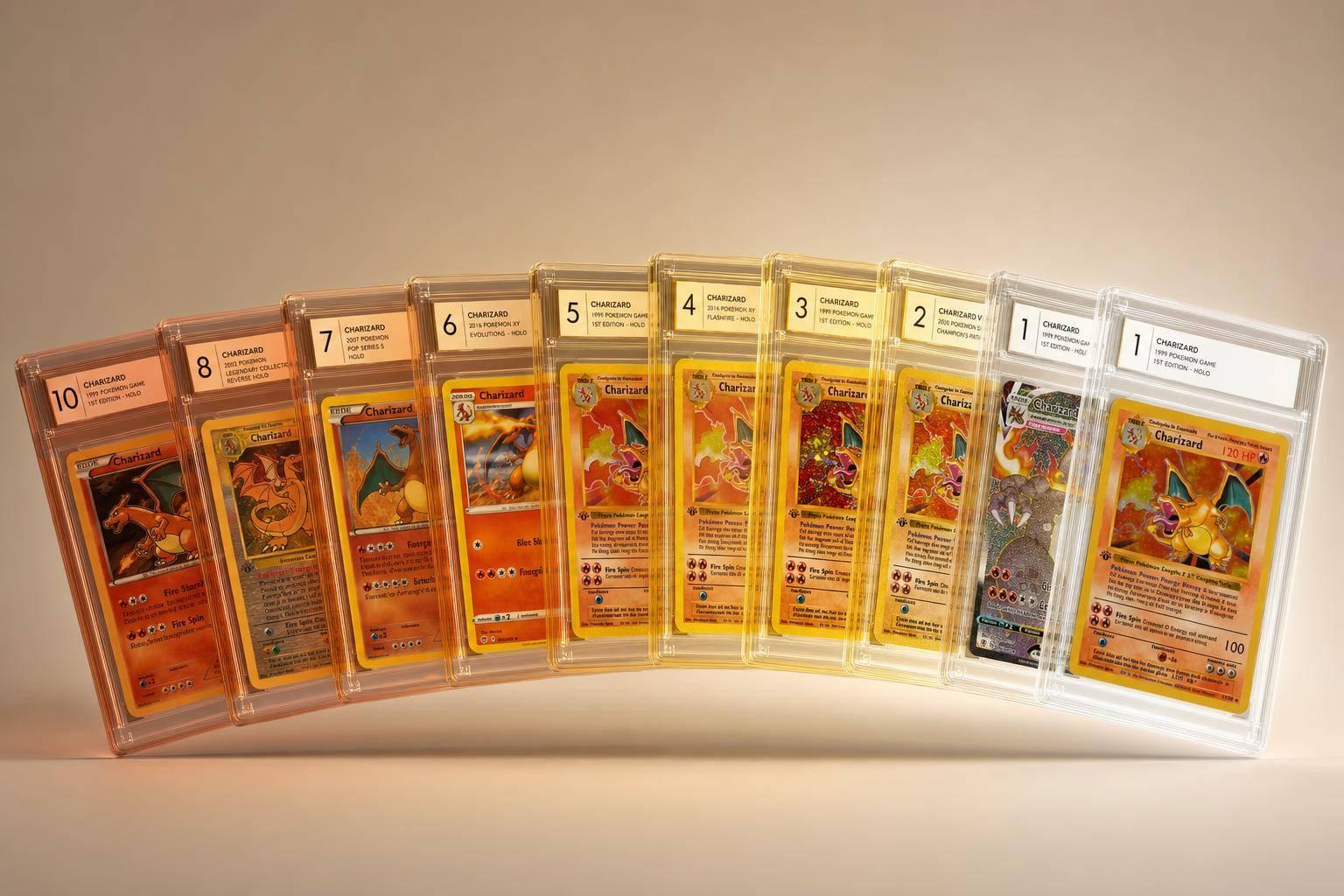
One Pokémon card sold for $16,492,000 on February 16, 2026. That sale set the high point for the market and shows what drives top prices: tiny supply, top grades, strong buyer interest, and sale history.
If I boil this article down to the parts you need most, it’s this:
- Japanese trophy cards lead the market
- 1st Edition Base Set Charizard is still the main English grail
- PSA 10, BGS Black Label, and CGC Pristine 10 grades can swing prices by huge amounts
- Version details matter - 1st Edition, Shadowless, No Rarity, and Blue Back can change price fast
- Public sale records matter more than asking prices
The list covers these 10 cards:
- Pikachu Illustrator
- 1st Edition Base Set Charizard
- Trophy Pikachu No. 1 Trainer
- Trophy Pikachu No. 2 Trainer
- Trophy Pikachu No. 3 Trainer
- Topsun Charizard Blue Back
- 1st Edition Base Set Blastoise
- Shining Charizard
- Tropical Wind Trophy Card
- Kangaskhan Parent/Child Mega Battle Trophy Card
Quick takeaway: if you’re checking a high-end Pokémon card, look at the exact print version, grade, population count, and sale record before you look at the headline price.
Selling My $5,300,000 Pokémon Card
sbb-itb-905f8ad
Quick Comparison
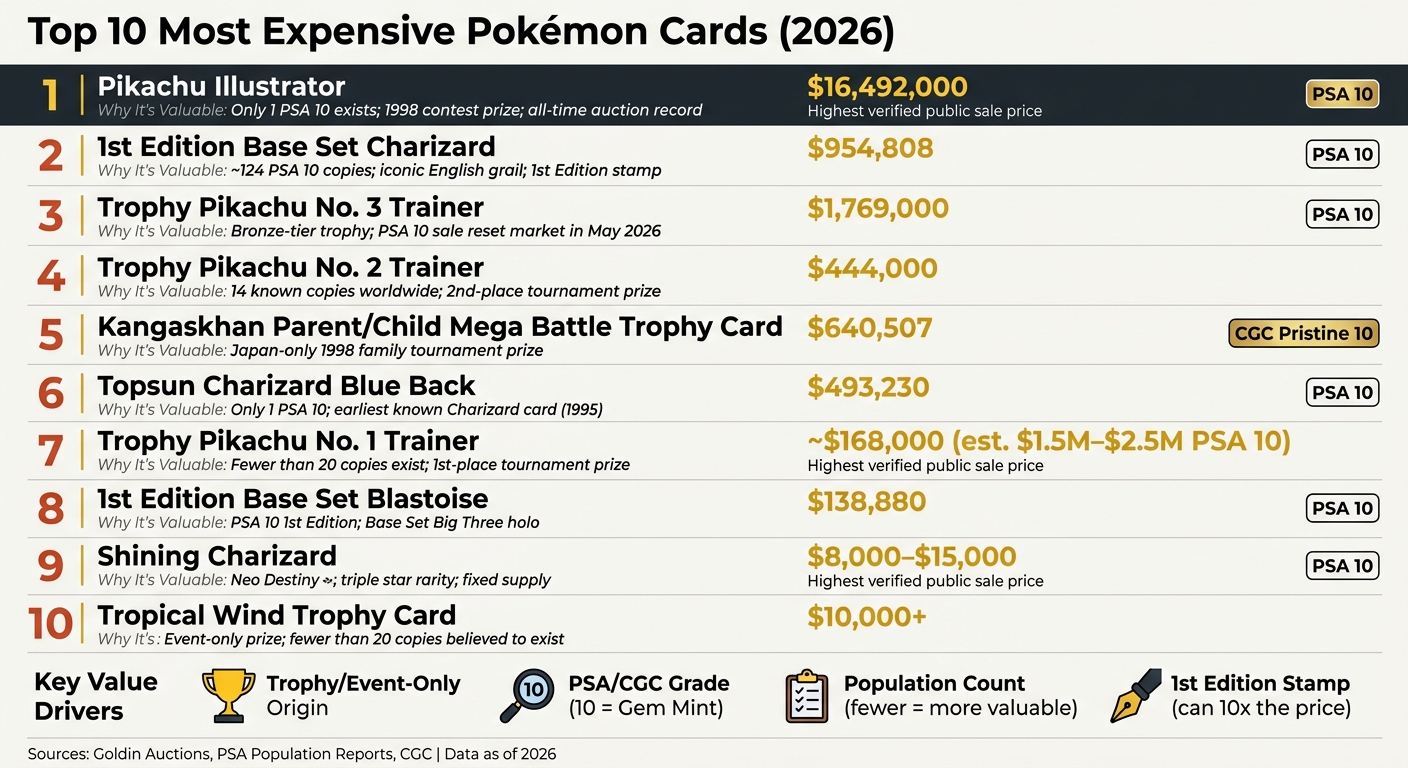
Top 10 Most Expensive Pokémon Cards: Prices, Rarity & Grades
| Card | Top Public Sale Mentioned | Why Buyers Pay So Much |
|---|---|---|
| Pikachu Illustrator | $16,492,000 | Contest prize card, 1 PSA 10, huge sale record |
| 1st Edition Base Set Charizard | $954,808 | Top English Charizard, strong PSA 10 demand |
| Trophy Pikachu No. 1 Trainer | ~$168,000 | First-place event prize, very low supply |
| Trophy Pikachu No. 2 Trainer | $444,000 | Second-place trophy, 14 known copies |
| Trophy Pikachu No. 3 Trainer | $1,769,000 | Third-place trophy, PSA 10 sale reset its market |
| Topsun Charizard Blue Back | $493,230 | Earliest Charizard card, 1 PSA 10 |
| 1st Edition Base Set Blastoise | $138,880 | Big Three Base Set holo, low PSA 10 supply |
| Shining Charizard | $8,000–$15,000 | Neo Destiny secret rare with steady Charizard demand |
| Tropical Wind Trophy Card | $10,000+ | Small-event prize card with very low supply |
| Kangaskhan Parent/Child Mega Battle Trophy Card | $640,507 | Japan-only event card, top-grade sale in 2026 |
In short: this market is led by cards that were never sold in packs, or by pack cards that are very hard to find in top condition. The full article explains where each card fits and what to check before you buy.
What Makes a Pokemon Card So Expensive
The biggest factor is how the card was first handed out. Cards sold in retail packs were printed in much larger numbers. But cards given out at contests or tournaments were never sold at mass scale. That gap in supply is the first reason some cards sell for six or even seven figures.
Early print variants also matter a lot, especially 1st Edition stamps and Shadowless Base Set cards. A small "1st Edition" stamp to the left of the Pokémon image can push a card's price up by 10x or more versus the same card without it. The "Shadowless" frame - where the drop shadow behind the artwork box is missing - is another early Base Set detail that points to a rarer print.
Then there's condition rarity, which is a different thing from print rarity. A card can be rare in general, but if many clean copies still exist, top-end prices may stay lower. For example, only about 120 to 125 PSA 10 1st Edition Base Set Charizards exist. That's the figure that tends to move auction prices - not the total print run.
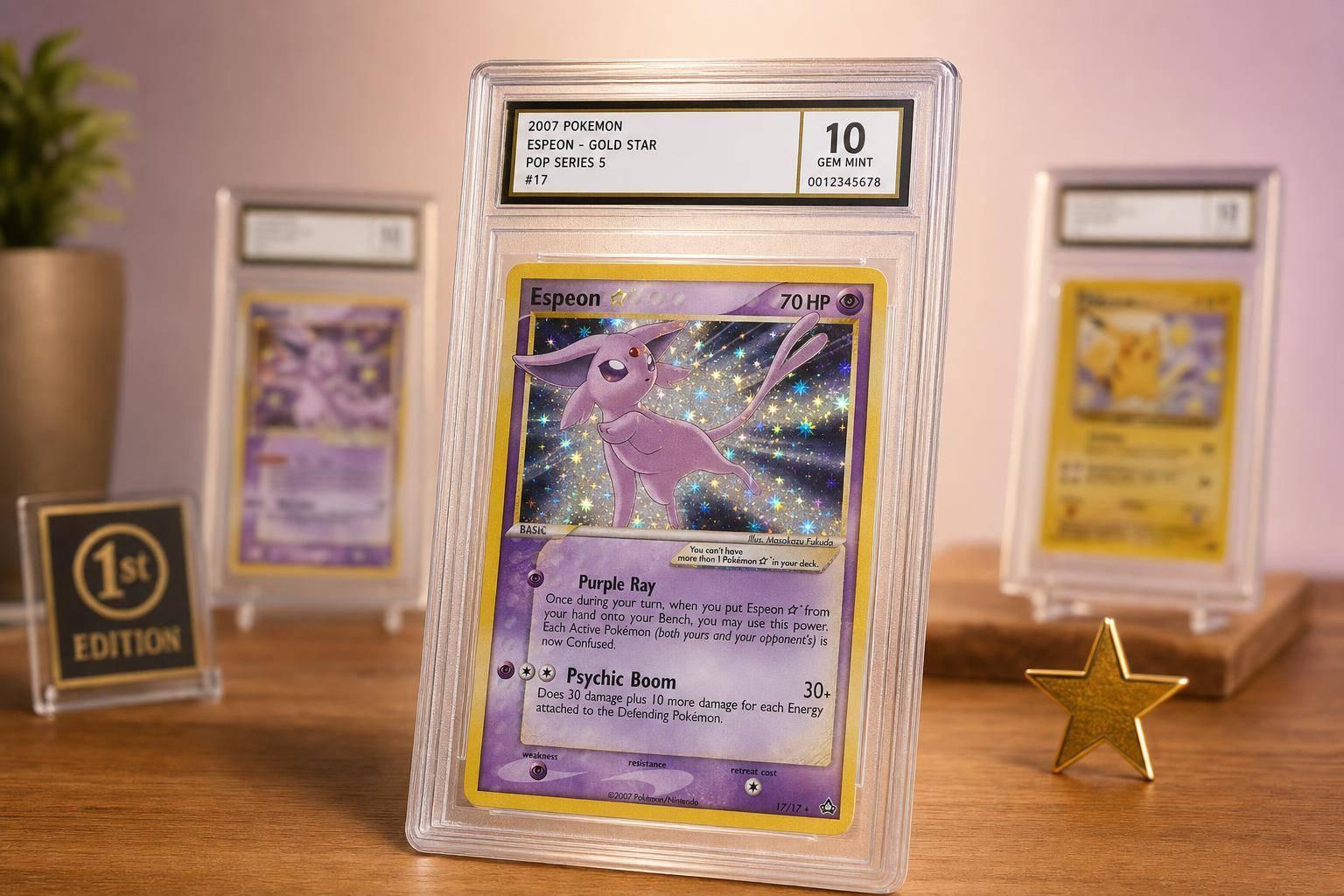
Grading companies like PSA and BGS check that a card is genuine and log its condition. And the gap between one grade and the next can be huge. The BGS Black Label is the hardest grade to get. It calls for 10s in centering, corners, edges, and surface.
Demand from collectors adds another layer. Charizard and Pikachu often sell for a 2x to 5x premium over other species from the same set. At the very top end of the market, provenance can matter just as much as population data.
These are the main filters behind the rankings below.
Quick Reference: Top 10 Most Expensive Pokemon Cards
Here’s the quick version: the cards below are ranked by documented public-sale value and collector demand.
| Card Name | Highest Verified Sale | Main Reason It's Valuable |
|---|---|---|
| Pikachu Illustrator | $16,500,000 | Record-setting trophy card with unmatched provenance |
| 1st Edition Base Set Charizard | No verified public sale cited | Iconic Base Set holo with sustained collector demand |
| Trophy Pikachu No. 1 Trainer | No verified public sale cited | Top-tier tournament trophy with confirmed event origin |
| Trophy Pikachu No. 2 Trainer | No verified public sale cited | Second-place tournament trophy with limited distribution |
| Trophy Pikachu No. 3 Trainer | No verified public sale cited | Third-place tournament trophy with scarce surviving copies |
| Topsun Charizard Blue Back | No verified public sale cited | Pre-Base Set Charizard with rare blue-back variant print |
| 1st Edition Base Set Blastoise | No verified public sale cited | 1st Edition Base Set holo with strong graded-copy scarcity |
| Shining Charizard | No verified public sale cited | Charizard-species holo with sustained demand across collector tiers |
| Tropical Wind Trophy Card | No verified public sale cited | Event-exclusive trophy with documented tournament provenance |
| Kangaskhan Parent/Child Mega Battle Trophy Card | No verified public sale cited | One-of-a-kind event trophy tied to a single Japan-only competition |
The early-2026 $16,500,000 Pikachu Illustrator sale reset the top end of the market.
Next, the list starts with the card that set the current ceiling.
1. Pikachu Illustrator
The only PSA 10 Pikachu Illustrator known to sell in public changed hands for $16,492,000 on February 16, 2026 at Goldin Auctions. That sale set the all-time auction record for any trading card.
This card was never sold in stores or pulled from packs. It was awarded to winners of the 1998 CoroCoro Comic illustration contest in Japan. Officially, 39 copies were given out, though about 41 are believed to exist today. Of those, 20 have been graded by PSA, and only one has earned a PSA 10.
A big part of the card’s appeal is how different it looks from normal Pokémon cards. The header says "Illustrator" instead of "Trainer," and it features a double-star rarity symbol plus a fountain pen icon. It was made as a recognition piece, not as a card for play. The artwork comes from Atsuko Nishida, Pikachu’s original creator, and shows Pikachu holding a paintbrush and fountain pen, with sketches of Charmander in the background.
| Grade | Value | PSA Population |
|---|---|---|
| PSA 10 | $16,492,000 | 1 |
| PSA 9 | ~$1,275,000 | 8 |
| PSA 7–8 | $375,000–$480,000 | ~11 |
That sale sits in a league of its own, but the next card is the one that shaped early Base Set collecting.
2. 1st Edition Base Set Charizard
If Pikachu Illustrator is the ceiling, 1st Edition Base Set Charizard is the benchmark. A PSA 10 sold at Goldin Auctions in February 2026 for $954,808. That copy carried the "Logan Paul Break" provenance label, which pushed the price higher.
That sale keeps Base Set Charizard near the top of the modern Pokémon market.
The gap between versions is bigger than many casual buyers think. For the Unlimited version, PSA has graded about 94,731 copies as of March 2026, and only 488 earned PSA 10. That's a gem rate of under 1%. For the 1st Edition Shadowless version, the PSA 10 population sits at only about 124 to 125 copies.
Put simply: the edition can change the price by a LOT.
| Variant | 1st Edition Stamp | Drop Shadow on Art Frame | Market Tier |
|---|---|---|---|
| 1st Edition Shadowless | Yes | No | Highest value |
| Shadowless | No | No | Mid-high value |
| Unlimited | No | Yes | Lowest value |
A 1st Edition stamp can multiply a card's value by 10x or more compared with an Unlimited copy.
Next up are the trophy Pikachu cards, where event history matters more than set pull history.
3. Trophy Pikachu No. 1 Trainer
No. 1 Trainer sits at the very top of trophy Pikachu cards. It was given only to first-place finishers at official Japanese Pokémon tournaments in 1997 and 1998. You couldn’t pull it from a booster pack or buy it in a store. The ONLY way to get one was to win.
That puts it in the event-card tier that rules the top end of the market. And the supply is tiny. Fewer than 20 copies are believed to exist worldwide.
Prices reflect that scarcity. One public sale hit about $168,000. A PSA 10 copy is estimated at $1.5 million to $2.5 million as of 2026. That gap tells you something important: at this level, condition can change the number by a huge margin.
Inside the trophy Pikachu line, placement matters just as much as rarity. The silver and bronze versions sell for far less, which shows how much first place carries the market. In plain terms, trophy-card prices come down to three things: rank, condition, and how few are left.
4. Trophy Pikachu No. 2 Trainer
Trophy Pikachu No. 2 Trainer was given only to second-place finishers at official Japanese Pokémon Card Game tournaments in 1997 and 1998. It was never sold in stores or included in booster packs. This was a prize-only card.
Only 14 copies are known worldwide, which shows just how limited the original distribution was and how many copies likely disappeared over time. And with a card this scarce, condition can change the price in a big way. A high-grade copy sits in a completely different price tier from one with visible wear.
A PSA 10 (Gem Mint) copy sold for $444,000 in 2023.
5. Trophy Pikachu No. 3 Trainer
Trophy Pikachu No. 3 Trainer is the bronze card in the Trophy Pikachu trio, and even so, top-grade copies can still sell for seven figures. It was given to third-place finishers at the first official Japanese Pokémon Card Game tournaments in 1997 and 1998, and it was never sold in retail packs.
Only a very small number were awarded at a handful of early Japanese events. Fewer than 20 Trophy Pikachu cards are thought to exist across all three ranks, and many were used, carried, or put on display by the original winners long before grading became common. That backstory makes a high-grade copy especially hard to track down.
And with a card like this, condition changes everything. In May 2026, a PSA 10 (Gem Mint) copy sold for $1,769,000. That made it the second most expensive card on this list, behind only Pikachu Illustrator, even though this is the bronze-tier version. Put simply: a perfect slab of a card this scarce sits in a completely different price bracket from a lower-grade copy.
6. Topsun Charizard Blue Back
Released in 1995 through a tie-in with the Topsun candy company in Japan, these cards came packed with chewing gum. In that release, the Blue Back version is the one that matters most when people talk about scarcity.
The set came in two versions: Blue Back and Green Back. Blue Back was the first print, and it's the rarer one. It also has a pen icon in the bottom-right corner instead of the usual circle, diamond, or star rarity symbols.
A PSA 10 Blue Back Charizard sold for $493,230 in January 2021, and Guinness World Records documented the sale. That price stands out even more when you look at the population report: there is only 1 PSA 10 copy, so there's no second card at that grade to measure it against.
| Detail | Topsun Blue Back Charizard |
|---|---|
| Release Year | 1995 |
| Distribution | Packed with Topsun chewing gum |
| Variant | Blue Back (first printing) |
| PSA 10 Population | 1 |
| Record Sale Price | $493,230 (January 2021) |
It came out four years before 1st Edition Base Set Charizard, which makes it the earliest known Charizard card. For collectors, that's a big part of the draw. The age, the print history, and the fact that only one copy has reached PSA 10 all push demand higher. That same mix of age, rarity, and condition also shapes the value of the next card.
7. 1st Edition Base Set Blastoise
After Charizard, the market shifts to another member of the Big Three holo lineup that still pulls in top-dollar sales: Blastoise. It’s the third Big Three Base Set holo, and it still has serious pull with collectors. A PSA 10 1st Edition copy sold for $138,880 in February 2026, far below Charizard’s $954,800 result in the same auction. That gap is huge, but Blastoise still sits in elite company.
At the top end of the Blastoise market, two things matter most: grade and edition. A PSA 10 copy from the Logan Paul break sold for $138,880 in February 2026. For most collectors, though, a PSA 10 1st Edition Shadowless Blastoise usually lands in the $40,000 to $60,000 range.
Here’s the key detail: 1st Edition copies have the stamp and no drop shadow. That combo matters a lot. 1st Edition Shadowless is the top standard version, Shadowless comes next, and Unlimited ranks lowest.
Blastoise is a good example of how much the 1st Edition stamp and gem-mint condition can matter, even when the card sells for far less than Charizard.
8. Shining Charizard
Shining Charizard is a Neo Destiny secret rare. Instead of the usual foil background, the Pokémon itself has the foil treatment. It also has a Triple Star rarity symbol, which made it one of the toughest pulls in the set.
That setup matters. You have a hard-to-pull card, one of the most popular Pokémon ever, and a set with a lot of history behind it. Put those together, and demand stays high.
Charizard is a big reason this card sits above other Shining holos. Raw Near Mint copies usually sell for about $500 to $800, while PSA 10 copies can hit $8,000 to $15,000. As with most high-end Pokémon cards, condition can swing the final sale price by a lot. Surface issues, in particular, can make or break a strong auction result.
Neo Destiny is out of print, which means the supply is fixed. On top of that, the 1st Edition stamp adds a major premium when the card is in mint shape.
If you're checking a copy, pay close attention to:
- scratches
- edge wear
- creases
Any of those can cut the value fast. It also helps to verify the certification number in the grading company's database. Fake copies often fail texture and transparency checks.
That mix of low supply and steady collector demand is why Shining Charizard stays near the top of this list. It also makes the card one of the clearest high-end Neo Destiny benchmarks.
| Grade | Estimated Market Value |
|---|---|
| Raw Near Mint (NM) | $500 – $800 |
| PSA 10 (Gem Mint) | $8,000 – $15,000 |
9. Tropical Wind Trophy Card
The Tropical Wind Trophy Card was never sold in stores. It was awarded only to top finishers at the Tropical Mega Battle, an official Japanese tournament that came before today’s World Championships.
That event-only origin is the big reason it sells for so much. Put simply, cards handed out at a small event are far harder to find than cards pulled from packs. And when only a tiny number survive, prices can climb fast.
Some Tropical Mega Battle prize cards are believed to survive in fewer than 20 copies worldwide. Since they were given only to top finishers, surviving copies are extremely rare.
At this level, provenance and grade have a huge effect on price. Check the PSA or CGC population report for the exact variant, and lean toward a graded copy if you want proof of condition and legitimacy.
| Grade | Estimated Market Value |
|---|---|
| Raw (Ungraded) | Highest risk for authenticity and condition |
| PSA/CGC High Grade | $10,000+ |
The next trophy card is even scarcer.
10. Kangaskhan Parent/Child Mega Battle Trophy Card
Kangaskhan closes out the list as one of the rarest trophy promos in the hobby. Like the other trophy cards, it wasn't sold in stores. It was awarded during Japan's 1998 Parent/Child Mega Battle tournament, where a parent and child played together as a team. Since it was event-only, supply is fixed for good. That's the core reason it earns a spot here.
What makes this card stand out is the mix of scarcity and backstory. The family-tournament angle gives it a story few trophy cards have. And in a market like this, story can matter a lot because the pool of top-grade copies is so small.
Top-condition examples attract strong demand because the card is both event-only and extremely scarce at the highest grade. In March 2026, a copy graded CGC Pristine 10 sold for a verified $640,507, setting a new benchmark for the card.
Grade matters a lot here. The spread between a mid-grade copy and a CGC Pristine 10 can be large. Before buying, check the certification number and the population report.
| Grade | Estimated Market Value |
|---|---|
| Raw (Ungraded) | Harder to verify for authenticity and condition |
| CGC Pristine 10 | $640,507 verified sale (March 2026) |
How to Check a High-End Pokemon Card Before You Buy
Before you buy a high-end Pokémon card, check the version first, then the condition. For returning collectors, this is the fastest way to tell the difference between a top copy and an expensive regret.
Start with the version. For English Base Set cards, check these four details in order: the 1st Edition stamp (left of the Pokémon image, below the art box), the frame shadow (Shadowless cards do not have a drop shadow on the right side of the art frame), the set symbol at the bottom right, and the card number at the bottom. That 1st Edition stamp can push a card into a much higher price tier. For early Japanese Base Set cards, look at the bottom right corner and see whether the rarity symbol is missing. That No Rarity detail marks the earliest print run. For 1995 Topsun cards, flip the card over: a blue back marks the first-run variant.
For promo and trophy cards, pay close attention to one-off markers. The Pikachu Illustrator has a pen icon where a standard rarity symbol would usually appear. That’s one of the main authentication markers. If the card is graded, compare the label details to the exact version, set symbol, card number, and any variant markers.
Once the version checks out, move to condition. Graders focus on four main areas: centering, corners, edges, and surface. Centering is about how evenly the art sits on the card. Corners should be sharp. Edges should have no whitening or silvering. The surface should be free of scratches, stains, and print lines. Use bright, direct light when you inspect a card, because flaws can hide in dim light.
This part can feel harsh, but that’s how high-end grading works. One tiny print line can drop a card from a PSA 10 to a PSA 7. At the top end of the market, a one-grade difference can mean a six-figure gap in price. And one hard rule: never clean or restore a card. Alteration kills resale value. After the card clears these checks, grade and population data usually explain the rest of the price gap.
| Print Detail | What to Look For | Why It Matters |
|---|---|---|
| 1st Edition Stamp | Left of Pokémon image, below art box | Can raise value 10x or more vs. Unlimited |
| Shadowless Frame | No drop shadow on right side of art frame | Earlier print run than Unlimited |
| Set Symbol / Card Number | Bottom right set symbol; card number at bottom | Verifies the exact version |
| No Rarity Symbol | Bottom right corner is blank (Japanese cards) | Earliest Base Set print; much scarcer than standard prints |
| Blue Back (Topsun) | Card back is blue, not green | First-run variant; far rarer |
| Pen Icon | Replaces standard rarity marker (Illustrator only) | Key authentication marker for Illustrator |
Why Grading and Population Reports Affect Price
A grade tells you more than condition. It also hints at scarcity.
PSA, BGS, and CGC population reports show how many copies exist at each grade. That gives collectors a much better way to judge whether a card is scarce in Gem Mint condition, or just scarce in general. Put simply: population reports carry more weight than vague scarcity claims.
At the top end of the market, buyers pay for cards that are as close to perfect as possible.
Take Base Set Charizard. Out of nearly 95,000 copies submitted to PSA, only 488 earned a PSA 10. That’s a gem rate of less than 1%. For the 1st Edition Base Set Charizard, about 124 PSA 10 copies are known worldwide. That tiny supply is what creates the huge price jump between a PSA 9 and a PSA 10 of the same card.
If you're trying to judge the premium, focus on two numbers:
- PSA 10 population
- Gem rate
When PSA 9s show up often but PSA 10s barely exist, the premium usually makes sense. With vintage cards, that’s where the money is. The big price gap comes from how few true gem copies have made it through the years.
| Card | PSA 10 Population | Gem Rate |
|---|---|---|
| Pikachu Illustrator | 1 | 5% |
| Base Set Charizard (#4, all prints) | 488 | <1% |
| 1st Edition Base Set Charizard | 124 | Very low |
Vintage cards are harder to grade at the top because years of play, handling, and storage damage push gem rates down.
Where Returning Collectors Can Learn More
For price research, start with PriceCharting and eBay Sold Items. They show what cards have actually sold for, which matters a lot more than wishful asking prices.
If you're looking at high-end grail cards, archived sales from Goldin, Heritage Auctions, and Fanatics Collect give you a better baseline than active listings. That covers the sales side. Population reports help you see how scarce top-grade copies are.
Use PSA, BGS, and CGC population reports to check supply at each grade level.
Off Center is a good place to brush up on set history, grading, print runs, and key variations if you're coming back to the hobby.
Once you can verify price, grade, and population, the next thing to read is how the 2026 market is pricing those factors right now.
Market Context for 2026
With pricing data in hand, the 2026 market makes one thing plain: the top end can move FAST. At that level, each public sale can reset the market. These cards almost never trade in public, so when one does, that result often becomes the new point of reference.
You can see that most clearly in the biggest public sale of the year. In February 2026, a Pikachu Illustrator sold for $16,492,000 at Goldin Auctions. That sale more than tripled its 2021 price and was certified by Guinness World Records as the highest price ever paid for a trading card at auction.
The same pattern shows up with high-end Base Set cards. A PSA 10 1st Edition Base Set Charizard sold for $550,000 in December 2025. Then, in February 2026, a provenance-labeled copy sold for $954,808. Same card. Same grade. Nearly double the price. That gap says a lot. Venue and provenance can swing the result hard, even when the card and grade are identical.
There’s another shift happening too: institutional buyers are moving into the space and treating apex cards as alternative assets. In plain English, that puts even more weight on provenance and auction depth. The headline number gets attention, sure. But in major auctions, bidder depth often tells you more about the market than the top bid alone.
So for 2026, public sales are best read as snapshots of where the market was at that moment - not fixed ceilings.
Conclusion
For collectors getting back into the hobby, the takeaway is pretty simple: the highest prices usually go to the cards that are hardest to find again. At this level, value comes down to the same few things over and over - scarcity, provenance, condition, and collector demand.
That said, price tags need context. A big sale number might look like the standard, but it often reflects a specific moment, a specific buyer, and a specific selling venue. Recent sales can swing a lot based on timing, where the card was sold, and the card’s documented history. In other words, headline prices are snapshots, not fixed benchmarks.
A 1st Edition stamp, a PSA 10 grade, and a verified sales record aren’t small add-ons in this part of the market. They’re what the price is built on. Before paying top-dollar, check the exact version, confirm the grade, and compare recent sold listings.
FAQs
Why do trophy cards sell for more than pack cards?
Trophy cards usually sell for more because they’re much rarer than pack-pulled cards. Standard booster cards were printed in large numbers. Trophy cards, on the other hand, were given out for specific contests or tournaments, often in very small quantities.
They also weren’t sold in stores, so the supply is fixed. For collectors, that can make them feel less like ordinary game pieces and more like artifacts with history, which helps push demand higher.
How much does a PSA 10 grade change value?
A PSA 10 can push a card’s price way up. In many cases, it sells for 5 to 20 times more than the same card in raw, ungraded form.
Why such a big gap? It comes down to condition scarcity. Gem Mint grades are tough to get, especially on vintage or rare cards, so buyers will often pay a steep premium for one.
The jump can be big even between top grades. On high-value cards, moving from a PSA 9 to a PSA 10 can add about 50% to 70% to the market price.
What should I check before buying an expensive Pokémon card?
Before you buy an expensive Pokémon card, make sure the card is real and in good shape. The safest move is usually to buy a professionally graded copy from a well-known service like PSA. Then check the certification number in the grading company’s official database. If the number isn’t there or the details don’t match, walk away.
Take a close look at the photos and the item description too. Watch for scratches, edge whitening, centering problems, poor print quality, odd fonts, or a missing opaque inner layer. And before you pay, compare the asking price with recent sold listings so you know what people are actually paying.