If you want the short answer, Espeon Gold Star cards sit at the top, with PSA 10 sales above $10,000 as of August 3, 2026. After that, the biggest price drivers are 1st Edition vintage holos, low pop high grades, and modern chase cards with strong PSA 10 premiums.
Here’s the list in plain English:
- #1: Espeon Gold Star 16/17 (POP Series 5, English)
- #2: Espeon Gold Star 025/PLAY (Japanese PLAY Promo)
- #3: Espeon 1/75 1st Edition Holo (Neo Discovery)
- #4: Dark Espeon 4/105 1st Edition Holo (Neo Destiny)
- #5: Espeon H9/H32 Holo (Aquapolis)
- #6: Espeon ex 102/115 (EX Unseen Forces)
- #7: Espeon VMAX 270/264 Alternate Art Secret Rare (Fusion Strike)
- #8: Espeon VMAX 189/S-P Promo (Japanese Pokémon Card Gym Promo)
- #9: Espeon ex 155/131 Special Illustration Rare (Prismatic Evolutions)
- #10: Espeon GX SV60/SV94 Shiny Full Art (Hidden Fates)
What matters most when I size up an Espeon card:
- Gold Star rarity can push top copies into five figures
- PSA 10 scarcity often creates the biggest price gap
- 1st Edition stamps can change a card from a mid-range buy into a high-end card
- Condition flaws like whitening, holo scratches, print lines, and off-centering can cut prices hard
- Modern Espeon cards still have strong upside, but most sit far below the top vintage cards
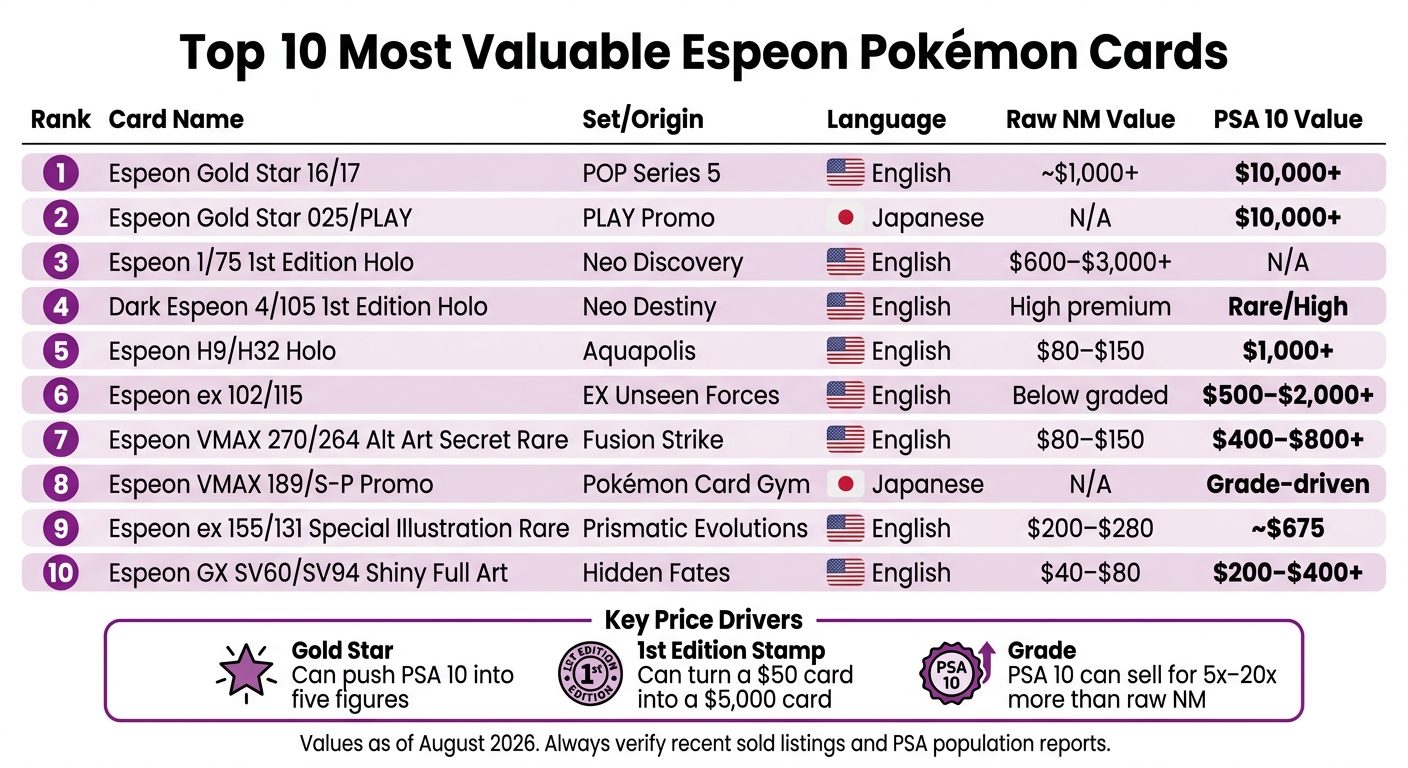
Top 10 Most Valuable Espeon Pokémon Cards: Price & Rarity Guide
The 10 Most EXPENSIVE Espeon Pokemon Cards 👀 #top10 #pokemon #espeon
sbb-itb-905f8ad
Quick Comparison
| Rank | Card | Main price driver | Top range noted |
|---|---|---|---|
| 1 | Espeon Gold Star 16/17 | Gold Star scarcity + Eeveelution demand | $10,000+ PSA 10 |
| 2 | Espeon Gold Star 025/PLAY | Japanese promo scarcity | $10,000+ PSA 10 |
| 3 | Espeon 1/75 1st Ed. Holo | 1st Edition + first English Espeon | $600 to $3,000+ |
| 4 | Dark Espeon 4/105 1st Ed. Holo | 1st Edition vintage holo scarcity | High-end graded premium |
| 5 | Espeon H9/H32 Holo | Low high-grade supply | $1,000+ PSA 10 |
| 6 | Espeon ex 102/115 | EX-era grade scarcity | $500 to $2,000+ PSA 10 |
| 7 | Espeon VMAX 270/264 | modern alt art demand | $400 to $800+ PSA 10 |
| 8 | Espeon VMAX 189/S-P | Japan-only promo supply | Grade-driven premium |
| 9 | Espeon ex 155/131 | SIR pull odds + PSA 10 spread | ~$675 PSA 10 |
| 10 | Espeon GX SV60/SV94 | shiny chase demand | $200 to $400+ PSA 10 |
Bottom line: if you’re buying for price strength, start with Gold Stars and 1st Edition holos. If you’re buying raw to grade, check surface, edges, and centering first. That’s where most of the money is won or lost.
What Makes an Espeon Card Valuable
Four things shape Espeon prices here: edition, rarity, grade, and demand for certain versions. And the jump from raw to graded can be HUGE. On top Espeon cards, a PSA 10 can sell for 5x to 20x more than a raw Near Mint copy of the same card. When the PSA 10 population is low, that shortage is what drives prices up.
Before you buy, check the four details that matter most. They can change the price fast:
- 1st Edition stamp: This can be the difference between a $50 card and a $5,000 card
- Holographic version: Holo copies often sell for 10x to 100x more than non-holo versions from the same set
- Alternate Art or Special Illustration Rare status: These are different products with very different price ranges
- PLAY markings on Japanese cards: This shows promo status from the Pokémon Players Club
Condition matters too. Espeon’s purple-and-pink color palette makes surface wear, haze, and print flaws easier to spot. That means edge whitening, scratching, and silvering tend to stand out right away.
| Flaw | Grade Impact | What to Watch |
|---|---|---|
| Edge whitening | Prevents PSA 10 | Most common flaw on played vintage cards |
| Centering (60/40 or worse) | Limits to PSA 8 | Check front and back alignment on all pulls |
| Holo scratching | Severe surface subgrade drop | Highly visible on Espeon’s light foil backgrounds |
| Print lines | Penalized heavily by BGS | Factory defect, not handling damage |
| Silvering | Signals edge wear | Holo foil showing through front border edges |
| Dents or creases | Grade 1 (Poor) result | Destroys most market premium |
Use a 10x loupe or raking light before grading. And don’t send in every card you pull. Grade the ones that can justify the fee. With those filters in place, the rankings below focus on the Espeon cards collectors pay the most for.
1. Espeon Gold Star 16/17 (POP Series 5, English)
The POP Series 5 Espeon Gold Star is the most expensive Espeon card for a pretty simple reason: very little supply, very broad demand. POP Series 5 packs were handed out only through Pokémon Organized Play (POP) events, so there were never many of them in circulation. On top of that, the estimated Gold Star pull rate was about 1 in 72 packs. That’s a small supply right out of the gate.
Then there’s Espeon itself. It’s one of the Eeveelutions, and that gives the card pull with both Espeon collectors and Eeveelution fans. That kind of cross-demand helps keep prices high.
Collector databases put this card at around $8,700, and PSA 10 copies can go past $10,000.
| Grade | Estimated Value (USD) |
|---|---|
| Raw Near Mint (NM) | About $1,000+ depending on condition |
| PSA 9 | Far below PSA 10 value |
| PSA 10 (Gem Mint) | $10,000+ |
The biggest money is in PSA 10, which means condition is everything. Surface issues tend to be the deal-breaker. If you're shopping for a raw copy, check the surface before anything else. Look closely at the purple and pink holo under angled light for haze, micro-scratches, and edge wear.
Also, make sure you’re looking at the English POP Series 5 16/17 card, not the Japanese PLAY promo. They’re different cards, and mixing them up is an easy mistake.
2. Espeon Gold Star 025/PLAY (Japanese PLAY Promo)
After the English POP Series 5 release came the 025/PLAY Espeon Gold Star, the Japanese version of that same Gold Star card. It was distributed through the Pokémon Players Club, and it's one of the hardest-to-find Espeon promos out there.
A big part of the price comes down to scarcity. But the real gap in pricing shows up when you look at grades.
Japanese copies often have better centering, which can help PSA 10 rates. Even so, Espeon’s purple-and-pink foil is rough on condition. It shows scratches and edge wear fast, so small flaws can stand out right away.
| Grade | Estimated Value (USD) |
|---|---|
| Raw Near Mint (NM) | Highly condition-dependent |
| PSA 10 (Gem Mint) | $10,000+ |
Collectors also chase this card as a separate language piece, especially if they want both the English and Japanese Gold Star versions. That gives it its own demand instead of tying it fully to the POP Series 5 card.
Before buying, look closely at:
- edges and corners for whitening
- foil for micro-scratches
- surface marks that can hurt grade upside fast
3. Espeon 1/75 1st Edition Holo (Neo Discovery, English)
Neo Discovery marks Espeon’s first English TCG appearance. That alone gives the 1/75 1st Edition Holo a special place for English collectors. If you’re building around vintage English Espeon cards, this is the card that usually sits at the center of the hunt.
The main reason it sells for more is simple: the 1st Edition stamp. That stamp appears only on the earliest print run, and that short supply is what pushes prices up. Unlimited copies are still collectible, but they don’t come close to the same level of demand. In raw Near Mint condition, Unlimited copies usually sell for $80–$120, while a CGC 9 often lands around $200–$300. High-grade 1st Edition copies can reach $600 to over $3,000, depending on condition and market timing.
Condition matters a lot here, maybe more than some buyers expect. A few holo scratches or a bit of edge wear can drag a card down fast. Espeon’s bright foil tends to show scratches and print flaws almost right away. That’s why the gap between grades can get big. A PSA 9 may sell for much more than a PSA 8, and a PSA 10 can climb again if the centering and surface are clean.
If you’re buying raw, inspect this card like you mean it. Tilt the holo under angled light to spot micro-scratches. Look closely at the edges for silvering and whitening, which are common vintage flaws and can hurt grade upside. And make sure the 1st Edition stamp is there on the left side of the card, just below the artwork frame. If it’s missing, you’re looking at the Unlimited version.
| Variant | Condition | Estimated Value (USD) |
|---|---|---|
| Unlimited Holo | Raw NM | $80–$120 |
| Unlimited Holo | CGC 9 | $200–$300 |
| 1st Edition Holo | High-grade | $600–$3,000+ |
4. Dark Espeon 4/105 1st Edition Holo (Neo Destiny, English)
Dark Espeon from Neo Destiny stands out as one of the strongest vintage Espeon cards. 1st Edition copies are hard to find, and demand for Eeveelutions stays strong. That mix keeps collector interest steady. From there, surface condition becomes the big swing factor.
The dark holofoil picks up scratches, silvering, and whitening fast, so clean copies don't come around often. High-grade examples are scarce, and that's why the gap between grades gets so steep.
| Condition | Value Context |
|---|---|
| Raw Unlimited | Lower demand than 1st Edition copies |
| Raw 1st Edition | Significant premium over Unlimited |
| Graded 9 | Strong collector demand for clean examples |
| Graded 10 | Rare; commands the highest prices on this card |
If you're buying raw, check the edges closely for silvering and white print marks. Those are common factory issues on early 2000s Espeon cards. If grading is part of the plan, spend extra time on the holo surface and look for light scratches before you buy. That's a big part of why Dark Espeon stays near the top of the list.
Next comes a newer Espeon chase with a very different price profile.
5. Espeon H9/H32 Holo (Aquapolis, English)
Aquapolis pushes this list into the later e-Reader holo era, where print quality and centering have a huge effect on price. Espeon H9/H32 sits near the top because Aquapolis holos are hard to find in top grade. It’s the holo rare from the H1–H32 subset, so it was tougher to pull than a standard rare.
Aquapolis holos are known for thin foil, uneven coating, and print misalignment. And those issues hit PSA 10 supply hard. Gem Mint rates for vintage Aquapolis holos sit below 2%.
| Grade | Value |
|---|---|
| CGC 7.5 | $80–$150 |
| BGS 7 | $60–$100 |
| PSA 10 | $1,000+ |
PSA 10 copies are scarce, and they define the high end of the market.
Buy the Holofoil version only. The non-holo 11/147 is a different card. Before grading, check centering and foil wear under bright light with a loupe.
6. Espeon ex 102/115 (EX Unseen Forces, English)
After the vintage holo era, Espeon ex 102/115 shows where collector demand moved next. This is the EX-era English chase card for people who want a top-tier Espeon without sticking to vintage holos. Its price is driven by strong Eeveelution demand and a small pool of high-grade copies.
That’s the catch with this card: clean copies are hard to find. Surface wear, edge whitening, and print flaws show up often. And the foil tends to show scratches and whitening fast, which makes gem-mint grades much tougher to get. That low supply in top condition helped set the stage for later alternate-art and special-rare Espeon cards.
| Grade | Estimated Value |
|---|---|
| Raw NM | Usually far below graded copies |
| PSA 10 | $500–$2,000+ |
A PSA 10 can sell for 5–20x more than a raw copy. If you're buying raw, check the holo under raking light for micro-scratches. Then look closely at the back edges for whitening. Those are two of the most common issues, and they’re the kind of flaws graders dock hard for.
7. Espeon VMAX 270/264 Alternate Art Secret Rare (Fusion Strike)
Modern Espeon demand works a little differently than vintage demand. Instead of being driven by age and low supply, this card gets most of its pull from the artwork. Espeon VMAX 270/264 stands out as a modern chase card because alternate-art Espeon cards appeal to both set builders and collectors who buy cards mainly for the art.
Raw NM copies usually sell in the $80–$150 range, while PSA 10 copies have reached $400–$800+, depending on market timing. In plain terms, this is the modern-era version of a chase Espeon card, backed by a much larger modern collector base.
Condition matters a lot here. The purple-pink artwork and textured foil surface tend to show scratches, print flaws, and edge wear fast.
That same demand gets even tougher to meet in the Japanese promo release.
8. Espeon VMAX 189/S-P Promo (Japanese Pokémon Card Gym Promo)
After the Fusion Strike alternate art, this promo gets its value from something else: Japan-only distribution.
The Espeon VMAX 189/S-P is a Pokémon Card Gym promo released only in Japan, which keeps supply tight and interest high for collectors trying to complete Eeveelution promo runs.
Clean copies have a good shot at strong grades, but surface wear still makes Gem Mint cards hard to find. Espeon cards have real high-grade scarcity, so even small surface or edge flaws can make a big difference in the final grade. That gap shows up in prices fast. Raw copies sit well below graded copies, and Gem Mint examples command the biggest premium.
A lot of the demand comes from Eeveelution promo set builders. Clean copies often sell for 20% to 50% more, which is why buying raw takes a careful eye. Check the holo under direct light before you buy.
That promo-only scarcity carries into the next modern Espeon chase.
9. Espeon ex 155/131 Special Illustration Rare (Prismatic Evolutions)
Released on Jan. 17, 2025, Prismatic Evolutions gave all nine Eeveelutions a Special Illustration Rare at the same time. Within the set, Espeon ex 155/131 usually sits in the fourth- or fifth-place spot, behind Umbreon and Sylveon.
After the set hit its high point in 2025, prices dropped about 40% to 50% before leveling out by April 2026. By mid-2026, raw Near Mint copies were selling for about $200 to $280, while PSA 10 copies were around $675. At this point, the big value split comes down less to set buzz and more to condition.
| Condition/Grade | Estimated Market Value (USD) | Value Multiplier vs. Raw |
|---|---|---|
| Raw Near Mint | $200 – $280 | 1.0x |
| PSA 10 Gem Mint | ~$675 | 2.4x – 3.4x |
| CGC 10 (Est.) | ~$540 – $600 | 1.9x – 2.1x |
PSA 10 rates are only about 20% to 30%, and it’s not hard to see why. Centering issues, surface scratches, and edge whitening show up a lot. Around 30% to 40% of pulls have top-to-bottom misalignment, and the card’s purple-and-pink foil tends to show wear fast.
With pull odds at about 1 in 1,441 packs and expected pack cost running above $5,000, buying a raw single usually makes more sense than trying to pull one yourself. If grading is the plan, aim for 60/40 centering or better in every direction and no visible edge whitening. A PSA 9 often ends up much closer to raw price than PSA 10 price, so most of the upside goes to copies that are gem mint.
That grading spread sets up the final card on the list, where modern Espeon demand follows a different kind of chase pattern.
10. Espeon GX SV60/SV94 Shiny Full Art (Hidden Fates)
Hidden Fates keeps Espeon firmly in the modern shiny-chase tier. When it landed in the Shiny Vault, it quickly became one of the card’s most wanted modern shiny prints. That demand still helps it hold its place within the set. Raw Near Mint copies usually sell for $40–$80, while PSA 10 copies can hit $200–$400+, depending on market timing.
The purple-and-pink foil texture looks great, but it also makes flaws stand out fast. Surface wear is easy to spot, and common issues include print lines, misregistration, and edge whitening.
For grading, centering and texture quality are the big PSA 10 hurdles. Use the table below to compare this card’s value with the others at a glance.
Quick Value and Variant Reference Table
Use this table as a fast side-by-side check of value tiers and grading risk. The same factors from the list above still drive these rankings: rarity, grade scarcity, language, and condition.
| # | Card | Set | Language | Raw NM Value | PSA 10 Value | Key Thing to Check |
|---|---|---|---|---|---|---|
| 1 | Espeon Gold Star 16/17 | POP Series 5 | English | About $1,000+ depending on condition | $10,000+ | Stock, flexibility, and Gold Star texture |
| 2 | Espeon Gold Star 025/PLAY | PLAY Promo | Japanese | Not stated | Not stated | Japanese promo print quality and Gold Star details |
| 3 | Espeon 1/75 1st Ed. Holo | Neo Discovery | English | 1st Edition raw NM: $600–$3,000+ | Not stated | 1st Edition stamp and holo pattern |
| 4 | Dark Espeon 4/105 1st Ed. Holo | Neo Destiny | English | Not stated | Not stated | 1st Edition stamp and edge whitening |
| 5 | Espeon H9/H32 Holo | Aquapolis | English | About $80–$150 | Not stated | Holofoil wear and whitening |
| 6 | Espeon ex 102/115 | EX Unseen Forces | English | Not stated | $500–$2,000+ | Surface haze and micro-scratches |
| 7 | Espeon VMAX 270/264 Alternate Art Secret Rare | Fusion Strike | English | $80–$150 | $400–$800+ | Centering; verify 60/40 or better |
| 8 | Espeon VMAX 189/S-P Promo | Japanese Pokémon Card Gym Promo | Japanese | Not stated | Not stated | Japanese promo print quality |
| 9 | Espeon ex 155/131 Special Illustration Rare | Prismatic Evolutions | English | $200–$280 | ~$675 | Print lines and texture consistency |
| 10 | Espeon GX SV60/SV94 Shiny Full Art | Hidden Fates | English | $40–$80 | $200–$400+ | Centering and texture consistency |
A quick read of the table shows a pretty clear split. At the top end, Espeon Gold Star 16/17 stands out by a mile, especially in PSA 10, where the price jumps into five figures. A card like Espeon 1/75 1st Ed. Holo can also climb hard in raw Near Mint shape, with a big value spread tied to grade and eye appeal.
Further down, cards like Espeon VMAX 270/264 Alternate Art Secret Rare, Espeon ex 155/131 Special Illustration Rare, and Espeon GX SV60/SV94 Shiny Full Art sit in a more mid-tier range, but they still have real grading upside if the copy is clean. That’s where small flaws can make or break the outcome. A tiny print line, slightly off centering, or uneven texture can change the grade fast.
If you’re using the chart while buying, selling, or pre-grading, focus on the single check listed in the last column first. That’s the shortcut. For some cards, it’s centering. For others, it’s holo wear, surface haze, whitening, or whether the Gold Star finish looks right. In plain English: don’t just ask, “What’s it worth?” Ask, “What usually keeps this exact card out of a top grade?”
Conclusion
Espeon’s top cards run from vintage Gold Stars to modern chase cards. Their prices usually come down to three things: rarity, grade, and demand. So yes, putting a rough price on a card is often the easy part. Grading it the right way is where things get tricky.
Before you buy, check recent sold listings and population reports for the exact card and exact grade. After that, look closely at condition.
Condition is what creates most of the price gaps. Whitening, scratches, dings, and centering can decide whether a card lands at Gem Mint. That matters even more for vintage holos, Gold Stars, and modern cards with foil that shows centering issues fast.
Set your grade target based on the card’s rarity, condition, and demand before you buy or submit it. In plain English: buy the copy that fits the market for that card, not just the number on the label.
FAQs
How do I tell 1st Edition from Unlimited?
Look for the 1st Edition stamp on the front of the card. You’ll find it on the left side, just under the artwork frame. It shows a circled 1 with EDITION printed below it.
If the stamp isn’t there, the card is either Shadowless or Unlimited.
Here’s the easy way to tell them apart:
- Unlimited cards have a visible drop shadow on the right side of the artwork frame.
- Shadowless cards do not have the stamp and do not have that shadow.
It’s a small detail, but once you know where to look, the difference jumps out fast.
Which Espeon cards are safest to buy raw for grading?
The safest raw-to-grade buys are Espeon cards that already move well in Near Mint condition and show a strong PSA 10 premium. The sweet spot is simple: look for eye-clean copies with sharp corners, clean edges, and solid centering.
From the listings provided, the top raw candidates are Espeon V Alt Art (#195) and Espeon ex SIR (#162). Both show strong PSA 10 premiums compared with Near Mint raw prices.
How can I spot a valuable Espeon variant fast?
Check the big value markers first: 1st Edition stamps, Shadowless printing, and rarity symbols like stars. Also confirm the card number and set symbol.
Then inspect the card under bright light. Look at centering, corners, edges, and any surface wear. After that, compare it with recent sold prices on eBay, not asking prices.