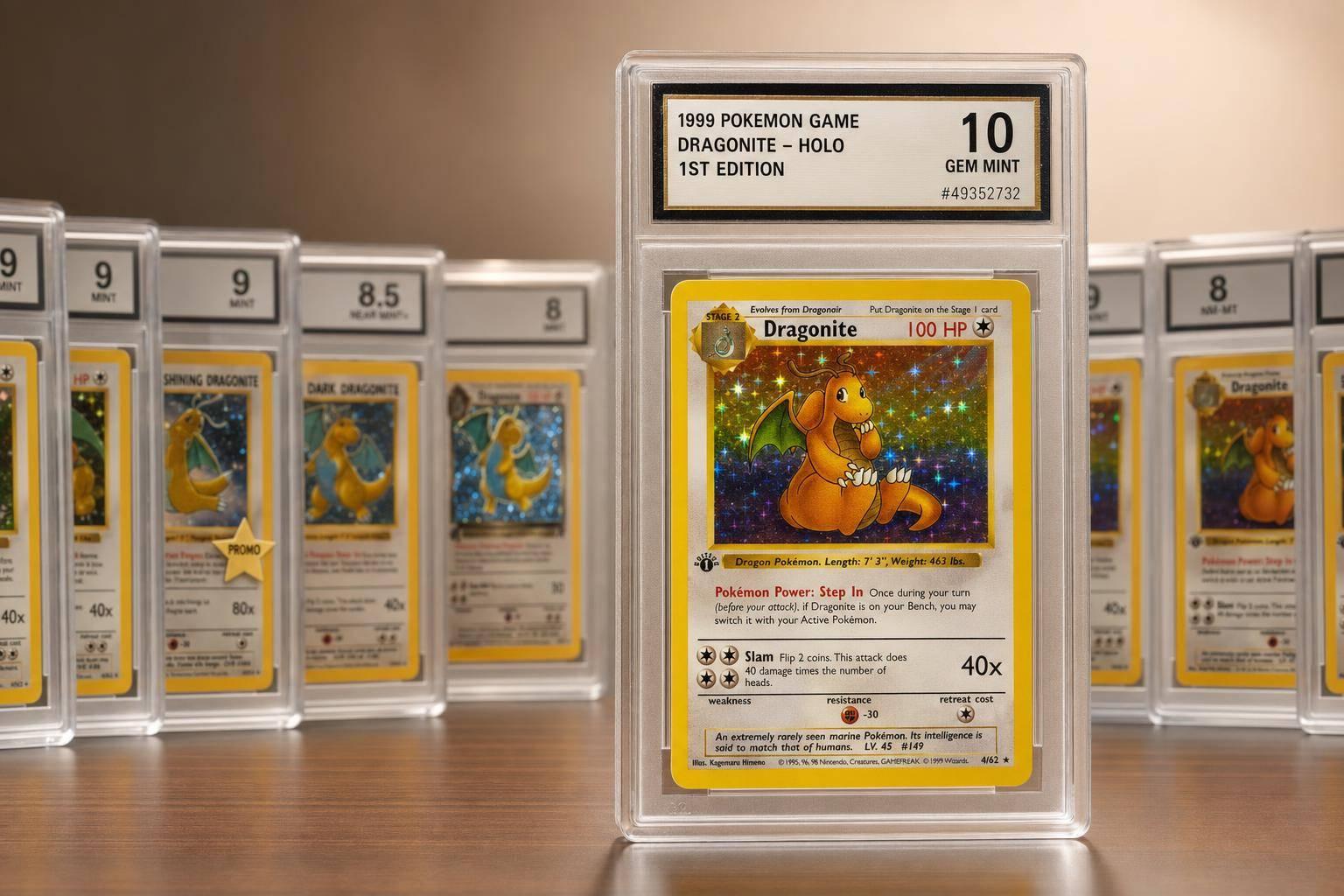
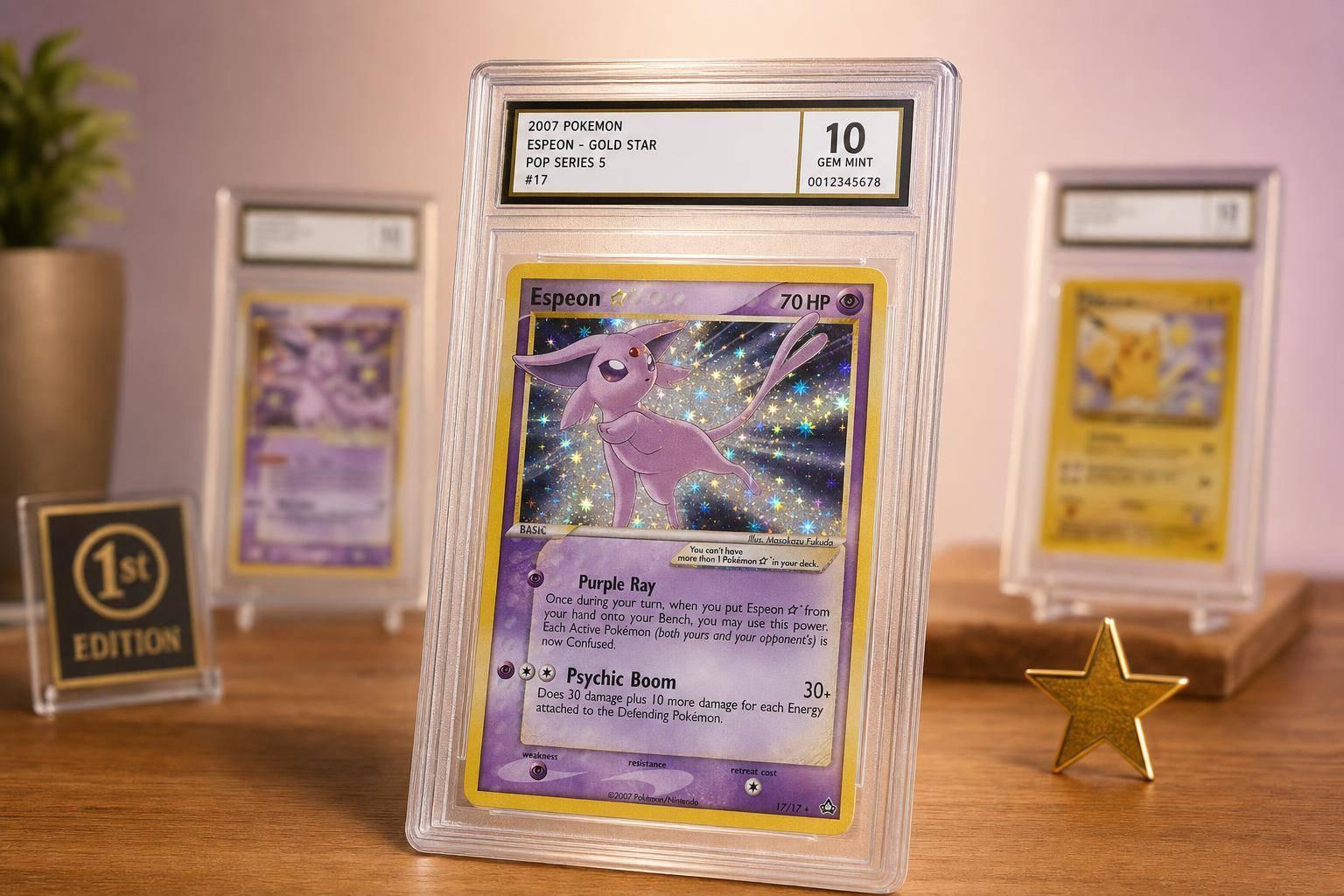
Most cards should stay raw. If I’m thinking about grading, I’d only send cards that are in near-top shape, have strong buyer demand, or need proof that they’re real and unchanged.
Here’s the short version:
- Professional grading means a third-party company checks if a card is real, scores its condition, and seals it in a plastic holder.
- The big three are PSA, BGS, and SGC.
- Graders focus on 4 things: centering, corners, edges, and surface.
- A card that looks perfect can still miss a 10 because of tiny print lines, edge wear, or off-centering.
- Costs add up fast: about $25 for grading plus about $20 for shipping and insurance.
- For many modern cards, a PSA 9 may sell for about the same as a raw copy.
- Only 8.88% of PSA submissions get a Gem Mint 10.
- About 63% of trading cards sell for under $1, so grading a whole binder often makes no sense.
If I want a simple rule, it’s this: grade only when the card’s likely sale price after grading clearly beats the full cost. That means fee, shipping, insurance, and the risk of getting a lower grade all need to be part of the math.
Quick comparison:
| Company | Scale | Subgrades | Best known for |
|---|---|---|---|
| PSA | 1–10 | No | Strong resale on modern cards and TCG |
| BGS | 1–10 with 0.5 steps | Yes | Detailed subgrades and Black Label 10 |
| SGC | 1–10 | No | Vintage sports cards and fast service |
Before I submit anything, I’d do a strict home check with a bright light, a 10x loupe, a new sleeve, and a semi-rigid holder. If I see surface marks, soft corners, edge chipping, or centering issues, I’d keep it raw.
That’s the core idea of this guide: use grading on purpose, not by default.
PSA 1-10 Grading Scale Explained!! Defining each grade & showing my examples from PSA 3-10.
sbb-itb-905f8ad
1. How Professional Card Grading Works
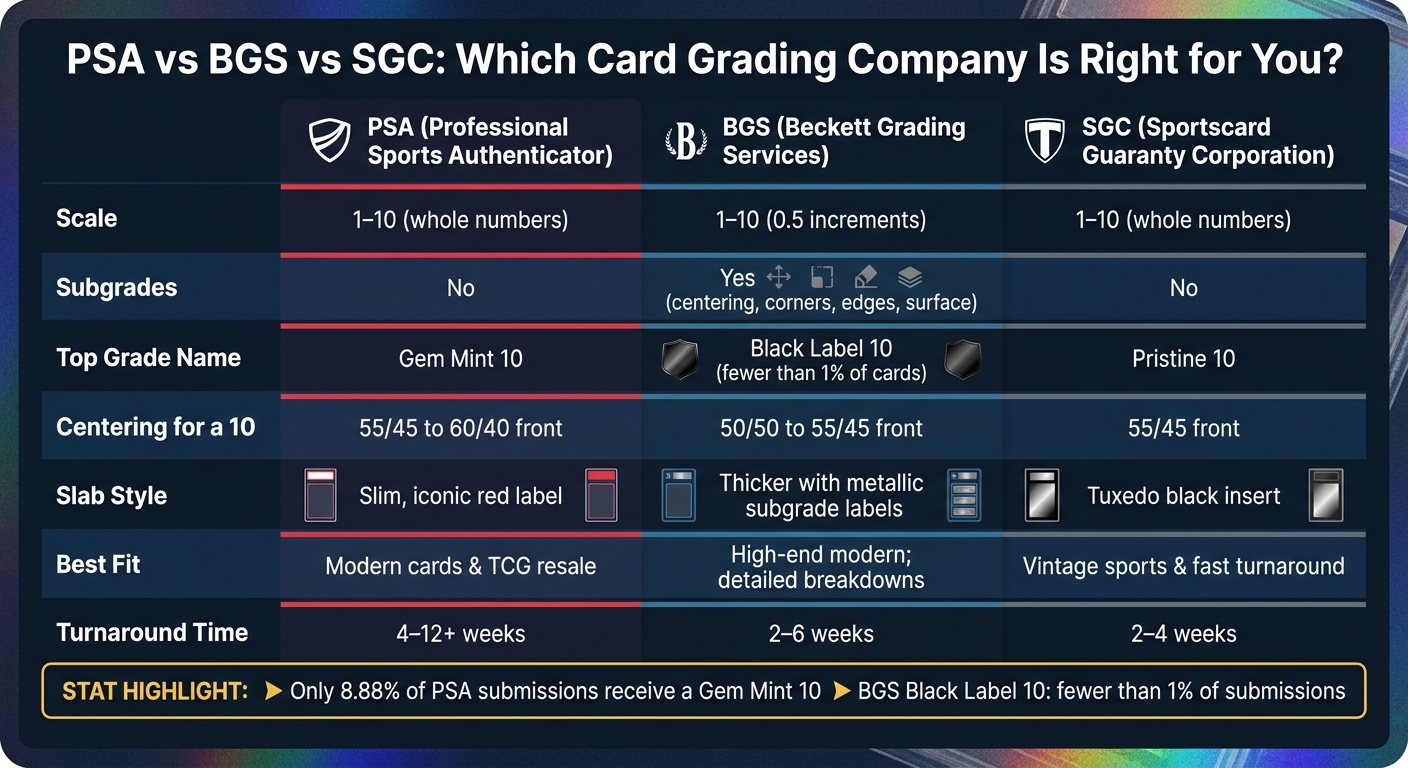
PSA vs BGS vs SGC: Card Grading Companies Compared
The process is pretty straightforward: inspect, package, submit, authenticate, grade, and slab. But each step matters. A small mistake before the card even reaches the grader can cost you money or leave you with damage that could've been avoided.
Preparing a Card for Submission
Start at home with a careful inspection. Hold the card under one bright LED light and tilt it slowly. This tilt-and-light test helps you spot surface scratches, fingerprints, and print lines that flat lighting can miss. Then use a 10x jeweler's loupe to check the corners and edges up close. If you can see a flaw without magnification, it's safest to assume the grader will count it against the card.
If the card looks good, handle it only with clean hands or cotton gloves. Don't touch the surface directly. Put it in a fresh penny sleeve, then into a semi-rigid holder. Skip rigid top loaders for submissions. Cards can move around inside them during shipping, and that movement can lead to corner damage.
Good prep cuts down the risk of damage before submission. Pack the card between cardboard supports in a sturdy box, and always use insured, tracked, signature-required shipping.
When you set up the submission online, you'll enter the card's details, such as the year, set, card number, and player. You'll also choose a service tier based on the card's declared value. That declared value helps decide your service level, insurance coverage, and any possible upcharges if the card ends up grading higher than expected.
What Happens After You Send It In
Once your package arrives, the grading company logs it into the system during intake. After that, the card moves to authentication. At this stage, graders confirm that the card is genuine and look for alterations such as trimming, recoloring, or cleaning. If a card fails authentication, it won't get a numerical grade.
If it passes, graders assign the final grade and seal the card in a tamper-evident slab. Grading tends to add the most market value when the card already has demand and the grade changes how buyers view it.
That process matters because the next piece is knowing what each grade actually reflects.
PSA, BGS, and SGC at a Glance
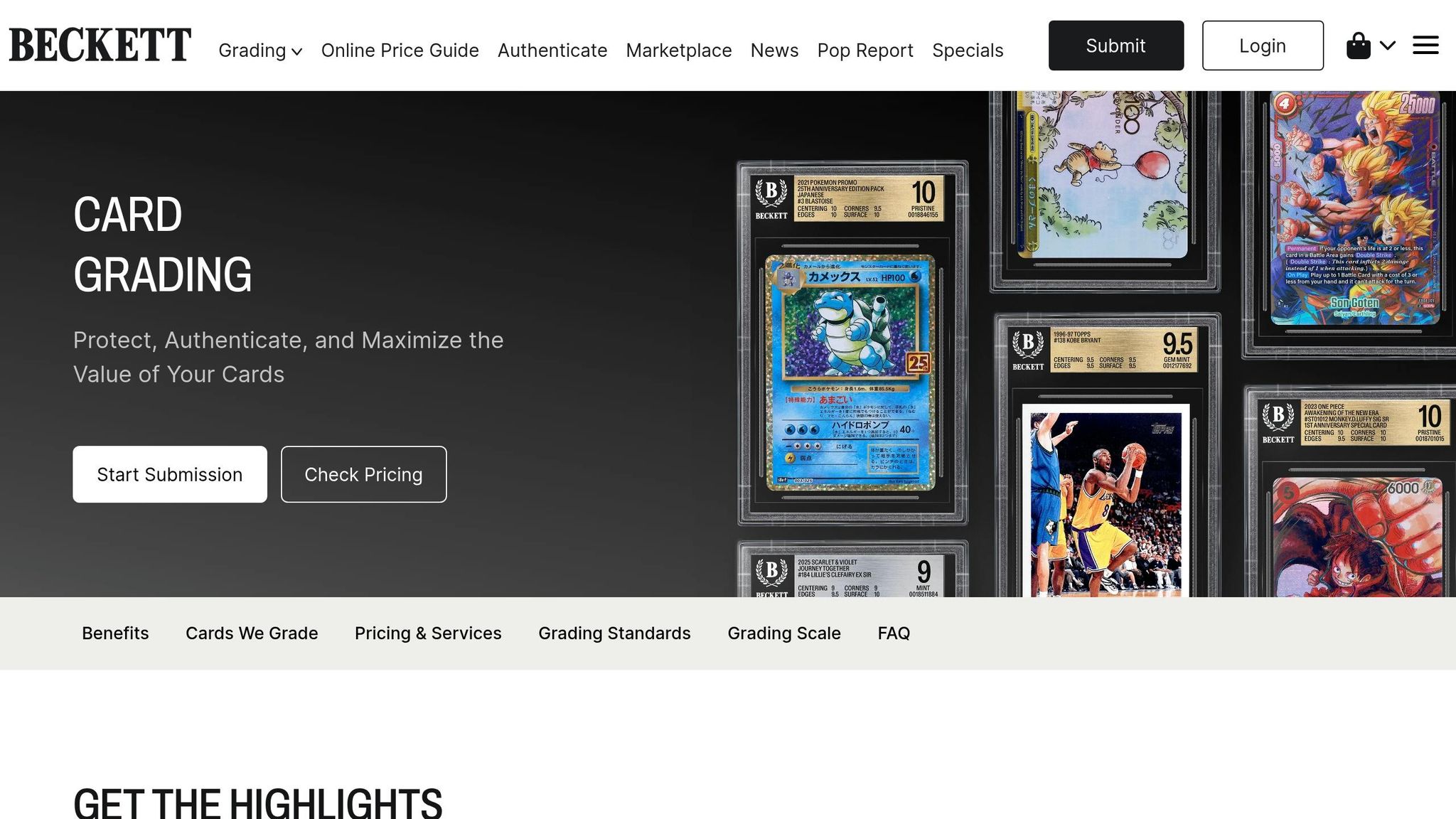
The three main services all use a 1–10 grading scale, but they differ in how grades are shown, how the slabs look, and where each service tends to shine.
| Feature | PSA | BGS (Beckett) | SGC |
|---|---|---|---|
| Scale | 1–10 (whole numbers) | 1–10 (0.5 increments) | 1–10 (whole numbers) |
| Subgrades | No | Yes (centering, corners, edges, surface) | No |
| Slab Style | Slim, iconic red label | Thicker with metallic subgrade labels | "Tuxedo" black insert |
| Best fit | Strong resale for modern cards and TCG | High-end modern; known for "Black Label" 10s | Vintage sports specialist |
| Turnaround | 4–12+ weeks | 2–6 weeks | 2–4 weeks |
For most returning collectors, PSA tends to bring the strongest resale premium on modern cards and TCG. BGS appeals to people who want a detailed breakdown of where a card lost points. SGC is often the first pick for vintage sports cards and is generally the fastest of the three for standard submissions.
The next section breaks down what those grades actually mean.
2. Grading Scales and the Four Condition Categories
How PSA, BGS, and SGC Scales Compare
PSA uses whole numbers. BGS and SGC use half-point steps. But BGS is the only one that shows subgrades on the label. That difference matters because the same card can look very different depending on how the grade is presented.
| Feature | PSA | BGS | SGC |
|---|---|---|---|
| Scale Format | 1–10 (integers) | 1–10 (half-point increments) | 1–10 (half-point increments) |
| Top grade name | Gem Mint 10 | Black Label 10 | Pristine 10 |
| Subgrades on Label | No | Yes | No |
| Centering for a 10 | 55/45 to 60/40 front | 50/50 to 55/45 front | 55/45 front |
A BGS Black Label 10 means the card got perfect 10s in every subgrade, and fewer than 1% of submitted cards reach it. That label carries weight because buyers can read the card’s condition almost instantly.
Centering, Corners, Edges, and Surface in Plain English
Every grading company checks the same four areas, even if the label shows the result in a different way.
Centering is about how even the borders look. A 50/50 ratio is perfect. A 60/40 ratio means one border is plainly wider than the one across from it. And back centering matters too. Even if the front looks sharp, weak back centering can keep a card at a 7 or 8.
Corners get checked under magnification. Graders look for fuzzing, whitening, blunting, and impact dings. This is one of those areas where your eyes can fool you. A corner may look clean in normal light, then show wear the second it’s magnified.
Edges are checked for chipping, silvering, and rough cuts. Graders use angled light to spot nicks and tiny issues that don’t stand out when you look straight at the card.
Surface is the most common reason modern cards miss a 10. Graders look for print lines, scratches, dimples, fingerprints, and creases. If a modern card falls short, surface is often the reason.
Once you know how to spot these flaws, the next step is simple: decide if the grade is worth the fee.
How Small Flaws Affect a Grade
A card can look perfect in hand and still miss a 10. Graders inspect cards under magnification and angled light, so tiny flaws don’t stay hidden for long. One clear defect in any of the four categories can set the ceiling for the final grade.
Approximately 40%–60% of modern cards submitted to PSA receive an 8 or lower. That’s a big swing. A small flaw can wipe out the upside of grading, which is why it makes sense to inspect every corner and edge before paying the submission fee.
3. When Grading Is Worth the Cost
A Simple Cost vs. Value Check
Grading only makes sense when the extra sale price is clearly higher than the full cost of grading. That means fees, shipping, and insurance all need to be part of the math.
A grading fee is about $25, plus around $20 for shipping and insurance.
That doesn’t leave much room for error. A solid rule of thumb is the 4x rule: the estimated PSA 10 value should be at least four times the raw card’s value. Why? Because if the card comes back a PSA 9 instead of a 10, the deal can fall apart fast. With many modern cards, a PSA 9 sells for about the same as a raw copy, which means grading turns into a loss if you miss the top grade.
A simple way to check the deal is this: take the expected net sale price and subtract grading, shipping, and the card’s purchase cost. If that number is negative even in the best-case outcome, skip it. The math has to work before you send the card in.
Once the numbers make sense, the next step is figuring out which cards are even worth putting in a slab.
Cards Worth Grading vs. Cards Better Kept Raw
Most cards aren’t worth grading. About 63% of all trading cards sell for under $1. So for most collectors coming back into the hobby, the smart move is usually to grade a small group of high-upside cards, not the entire binder.
| Card Type | Likely Condition | Grading Upside | Sentimental Value | Keep-Raw Reasons |
|---|---|---|---|---|
| Modern Hits (Rookies, Alt-Arts) | Pack-fresh (9–10) | Massive (5x–10x value) | Low to Medium | Surface scratches or centering worse than 60/40 |
| Vintage Singles (Pre-1980) | Poor to Mid (1–6) | High (authentication/liquidity) | High | Heavy creasing or rounded corners; fees may exceed value of a low-grade common |
| Binder Cards (Base, Commons) | Mid-grade (5–8) | Very Low | High | Grading fee often exceeds card value |
| Childhood Favorites | Heavily Played | Minimal | High | Grading fees exceed card value; grade for preservation only |
One simple way to cut the shipping cost per card is to submit at least 10 cards at once.
Even if resale upside is weak, grading can still make sense in a few cases. Protection and authentication are the big ones.
Reasons to Grade That Have Nothing to Do With Resale
Some collectors grade for preservation first and value second. A slab gives the card long-term archival protection and a permanent record of its condition. For high-value vintage cards, grading also helps with authentication, which matters if you ever plan to sell the card later or insure it.
There’s also the paperwork side of this. If you’re getting back into the hobby after years away, grading a small group of key cards can give those pieces a permanent record. Grade the cards that matter most for protection and record-keeping, and leave the rest raw. Grading works best when you use it on purpose, not by default.
4. A Pre-Grading Routine for Returning Collectors
Use the grading standards above as a quick at-home filter before you send anything in. Give each card about ten minutes. That small habit can save you money by weeding out cards that are likely to come back with disappointing grades.
A 10-Minute At-Home Inspection Checklist
Stick to the same four checks graders use: centering, corners, edges, and surface.
Start with centering. It’s the fastest pass-or-fail screen. Use a ruler or centering tool to check whether the borders look balanced on all four sides.
Then move to corners and edges. A 10x jeweler's loupe helps a lot here. Look for soft corners, fraying at the tips, or chipping along the borders. These defects are easy to miss at a glance, and they often pull a grade down.
After that, check the surface under angled light. Slowly rotate the card under a bright lamp or your phone flashlight. That makes scratches, print lines, and dimples much easier to spot.
Before shipping, swap out old sleeves. Use a fresh, acid-free sleeve, and give the card 48 hours after cleaning so any leftover moisture has time to evaporate.
If a card misses on any of those checks, put it in the raw pile.
Grading Decisions by Card Type: Binder Cards, Vintage Singles, and Modern Hits
Run the same inspection on every card, then sort them into clear submit, borderline, or keep-raw piles.
Binder cards from childhood collections are usually the biggest gamble. Cards that sat in binder pages for years often pick up back-surface scratches from sliding around, soft corners from repeated handling, and a light haze on the gloss that only shows under angled light. Most of these are better left raw.
Vintage singles (pre-1980) play by a different set of expectations. Graders look at vintage cards in the context of their era, so a 1955 card with 60/40 centering is not judged the same way as a 2023 card. For key vintage cards, even a PSA 4 or PSA 5 may still justify submission for authentication and preservation.
Modern hits are the harshest category. Print quality is tighter, so graders hit small defects hard. One soft corner on a 2023 card can be enough to knock it down to a 9. Since many modern cards need a 10 to make the grading fee make sense, your inspection has to be strict. If centering is plainly off or the loupe shows corner fraying, keep it raw.
| Card Type | Key Inspection Focus | When to Submit | When to Keep Raw |
|---|---|---|---|
| Binder Cards | Back surface, corner softness | Rarely | If back-surface scratches or fraying are visible under 10x |
| Vintage Singles | Authentication need, overall condition | Key cards even at PSA 4 or 5 | Common cards with heavy creasing or staining |
| Modern Hits | Centering, corners, edges, surface | When it looks close to gem-mint level | Any soft corner or surface scratch visible under angled light |
Using Off Center's Guides to Train Your Eye

Once you know the main trouble spots, short grading guides can help you spot them faster. Off Center's grading guides are a good way to train your eye before your first submission and avoid costly mistakes early on.
Conclusion: Use Grading as a Tool, Not a Reflex
Professional grading still comes down to four things: centering, corners, edges, and surface. PSA, BGS, and SGC may show that call in different ways, but they’re all judging the same condition areas.
What matters most isn’t how grading works. It’s whether a given card is worth grading in the first place.
Use grading as a tool, not an automatic move. If the grading fee, shipping, and insurance wipe out the upside, keep the card raw.
Only 8.88% of all PSA submissions come back as a Gem Mint 10, so building your plan around a 10 is a bet.
A slab is optional, not required. For returning collectors, the smart play is to grade selectively based on condition, value, and purpose. Submit cards that are high-value, near-perfect, or worth authenticating. Keep low-demand binder cards and cards with clear flaws raw. If grading doesn’t solve an actual problem, raw is the better call.
FAQs
How do I know if a card is likely to grade a 10?
Inspect the card under bright light with at least 10x magnification. Check the centering, corners, edges, and surface one by one. For a 10, centering should be around 55/45 or better. And here’s the tough part: even tiny flaws like whitening, chipping, scratches, print lines, or dimples can knock a card down to a 9.
It pays to be conservative. A pack-fresh card can still have flaws that don’t show up at first glance. If you notice even a small issue, it’s safer to expect a 9 instead of a 10.
Should I grade a card for protection instead of resale?
Yes. Grading for protection is a common choice for a personal collection.
If a card has sentimental value or you plan to keep it for the long haul, a professional slab can help guard it from bending, dust, moisture, and damage from handling. In that case, the main goal isn’t resale profit. It’s protection and display.
Which cards from an old collection are worth grading?
Focus on cards with high value, strong demand, and top condition. That usually means rookie cards of Hall of Famers, rare parallels, and vintage stars. With vintage cards, authentication by itself can add trust and price support, even when the grade is on the lower side.
A simple rule: the raw card should be worth at least $50 and have a fair shot at grading well. Skip common base cards, heavily worn cards, and players whose market interest is slipping.