If you want the short answer: old Dragonite cards lead this list, and grade changes everything. The highest prices come from WotC-era holos, 1st Edition prints, error cards, staff promos, and a few modern chase cards. In many cases, a PSA 10 sells for 5x to 50x more than a raw copy.
Here’s the full list at a glance:
- Dark Dragonite Error Holo 1st Edition #5 from Team Rocket
- Dragonite 1st Edition Holo #4 from Fossil
- Dragonite ex δ #91 from Dragon Frontiers
- Dragonite Holo #9 from Expedition Base Set
- Mega Dragonite ex Special Illustration Rare #290 from Ascended Heroes
- Dragonite V Alternate Art #192 from Evolving Skies
- Light Dragonite 1st Edition Holo #14 from Neo Destiny
- Dragonite δ Holo #3 from Delta Species
- Dragonite Tekno Chrome #149 from Pokémon 2000 Topps Chrome
- Dragonite National Championship Staff Promo
If I were boiling the article down to the main point, it would be this:
- Vintage beats modern at the top end
- 1st Edition stamps can mean a 3x to 10x jump
- Error and staff-stamped cards sit in their own price tier
- Centering, scratches, and edge wear are the main price killers
- For modern cards, PSA 10 pop matters more than nostalgia alone
Top 10 Most Expensive Dragonite Cards in PSA 10 Pokemon English
sbb-itb-905f8ad
Quick Comparison
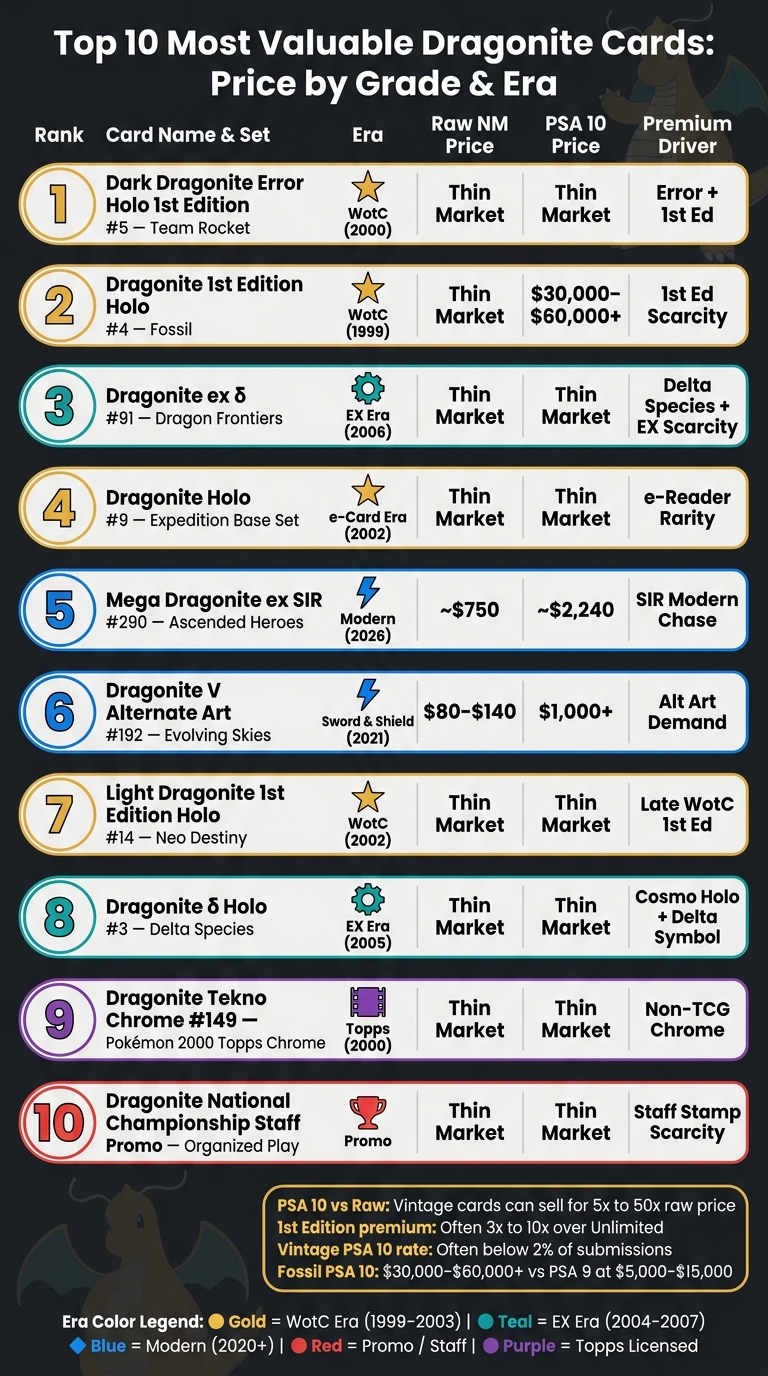
Top 10 Most Valuable Dragonite Cards: Price by Grade & Era
| Card | Why it ranks high | What to check first |
|---|---|---|
| Dark Dragonite Error Holo 1st Edition #5 | Error print + 1st Edition | Holo pattern, stamp, wrong number |
| Dragonite 1st Edition Holo #4 | Heavy vintage demand | 1st Edition stamp, holo wear, centering |
| Dragonite ex δ #91 | EX-era scarcity | δ symbol, ex label, set number |
| Dragonite Holo #9 | e-Reader holo demand | Dot Code border, #9/165 |
| Mega Dragonite ex #290 SIR | Top modern chase | Texture, full-art layout, grade |
| Dragonite V Alt Art #192 | Alt-art demand | Surface flaws, print lines, centering |
| Light Dragonite 1st Edition Holo #14 | Late-WotC 1st Edition | Stamp, holo scratches, corners |
| Dragonite δ Holo #3 | Delta Species demand | δ symbol, holo pattern, condition |
| Dragonite Tekno Chrome #149 | Low-supply non-TCG release | Tekno Chrome finish, #149 |
| National Championship Staff Promo | Staff stamp scarcity | STAFF stamp, slab cert if graded |
Bottom line: if you’re buying Dragonite cards in 2026, don’t focus on the name alone. The exact print, the stamp, and the grade are what drive the biggest prices.
How to Read Dragonite Card Values
Four things shape Dragonite prices in this list: era, rarity, condition, and grading population. If you want to judge any card on the page, start there.
Set era has the biggest effect on vintage cards. Dragonite cards from the Wizards of the Coast era (1999–2003) sit behind most top-dollar sales. Inside that window, 1st Edition and Shadowless copies usually sell for much more than Unlimited prints because they’re harder to find and more sought after. You can spot a Shadowless card by the missing right-side shadow. For 1st Edition, look for the circled “1” stamp under the artwork.
Vintage holo Dragonite cards also tend to run into the same trouble spots. The four flaws that show up most often are:
- holo surface micro-scratches
- edge whitening on the back
- print lines or orange spots from manufacturing
- off-center borders
For a PSA 10, centering must be 60/40 or better on the front and 75/25 on the back.
Use this scale:
| Grade | Condition | Value Impact |
|---|---|---|
| PSA 10 / Gem Mint | Virtually flawless; sharp corners, excellent centering | Maximum premium; often 5–50x raw price on vintage cards |
| PSA 9 / Mint | One minor flaw allowed, such as slight off-centering | Large premium over raw, but often a steep drop from PSA 10 |
| PSA 7–8 / Near Mint | Light edge whitening or minor surface wear | Modest premium; often the sweet spot for collectors |
| Raw (Near Mint) / Played | Near Mint raw copies set the baseline; played copies show visible wear | Baseline market price; played or damaged cards often trade at 20–50% of Near Mint value |
Scarcity matters too, especially at the top of the market. Big premiums usually depend on how few gem-mint copies exist. Vintage Dragonite cards often come in below a 2% PSA 10 success rate. That’s why prices can jump so fast when only a small number of clean copies are out there. Before you buy a high-grade card, check the pop report.
Where Off Center Fits In for Returning Collectors
Now that you know what moves Dragonite prices, the next step is simple: figure out exactly which card you're looking at. If you came back to Pokémon around 2003, a price list by itself usually isn't enough. A 1st Edition stamp can mean a 60–80x jump in price compared with Unlimited.
Off Center gives returning collectors a quick refresher on grading, print variants, and the main factors behind Dragonite prices. It shows you how to tell a 1st Edition stamp from a Shadowless copy, and why a "Staff" promo stamp can change the card's collector profile in a big way.
This is where small details start to matter. If you're thinking about paying a premium for a raw card, you need to know how to check centering, surface scratches, edge whitening, and corner wear. Miss one of those, and you can overpay fast.
Use that context as you go through the cards below. Look at the exact version, not just the card name. With Dragonite, the same name can hide very different cards - and very different prices.
1. Dark Dragonite Error Holo 1st Edition #5 (Team Rocket)
This card takes the top spot because it’s a rare Team Rocket factory error. During Team Rocket production, some holo copies were printed with the wrong card number - #21 instead of #5. If you’re checking one, look for three things: the holo art window, the 1st Edition stamp, and the incorrect #21 numbering. That mix turns it into one of the biggest Dragonite variants for serious Team Rocket collectors.
PSA 10 copies are hard to find because the population of perfect grades is tiny next to the thousands of cards submitted. Put those pieces together - error status, holo format, and 1st Edition scarcity - and it’s easy to see why this card sits at the top of the list.
Next comes the clean 1st Edition Fossil holo, where scarcity is tied to the print run, not a printing error.
2. Dragonite 1st Edition Holo #4 (Fossil)
Fossil came out in 1999, and Dragonite #4 is the set’s holo rare. What makes this the chase version is the 1st Edition stamp. Without it, you’re looking at the more common Unlimited print. That’s why this card sits near the top of WotC-era vintage picks.
To spot it, check the left side of the artwork frame for the circled 1 stamp with EDITION underneath. Fossil doesn’t have a Shadowless print, so every card is either 1st Edition or Unlimited.
Condition matters here, but grade is what creates the biggest jump in price. Holo scratching, edge wear, and centering issues show up a lot. And if centering hits 60/40 or worse, that will often cap the card at PSA 8. That’s a big deal when top grades sell for so much more.
Recent sales tend to fall into these ranges, with PSA 10 copies bringing the biggest premium:
| Condition | Price Range |
|---|---|
| Raw (Ungraded) | $200 – $5,000+ |
| PSA 9 (Mint) | $5,000 – $15,000 |
| PSA 10 (Gem Mint) | $30,000 – $60,000+ |
PSA 10 copies are especially hard to find. Only a small share of submitted vintage cards get that perfect grade, and a PSA 10 can sell for 5–8x the price of a PSA 9. If you’re buying raw, check the holo under raking light for micro-scratches, then look closely at both front and back centering.
Next is Dragonite ex δ #91, where Delta Species printing creates a different kind of scarcity.
3. Dragonite ex δ #91 (Dragon Frontiers)
Released in 2006, Dragon Frontiers comes from the EX era. Its Delta Species cards pull extra demand because they mix unusual typings with strong collector appeal. That Delta Species angle, along with EX-era scarcity, helps push demand for Dragonite ex δ #91.
You can spot it by a few clear details:
- The lowercase ex suffix used in the EX era
- The δ symbol
- Card #91
- The Dragon Frontiers set logo
PSA 10 copies are scarce, so centering and surface quality matter most if you're looking at top-end value. From there, the list moves back into the older e-Reader era with Expedition Base Set.
4. Dragonite Holo #9 (Expedition Base Set)
Released in 2002, Expedition Base Set is an e-Reader-era chase, and high-grade copies are hard to find. That’s why the Dot Code frame is the fastest way to confirm this card.
To spot the holo, look for the thick Dot Code borders on the left and bottom edges and card #9/165. This set also includes a non-holo Dragonite, so check the number before you buy.
PSA 10 copies are scarce, and centering is the main thing that hurts the grade. If you’re buying raw, inspect the front and back borders closely.
Next is Dragonite ex δ #91, where the value story shifts from e-Reader format to Delta Species rarity.
5. Mega Dragonite ex Special Illustration Rare (Ascended Heroes)
Mega Dragonite ex #290 is a Special Illustration Rare (SIR) from Ascended Heroes and one of the strongest modern Dragonite chase cards. It’s also a good snapshot of today’s Dragonite market: modern Dragonite ex cards still pull strong demand, and for collectors who grew up with vintage holos, this feels like the modern benchmark in the top 10.
Before you buy, check the basics closely. Confirm card #290, the SIR tag, the textured finish, and the borderless full-art layout that sets it apart from the standard rares in the set.
Value jumps hard as grade goes up:
| Condition | Estimated Market Value |
|---|---|
| Raw | ~$750 |
| PSA 8 | $1,200–$1,500 |
| PSA 10 | ~$2,240 |
That PSA 10 price is about $1,490 above raw, or close to a 200% premium. Put simply, grade matters A LOT here. The PSA 10 gem rate for raw submissions is 68%, so a clean copy still has a fair shot at top grade.
The usual problems are pretty straightforward:
- Surface scratches
- Rounded corners
- Off-center printing
Those are the main flaws that keep copies from landing Gem Mint. If you’re thinking about a regrade, only do it with clean copies. Rounded corners and scratches will cap the grade no matter what holder the card is in.
Next is Dragonite V Alternate Art #192, where modern alt-art demand replaces SIR scarcity.
6. Dragonite V Alternate Art #192 (Evolving Skies)
This is where the list moves from older, hard-to-find cards to a modern card people still chase hard. Dragonite V Alternate Art #192/203 from Evolving Skies is the modern Dragonite chase card. You can spot it by its alternate-art illustration, and its price is tied to two things: low pull rates and heavy demand for gem-mint copies.
Alternate-art pulls show up at about 1 in 100 to 200 packs. That kind of pull rate helps keep supply tight. As a result, Near Mint raw copies usually sell for $80 to $140.
| Condition | Estimated Value (USD) |
|---|---|
| Raw (Near Mint) | $80 – $140 |
| PSA 9 (Mint) | ~$300 – $500 |
| PSA 10 (Gem Mint) | $1,000+ |
PSA 10 copies are tough to get. Centering issues, micro-scratches, print lines, and background defects can knock the grade down fast. If you're checking a raw copy under raking light and the surface looks clean with tight centering, that's a strong sign it may be worth grading.
7. Light Dragonite 1st Edition Holo #14 (Neo Destiny)
After the modern chase cards, this list swings back to late-WotC scarcity. Neo Destiny is still one of the most in-demand late-WotC sets, and as the final English Neo set, it carries late-WotC nostalgia plus secret-rare scarcity that keeps buyer interest steady. Light Dragonite #14 fits right into that demand as a Neo Destiny holo.
You can spot the circled 1/EDITION stamp under the artwork on the left. That said, stamps can be faked. Use 10x magnification and make sure the print looks crisp and matches the rest of the card text.
The holo uses the classic WotC holo pattern. It looks great, but it also picks up micro-scratches with ease. A simple way to check: hold the card under a bright LED at about a 45-degree angle and look for haze or surface wear. On a raw copy, centering and surface quality are usually the two things most likely to hold the grade back. The 1st Edition version often sells for 3x to 10x more than Unlimited.
No card-specific current price is listed, so use the grade spread below:
| Condition / Version | What the source material supports |
|---|---|
| Raw | No card-specific current price range is listed |
| PSA 9 | Typically sells for 30% to 60% of PSA 10 value |
| PSA 10 | Can command a 5x to 50x premium over raw |
| 1st Edition vs. Unlimited | 1st Edition often sells for 3x to 10x more than Unlimited |
From here, the ranking moves from Neo-era nostalgia to Delta Species rarity.
8. Dragonite δ Holo #3 (Delta Species)
Dragonite δ #3 brings the list back to mid-2000s EX-era scarcity. You can spot it by three details: the Delta Species symbol (δ), the exact set number, and the Cosmo Holo pattern.
EX Delta Species Dragonite δ #3 stands out for its Delta Species symbol and Cosmo Holo pattern. As usual with cards like this, grade does a lot of the heavy lifting. Top-grade copies get the biggest premium, and Dragonite tends to sell for more than cards with a similar rarity level in the same tier. PSA 10 populations are often very small, and in top grades, the price can jump to 5x to 20x the value of a raw copy.
It ranks below the error cards, 1st Edition cards, and promo-heavy entries above it for a simple reason: its price comes from standard EX-era scarcity, not from a print error or trophy-style status. So if you're buying one, the small details matter. The Delta symbol, exact set number, and Cosmo Holo pattern are the main things to check.
PSA 10 copies command the highest premium. Raw and PSA 9 prices are not confirmed here.
Next is a non-TCG outlier: Dragonite Tekno Chrome #149 from Topps Chrome.
9. Dragonite Tekno Chrome #149 (Pokémon 2000 Topps Chrome)
Dragonite Tekno Chrome #149 is a licensed Pokémon 2000 Topps Chrome card, but it is not part of the official TCG. That’s what gives it its own lane. For collectors who like officially licensed oddballs and less common Dragonite releases, this card stands out.
Unlike the WotC-era cards listed above, the value here doesn’t come from 1st Edition status or standard holo pull rates. It comes from two things: the lower supply of licensed non-TCG cards and how tough this card can be to grade well.
The big tell is the Tekno Chrome label. The glossy Tekno Chrome finish looks great, but it also makes flaws easier to spot. Surface wear shows up fast, and centering issues are hard to miss. Because of that, top-grade copies tend to sell for more, with Gem Mint examples getting the biggest premium.
Before you buy or send one in for grading, check two details first:
- The Tekno Chrome label
- Card #149
From here, the list moves away from retail inserts and into a true staff promo.
10. Dragonite National Championship Staff Promo
This is the staff-stamped promo version, and the STAFF stamp is the one detail that sets it apart from the standard print versions.
Its price comes from two things: promo status and that stamp. Not from pack-pull odds. That puts it in the same high-end lane as trophy-style and contest-prize cards.
If you're checking a copy, start with the STAFF stamp. That's the first thing to confirm.
The comparison table below makes the version differences much easier to scan at a glance.
Quick Comparison Table
The table below gives you a fast read on the biggest Dragonite price drivers.
A quick heads-up: some of these cards trade in very thin markets, so a few price fields are intentionally broad instead of pinning down one exact number.
| Card Name | Set | Release Era | Card Type | Raw (NM) | PSA 9 Range | PSA 10 Range | Main Reason for Premium |
|---|---|---|---|---|---|---|---|
| Dark Dragonite Error Holo 1st Edition #5 | Team Rocket | WotC (2000) | Holo Rare (Error) | Thin market | Thin market | Thin market | Print error and 1st Edition scarcity |
| Dragonite 1st Edition Holo #4 | Fossil | WotC (1999) | Holo Rare | Thin market | $5,000–$15,000 | Thin market | 1st Edition scarcity and strong vintage demand |
| Dragonite ex δ #91 | Dragon Frontiers | EX Era (2006) | Holo Rare ex | Thin market | Thin market | Thin market | Delta Species variation and ex-era chase appeal |
| Dragonite Holo #9 | Expedition Base Set | e-Card Era (2002) | Holo Rare | Thin market | Thin market | Thin market | e-Reader rarity and early e-Card-era holo appeal |
| Mega Dragonite ex Special Illustration Rare #290 | Ascended Heroes | Modern (2026) | Special Illustration Rare | ~$750 | Highly variable | ~$2,240 | Modern chase demand and full-art SIR format |
| Dragonite V Alternate Art #192 | Evolving Skies | Sword & Shield (2021) | Alternate Art | Thin market | $1,000–$3,000 | Thin market | Modern chase demand and low pull rates |
| Light Dragonite 1st Edition Holo #14 | Neo Destiny | WotC (2002) | Holo Rare | Thin market | Thin market | Thin market | 1st Edition scarcity and late-WotC demand |
| Dragonite δ Holo #3 | Delta Species | EX Era (2005) | Holo Rare | Thin market | Thin market | Thin market | Delta Species typing and Cosmo Holo appeal |
| Dragonite Tekno Chrome #149 | Pokémon 2000 Topps Chrome | Topps licensed era (2000) | Topps Chrome | Thin market | Thin market | Thin market | Non-TCG format and refractor rarity |
| Dragonite National Championship Staff Promo | Organized Play | Promo (Various) | Staff Promo | Thin market | Thin market | Thin market | Staff stamp scarcity and thin supply |
The pattern is pretty clear. Vintage WotC holos and 1st Edition copies push the biggest premiums, especially when supply is tight. For modern chase cards, PSA 10 usually sets the top end of the market, while vintage 1st Edition holos still pull the strongest premiums overall.
Next, break down which factors move Dragonite prices most.
What Moves the Price Most
These ten cards swing in price based on four things: condition, print status, variant type, and era. That’s the lens to use when reading the rankings above.
Condition comes first. Centering, surface scratches, and edge whitening can make or break a grade, so they matter more than anything else before submission.
After that, 1st Edition status is the next big multiplier. For vintage cards from 1999 to 2003, the 1st Edition stamp will often push value 3 to 10 times above the Unlimited version of the same card.
Errors and special variants can add another premium. But with raw copies, you need to verify every detail against documented examples. That’s why raw cards call for extra scrutiny.
EX and e-Reader holos are especially sensitive to condition because scratches and centering flaws show up fast. Once a card is at 60/40 centering or worse, it usually tops out around PSA 8.
Modern chase cards are simpler to spot. Their price now comes down mostly to PSA 10 population.
Next, use these factors to decide which Dragonite is worth buying.
How to Buy the Right Dragonite Card
For returning collectors, the first trap is simple: buying the right Dragonite card in the wrong version.
That matters a lot. Raw cards can hide condition issues. Graded slabs put a ceiling on that risk. With vintage cards, start by checking centering. If it's 60/40 or worse, the card will usually top out at a PSA 8. That grade ceiling should shape your next move. If the card can't grade high enough to justify the cost, skip the submission and compare the ranked versions first.
Before you pay, do a fast check on the exact copy you're buying:
- Confirm the 1st Edition stamp
- Verify any Staff stamp
- Check that Special Illustration Rares have raised texture; a smooth surface is a red flag for a fake
- Look up the certification number on PSA, BGS, or CGC before buying any graded copy
Population reports help too. They show how scarce top grades are, which can tell you a lot before you choose between buying raw to submit or buying graded right away.
Your goal as a collector should shape the card you go after. A nostalgia buy isn't the same as a top-grade modern chase card, and mixing those goals is where people get burned.
| Buyer Type | Best Target Cards | Key Watch-Out |
|---|---|---|
| Fossil nostalgia collector | Dragonite 1st Edition Holo #4 (Fossil) | Check centering and back-edge whitening first |
| Team Rocket variant hunter | Dark Dragonite Error Holo 1st Edition #5 | Verify the error against documented examples |
| Delta Species completist | Dragonite δ Holo #3, Dragonite ex δ #91 | Use a loupe to check for micro-scratches on the holo surface |
| Modern alt-art chaser | Dragonite V Alt Art #192, Mega Dragonite ex #290 (Special Illustration Rare) | Buy raw only if it looks perfect; otherwise buy a PSA 10 |
One last thing: use recent sold prices, not asking prices. Sellers can list a card for anything. What counts is what buyers paid in the last 30 to 60 days. Use eBay's "Sold Items" filter or TCGPlayer's Market Price to check that data.
Conclusion
This list points to a simple theme: Dragonite's biggest prices come from a few main lanes. Vintage WotC holos, promos and oddball variants, EX-era scarce cards, and modern chase cards all show up again and again. And across all of them, grade is often the main thing that separates a normal copy from a top sale.
Condition creates the biggest price gaps. Vintage 1st Edition holos and error cards can sell for huge premiums, while modern chase cards can still spike at PSA 10. In plenty of cases, the grade matters almost as much as the card itself.
If you're buying for nostalgia, vintage WotC holos make the most sense. If you're more focused on price upside, top-grade vintage cards and premium modern chases are usually the better place to look.
Stick to one lane, check the exact version, and buy the best condition your budget allows.
FAQs
Which Dragonite card is best for beginners?
For beginners, the McDonald’s holographic Dragonite (#5/25) is a great place to start. It’s fairly easy to find, simple to spot thanks to its foil finish, and usually carries a mid-range price that tends to climb in a steady way as condition improves.
Try to find Near Mint copies or better. Also double-check that it’s the holographic version, because the non-holographic card has almost no market value.
Should I buy raw or graded Dragonite cards?
It comes down to your goals and how much risk you’re comfortable taking.
Graded cards are often the go-to choice for investors and serious collectors. Why? Because the grade gives you an authenticated view of the card’s condition, and condition is a major piece of the value puzzle for high-end cards.
Raw cards usually cost less up front, and they can offer upside if the card grades well later. But there’s a catch: you’re taking on more risk, especially if the card has flaws that weren’t disclosed.
In most cases, grading makes sense only when a high grade would more than cover the grading fee, shipping costs, and the chance of getting a lower grade than you expected.
How can I tell if a Dragonite card is fake?
Check a few basics first. Genuine cards usually have a thin, dark inner core that blocks light. A lot of fake cards don't.
Under magnification, real cards should show crisp, consistent printing. Fake ones often have fuzzy text or a visible dot-pattern print.
You should also look for:
- A consistent, vibrant blue back
- The correct Pokémon card design
For vintage cards, the weight should be about 1.7 to 1.8 grams.
If you're still not sure, PSA, BGS, or CGC can authenticate it.