If you want the short answer: the biggest Rayquaza money is at the top of the grade scale, not just in the card name. A raw Rayquaza Gold Star can sell around $800 to $2,501, while a PSA 10 copy reached $340,000 in February 2026. That gap tells you almost everything you need to know.
If I were coming back to Rayquaza cards in 2026, I’d focus on three things first:
- Exact card number
- Set and promo details
- Condition, especially centering, edges, and surface
This list covers the main Rayquaza cards collectors chase most:
- Rayquaza ★ Gold Star - EX Deoxys 107/107
- Rayquaza ex δ Delta Species - EX Dragon Frontiers 97/101
- Rayquaza Secret Rare - Dragons Exalted 128/124
- Rayquaza ex - EX Deoxys 102/107
- Rayquaza C LV.X - Supreme Victors 146/147
- Rayquaza VMAX Alternate Art Secret Rare - Evolving Skies 218/203
- Rayquaza V Alternate Art - Evolving Skies 194/203
- Rayquaza GX Hidden Fates Promo - SM177
- Shining Rayquaza - Shining Legends 56/73
- M Rayquaza-EX Full Art - Ancient Origins 105/98
The big takeaway is simple: older EX-era cards win on scarcity, while modern Evolving Skies cards win on demand and PSA 10 prices. One small flaw can cut a card’s price hard, and similar-looking Rayquaza prints can be far apart in market value.
The 10 Most EXPENSIVE Rayquaza Pokémon Cards 🐉 #top10 #pokemon #rayquaza
sbb-itb-905f8ad
Quick Comparison
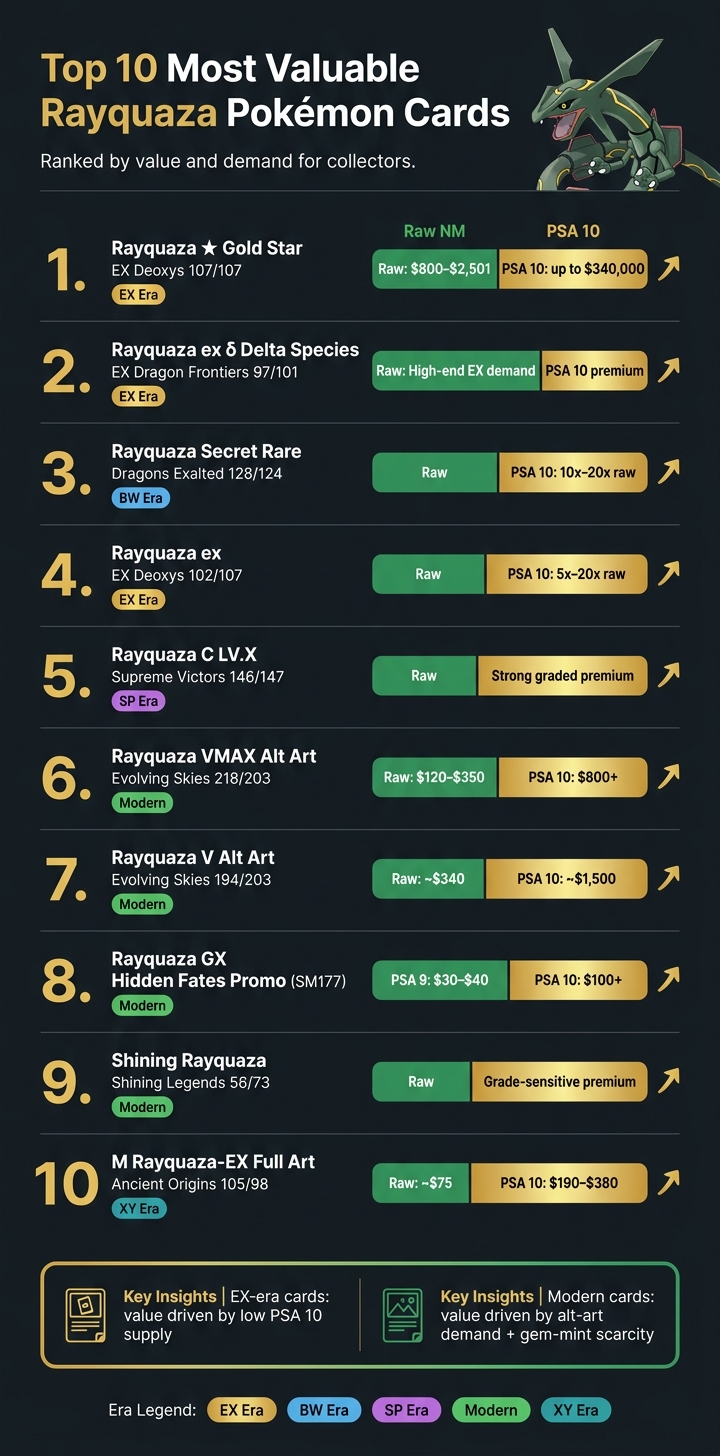
Top 10 Most Valuable Rayquaza Cards: Price & Grade Comparison
| Card | Era | Main price driver | Price snapshot |
|---|---|---|---|
| Rayquaza ★ Gold Star 107/107 | EX | Low PSA 10 supply | Raw $800–$2,501; PSA 10 up to $340,000 |
| Rayquaza ex δ 97/101 | EX | Delta Species + grade scarcity | High-end EX demand |
| Rayquaza 128/124 | BW | Secret Rare + PSA 10 premium | PSA 10 often 10x–20x raw |
| Rayquaza ex 102/107 | EX | Set demand + top-grade scarcity | PSA 10 often 5x–20x raw |
| Rayquaza C LV.X 146/147 | SP | Tough grading | Strong graded premium |
| Rayquaza VMAX AA 218/203 | Modern | Alt art demand | Raw $120–$350; PSA 10 $800+ |
| Rayquaza V AA 194/203 | Modern | Strong demand, healthy PSA 10 supply | Raw ~$340; PSA 10 ~$1,500 |
| Rayquaza GX SM177 | Modern promo | Condition from sealed promo wear | PSA 10 $100+ |
| Shining Rayquaza 56/73 | Modern shiny | Shiny chase demand | Grade-sensitive |
| M Rayquaza-EX 105/98 | XY | Secret Rare look + condition | Raw ~$75; PSA 10 $190–$380 |
So if you’re buying, selling, or grading, I’d treat this list as a checklist: match the print, check the flaws, then look at the grade spread before you set a price.
What to Check Before You Value a Rayquaza Card
Start with the basics: set name, card number, promo number, language, and release mark. That sounds simple, but it matters a lot. Two Rayquaza cards can look almost the same and still come from very different print runs, like EX Deoxys 107/107 and EX Emerald 95/106. Those small details are what separate similar-looking cards from cards that sell at very different price points.
Condition is where many collectors miss the fine print. The four biggest things to check are centering, corners, edges, and surface. PSA's centering standards are looser than BGS's, so a card that grades one way at PSA can come back lower at Beckett. It also pays to flip the card over and inspect the back. One small white chip can knock a near-10 card far below gem mint.
"A perfectly centered card can sometimes get a higher grade than an off-center one with a flawless surface." - Silas, Founder, Flavor365
That gap in condition leads to huge swings in price. A raw Near Mint Rayquaza Gold Star from EX Deoxys trades between $1,000 and $1,800. A PSA 10 copy, on the other hand, sold for $340,000 in February 2026, and only 47 PSA 10 copies were confirmed at that time. That's the kind of spread grading can create, and it shows up again in the top 10 below.
Japanese promos are a common target for counterfeits, so check slab certification numbers in the PSA or BGS database before you buy.
With those checks in mind, the ranking starts with the rarest Rayquaza printings.
1. Rayquaza ★ Gold Star (EX Deoxys 107/107)
This 2005 EX Deoxys Gold Star is the Rayquaza chase card. It shows a shiny Rayquaza with frame-breaking artwork and the Gold Star mark, which is a big part of why collectors keep coming back to it. Scarcity was baked in from day one too, with pull rates at about 1 in 72 packs.
Raw Near Mint copies usually sell for about $800 to $2,501. That range looks tiny once you jump to gem mint. PSA 10 copies often land between $60,000 and $85,000, and the top public sale hit $340,000 in February 2026.
Why such a huge gap? Simple: high-grade EX-era holos are tough to find. Print wear, edge issues, and holo flaws make PSA 10 copies hard to come by. In early 2026, only 47 PSA 10s were known. That’s why gem-mint copies sell for so much more than raw ones.
Next up is another early EX-era Rayquaza card that collectors want badly.
2. Rayquaza ex δ Delta Species (EX Dragon Frontiers 97/101)
Another early-EX Rayquaza to keep an eye on is the Delta Species print. This 2006 EX Dragon Frontiers Rayquaza ex δ Delta Species 97/101 stands out because it turns Rayquaza into a Fire-type card. That twist is a big part of the appeal. Collectors go after this copy for its unusual typing and the clean early-EX artwork.
Near Mint copies often sell for more because print quality in the EX era could be uneven, and high-grade copies are hard to find. When you check a card, look closely at centering, silvering, edge whitening, and corners. Even slight 60/40 or 70/30 centering can keep a card from reaching Gem Mint status.
Also, make sure you’re looking at the 97/101 Fire-type version. Other Rayquaza ex prints from the same era can have very different prices.
3. Rayquaza Secret Rare (Dragons Exalted 128/124)
The Dragons Exalted Rayquaza 128/124 is a Black & White-era secret rare that collectors still want. The 128/124 numbering marks it as a secret rare, and the full-art holographic finish gives it a big, flashy look in a binder or slab. It’s one of the Rayquaza cards that helped define the era.
That demand shows up most clearly at the top end of the grade scale. PSA 10 copies can sell for 10x to 20x the price of a raw Near Mint copy. The main reason is print quality: centering and print alignment often keep clean-looking cards out of Gem Mint.
If you’re buying raw, slow down and check the front carefully under good lighting. A card can look sharp at first glance, then miss on centering once you take a closer look.
4. Rayquaza ex (EX Deoxys 102/107)
The EX Deoxys 102/107 matters for one simple reason: it helps complete the set. It’s the regular ex version in EX Deoxys, which means set builders still need it. That link to the set is a big part of why this card holds strong value even below the Gold Star. Collectors pay more for 102/107 because it’s the standard EX Deoxys Rayquaza, not just another ex from the EX era.
Finding clean EX-era copies isn’t easy. Centering is often off, and raw cards can look fine at first glance but still have small surface issues that crush the grade. That’s why graded copies tend to feel like the safer play than raw ones. A PSA 10 can sell for 5x to 20x the price of a raw copy. That scarcity in top grade is a big reason this card stays ahead of many later Rayquaza prints.
5. Rayquaza C LV.X (Supreme Victors 146/147)
After the EX-era chase cards, Rayquaza C LV.X moves this list into SP-era demand. Rayquaza C LV.X (Supreme Victors 146/147) is the SP-era Rayquaza many collectors go after because of its exact set number, its LV.X look, and its pull in clean condition. It’s one of those SP-era Rayquaza cards that stands apart from the rest of the SP lineup.
This is not an easy card to grade well. Centering issues and edge wear make clean copies tough to find. That’s why graded copies, especially high-grade ones, tend to sell at a premium.
That same dynamic gives clean raw copies extra pull too. This card lands here because Rayquaza demand, paired with SP-era scarcity, does more to support it than its later-set release might suggest. Next up is the modern Rayquaza that pulled major collector attention back to the character.
6. Rayquaza VMAX Alternate Art Secret Rare (Evolving Skies 218/203)
After the EX and SP-era cards, Evolving Skies pushed Rayquaza right back into the spotlight. Rayquaza VMAX Alternate Art is still one of the main chase cards from the set, thanks to its alternate-art design and the steady demand Rayquaza always seems to have. For collectors, it sits in that sweet spot between older Rayquaza grails and modern alternate-art cards. That's a big part of why it stays near the top of modern Rayquaza prices.
Raw Near Mint copies usually sell for $120–$350, PSA 9s for $240–$480, and PSA 10s for $800+.
If you're grading one, pay close attention to centering, surface, and edge whitening. Print misalignment is a common issue, and it's often the reason a copy falls short of PSA 10. The pull rate is also low, which helps keep interest high, and Evolving Skies alternate arts have gone up by about 2x to 3x since release.
That combination helps keep Rayquaza VMAX firmly in the top tier of modern Rayquaza cards.
7. Rayquaza V Alternate Art (Evolving Skies 194/203)
After the VMAX chase card, this is the more attainable Evolving Skies Rayquaza. Rayquaza V Alternate Art is the set’s other big chase, and steady Rayquaza demand keeps prices high. What drives the price? Mostly demand, condition, and how easy it is to find clean copies in the raw market.
As of July 2026, raw Near Mint copies are selling for about $340, PSA 9s for about $525, and PSA 10s for about $1,500. That means a PSA 10 sells for about 4.4x the raw price. That gap is a big reason collectors still dig through raw listings looking for grade-worthy copies.
As of July 2026, PSA has graded 18,354 copies of this card, with a 51% Gem Mint rate. That’s a high PSA 10 hit rate, so supply at the top grade is still fairly healthy. In plain English: this card has demand, but it doesn’t have the scarcity of Rayquaza’s true grail cards.
If you’re buying raw, check three things first:
- Edge whitening
- Surface wear
- Centering issues
Centering matters most because grading can’t fix it.
8. Rayquaza GX Hidden Fates Promo (SM177)
After the modern chase cards, SM177 is a good reminder that supply and Gem Mint condition can make all the difference. This is the Hidden Fates Rayquaza GX promo, and Hidden Fates had multiple print waves from 2019 to 2021. So compared with older Rayquaza cards, SM177 is much easier to find.
That larger supply shows up fast in the prices. PSA 9 copies usually sell for $30 to $40, while PSA 10s can go past $100. In plain English: with this card, condition is everything.
There’s also a catch with promos from the Hidden Fates era. Many picked up edge contact from the packaging itself, which can leave minor surface flaws or edge whitening before the card is even opened. Kind of rough, but that’s part of the deal with sealed promos.
When you check one, look at:
- the holo under bright light for scratches and print lines
- the back corners and edges for whitening from packaging wear
With promos like this, clean surfaces and sharp corners usually matter most.
9. Shining Rayquaza (Shining Legends 56/73)
After the modern promo run, Shining Legends puts Rayquaza back where collectors expect to find a card like this: in a true chase-card spot. Shining Rayquaza is 56/73 in Shining Legends, but demand sits well above what that set number might suggest. Because of that, condition and print quality do most of the heavy lifting on price.
This is the set’s shiny chase card, and Shining Legends had a lower print run, which helps keep demand firm. The shiny color treatment is the main thing pushing value here, paired with one of the most collected Pokémon in the franchise. Unlike earlier EX-era cards, this one gets its price power from modern chase-card demand, not old-school scarcity.
High-grade copies bring the biggest premium because shiny holo surfaces show flaws fast. Scratches, print lines, and whitening tend to stand out right away. When you’re checking a copy, focus on:
- Centering
- Holo scratches
- Back-corner whitening
That mix is a big reason Shining Rayquaza stays in the upper tier of modern Rayquaza pulls.
10. M Rayquaza-EX Full Art (Ancient Origins 105/98)
M Rayquaza-EX Full Art Secret Rare (Ancient Origins 105/98) lands at No. 10. The 105/98 card number marks it as a Secret Rare, and that alone makes it stand out.
The big difference between this card and the standard M Rayquaza-EX Full Art (98/98) from the same set is the look. This version has black Mega Rayquaza artwork and gold-etched borders, which gives it a much bolder finish. That color combo is a big reason collectors go after it when they’re trying to round out a Rayquaza collection.
Raw Near Mint copies often sell for around $75, while PSA 10 copies usually land between $190 and $380.
Print quality in the mid-2010s could be hit or miss, so Gem Mint copies are tougher to come by. If you're checking a copy, pay close attention to centering, edge whitening, and holo scratches. Those small flaws are often what keep a card from reaching the top grade.
That gap between rarity and condition is also what helps separate the top Rayquaza prices from the rest.
Why Some Rayquaza Cards Are Worth Far More Than Others
Rayquaza’s biggest prices usually come from two very different lanes: EX-era chase cards with tiny gem-mint populations that still exist today, and modern alternate arts that aren’t hard to find raw but get much tougher in PSA 10.
Gold Star cards are the clearest example. They were pulled at about 1 in every 72 packs and were never reprinted. That alone puts pressure on supply. Add years of wear, binder damage, and heavy play, and the number of clean copies gets very small. That’s why PSA 10 Gold Stars can sell for five figures, while raw Near Mint copies usually sit around $1,000–$2,000.
Modern Rayquaza cards work a bit differently, but the end result is similar. Here, the issue is less about low print runs and more about gem-mint scarcity. Rayquaza VMAX Alternate Art and Rayquaza V Alternate Art are much easier to find raw, yet getting one into PSA 10 is another story. Small print defects, edge wear, and other factory issues can hold grades down, which keeps top copies scarce.
That’s where grading changes everything. On high-end Rayquaza cards, even one grade up or down can swing the price in a big way. Put simply: the grade drives the price.
Promos can also sell for strong numbers, but usually only when three things line up: the card is scarce, collectors want it, and the copy is clean enough to grade well. That’s the same pattern behind the rankings above.
Conclusion
Rayquaza value isn't random.
The EX Deoxys Gold Star and Evolving Skies Alternate Art cards show that cards from very different eras can still hit top prices, just for different reasons. When rarity, demand, and condition line up, prices climb fast. That's why the exact printing and grade matter more than the character name by itself.
Always verify the exact card number before buying or selling. Rayquaza 107/107, 128/124, and other printings can vary a lot in value.
Set builders can stay in raw or mid-grade territory. High-end collectors usually want PSA 10 or BGS 9.5+ copies, where condition drives most of the premium.
For returning collectors, Rayquaza is one of the clearest examples of how exact printing and top condition shape lasting value. It rewards precision, not guesswork.
FAQs
How can I tell which Rayquaza printing I have?
Check four key details on the card: the set symbol at the bottom, the card number in the bottom corner, the rarity mark, and any 1st Edition stamp.
Then match those details against authenticated databases or recent sales listings to pin down the exact printing. A small difference here can change the card version, and sometimes the price, by a lot.
Should I grade my Rayquaza card or sell it raw?
It depends on the card’s value and condition.
In most cases, grading only makes sense for Rayquaza cards worth about $50 to $75 or more in near-mint condition. That’s where authentication and a strong grade can add a price premium.
If the card is worth less than $50, selling it raw is often the better move. And there’s a catch: grading only helps if the card has a good shot at a high score. If it comes back with a lower grade, the card can end up being worth less overall.
Why do PSA 10 Rayquaza cards sell for so much more?
PSA 10 Rayquaza cards sell for more because they combine top condition with strong collector demand. Rayquaza is one of Pokémon’s most iconic and sought-after characters, so prices climb when more people want the card than there are copies available.
A PSA 10 means the card is flawless, with perfect corners, sharp edges, and clean surfaces. For modern chase cards like Evolving Skies alternate arts, that premium comes from two things at once: the lower supply of gem-mint copies and their appeal as true collection centerpieces.