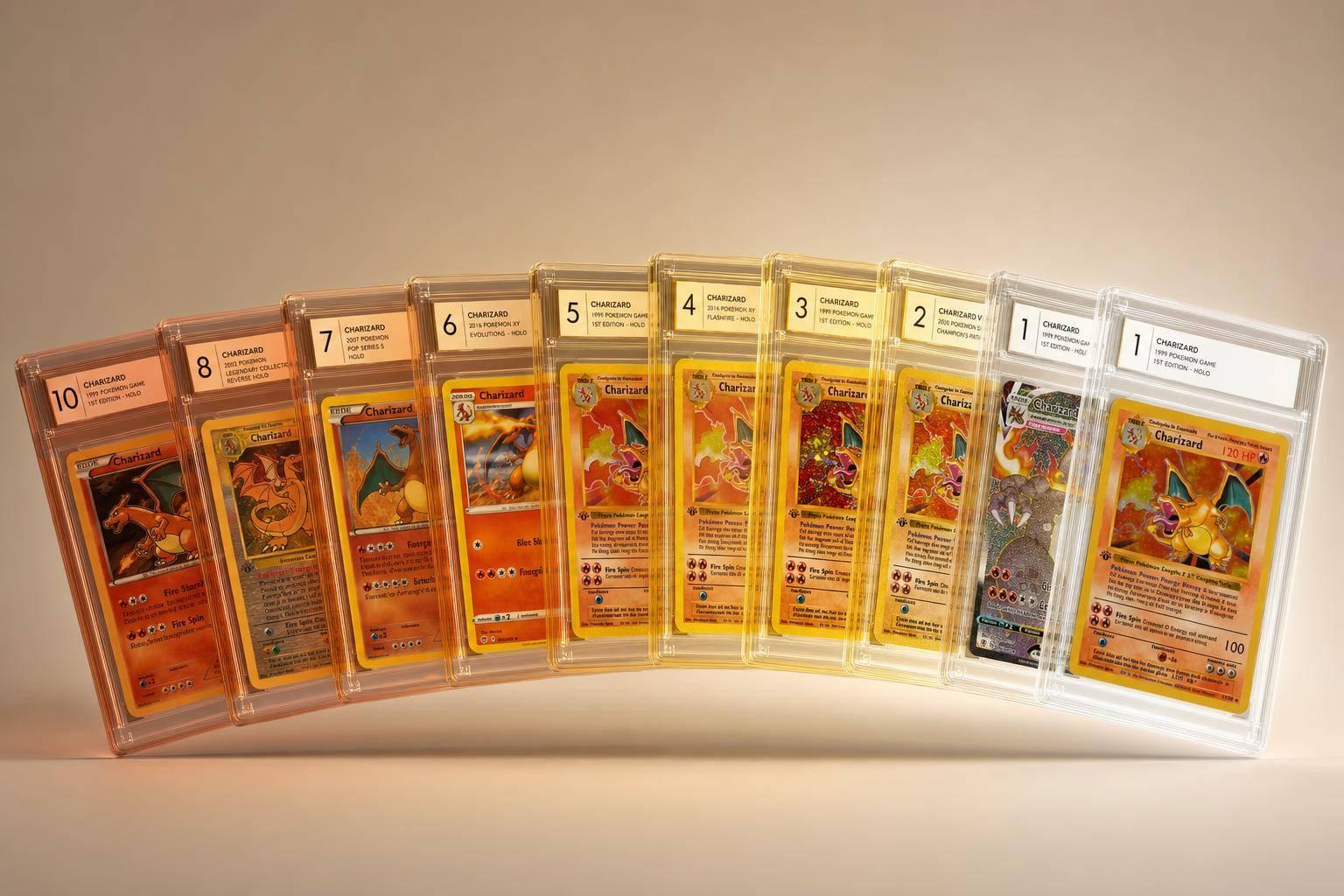
Most old Pokémon cards are Unlimited, not 1st Edition. And that one detail can change price from $180–$350 to $2,000–$4,000 on the same Base Set Charizard.
If I’m checking an old card, I use a simple order:
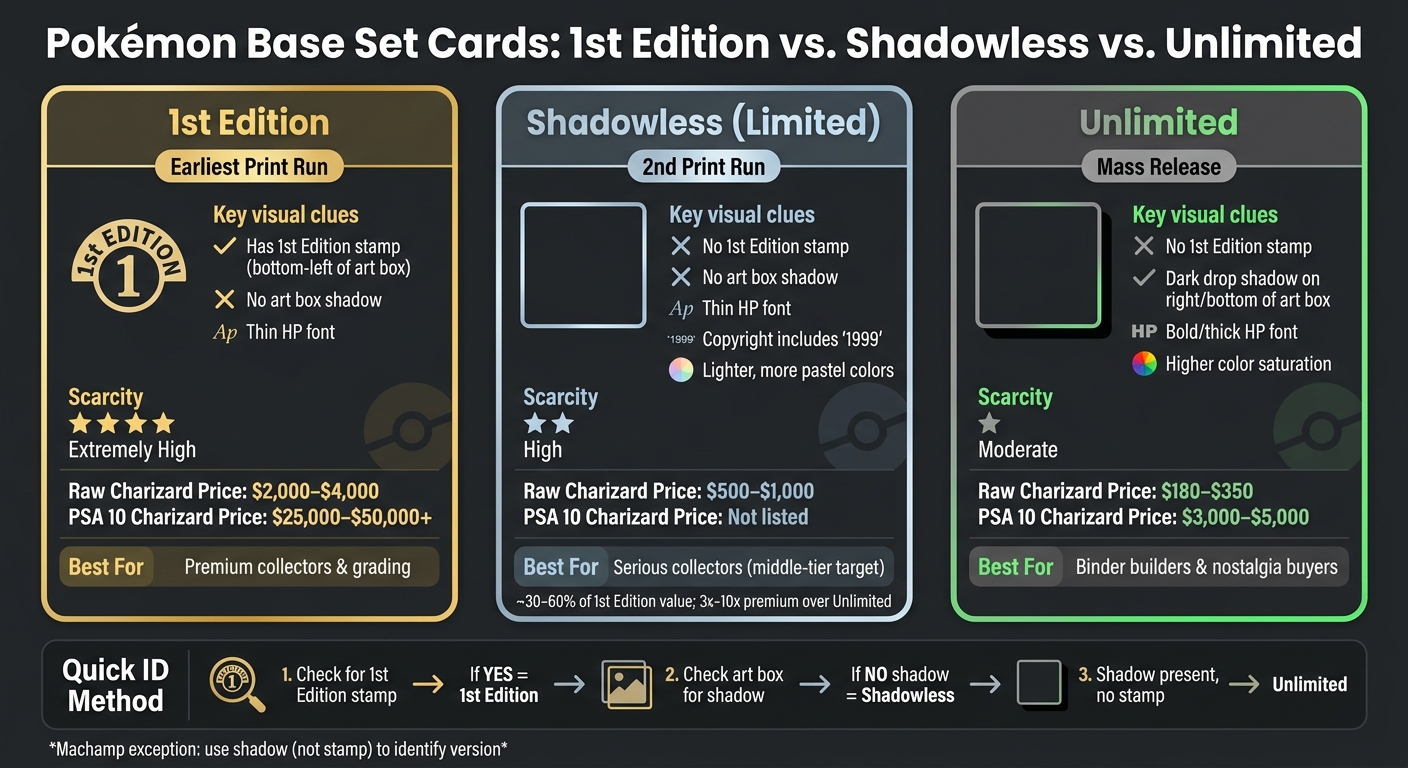
- 1st Edition = has the 1st Edition stamp
- Shadowless = no stamp, but also no frame shadow
- Unlimited = no stamp and has the frame shadow
The word “Limited” is where people get mixed up. It is not an official label on the card. In most cases, sellers use it to mean the short early print window that collectors tie to Shadowless, though some people use it loosely for 1st Edition too. That’s why I never stop at the listing title. I check the card itself.
A few fast facts matter most:
- 1st Edition is the earliest print run and usually the top-priced version
- Shadowless sits between 1st Edition and Unlimited for English Base Set
- Unlimited is the mass-release version most U.S. collectors had as kids
- Machamp is the card that needs extra care because the stamp alone can mislead you
- On Base Set Charizard, raw prices often land around:
- $2,000–$4,000 for 1st Edition
- $500–$1,000 for Shadowless
- $180–$350 for Unlimited
If you want the short answer: check the stamp first, then the shadow, then the text details. That will sort most English Base Set cards in seconds.
Pokémon Base Set Cards: 1st Edition vs Shadowless vs Unlimited
Are My Pokémon Cards RARE? 1st Edition vs. Shadowless vs. Unlimited - 1999 Pokemon Set
sbb-itb-905f8ad
Quick Comparison
| Version | What I look for | Print order | Price tier |
|---|---|---|---|
| 1st Edition | 1st Edition stamp, no shadow | 1st | Highest |
| Shadowless | No stamp, no shadow, thinner HP text | 2nd | Middle |
| Unlimited | No stamp, has right-side shadow, bolder HP text | 3rd | Lowest |
If I’m buying for a binder, I usually lean Unlimited. If I want an early print without paying full 1st Edition money, I look at Shadowless. And if I want the top version, I go straight to 1st Edition.
First Edition: The Earliest Printed Version
A First Edition card comes from the earliest and smallest print run of a set. It’s usually the easiest version to spot, and it often carries the highest price. The best way to check one is simple: look for the stamp first, then use frame details to back it up on early Base Set cards.
Where the 1st Edition stamp appears on a card
On most Pokémon cards, the 1st Edition stamp sits just below the art box on the left side. On Trainer cards, it shifts to the bottom-left corner.
No stamp? Then it isn’t First Edition.
Other visual clues on early Base Set prints
If the stamp is there, the next thing to check is whether the card is shadowless. That’s a key sign of early Base Set printing. In English Base Set, all 1st Edition character cards are shadowless, which means there’s no drop shadow along the right or bottom edge of the frame.
There’s one big exception: Machamp. Most Base Set Machamp copies came in the 2-Player Starter Set, so the stamp doesn’t carry the same weight here that it does on other 1st Edition Base Set holos.
How First Edition affects price and buying decisions
This is where things get expensive fast. On chase cards, First Edition versions can sell for 5x to 50x more than Unlimited copies. Base Set Charizard is the classic example: raw copies usually sell for about $2,000 to $4,000 in First Edition, compared with roughly $180 to $350 for Unlimited.
| Card (Base Set) | Print Variant | Raw Price | PSA 10 Price |
|---|---|---|---|
| Charizard | 1st Edition | $2,000–$4,000 | $25,000–$50,000+ |
| Charizard | Unlimited | $180–$350 | $3,000–$5,000 |
If you’re building a binder, First Edition usually makes sense only if you want the premium copy. If the stamp isn’t there, move on and check for shadowless traits next.
Limited and Shadowless: Between First Edition and Unlimited
If a card doesn't have a 1st Edition stamp, don't call it Unlimited right away. Check for Shadowless first.
Shadowless English Base Set cards don't have the dark drop shadow around the art frame. They came from a short print window between 1st Edition and Unlimited. The simplest way to check is the frame. After that, confirm with the HP line and the copyright date.
English Base Set 1st Edition cards are also shadowless, but most collectors use "Shadowless" to mean the version without the 1st Edition stamp.
This term applies only to the English Base Set. Later sets like Jungle, Fossil, and Team Rocket didn't have a Shadowless phase. They went straight from 1st Edition to Unlimited.
What shadowless cards are and why collectors group them here
Collectors usually treat Shadowless as its own tier because the print run was short. In the market, that matters.
In general, Shadowless cards often sell for about 30% to 60% of what a similar 1st Edition card sells for. At the same time, they can bring a 3x to 10x premium over Unlimited copies in the same grade.
A raw Shadowless Charizard is a good example. It usually sells for $500 to $1,000, compared with $180 to $350 for Unlimited and $2,000 to $4,000 for First Edition.
How to tell a shadowless card from an Unlimited card
The fastest check is the right edge of the art box.
On a Shadowless card, the yellow border meets the artwork directly. There's no shadow. On an Unlimited card, you'll see a gray-black shadow along the right side and bottom of the frame.
Start with that right-edge shadow. Then double-check the thinner HP font and the copyright line at the bottom, which includes "1999".
| Feature | Shadowless | Unlimited |
|---|---|---|
| Artwork shadow | None | Dark drop shadow on right/bottom |
| HP font | Thin / light | Bold / thick |
| Copyright date | Includes "1999" | Typically omits "1999" |
| Color saturation | Lighter, more pastel | Darker, higher saturation |
Machamp needs extra care. It's the exception here: use the shadow, not the stamp, to tell Shadowless Machamp from Unlimited.
Unlimited: The Standard Wide-Release Version
Unlimited does not mean the cards are still being printed today. It refers to the wide-release print run that came after the early limited releases. For Base Set, Unlimited was the mass-release version, and it accounts for most of the surviving cards people see today. That’s why these cards are usually the easiest to identify by their frame, stamp, and text details.
Visual signs of an Unlimited card
Start by checking the right side of the artwork box. If you see a drop shadow there and there’s no 1st Edition stamp on the lower left, you’re looking at an Unlimited card. The HP font also looks bolder and thicker than it does on a Shadowless card. Once you know how to spot that frame shadow, the next step is simple: figure out whether Unlimited matches your budget and what you want from the set.
Why Unlimited is often the best starting point for returning collectors
For a lot of adults getting back into the hobby, Unlimited is the lowest-cost vintage option. It’s also the version many of them actually had as kids. If you want to build a complete binder set, raw Unlimited cards are usually the smarter buy.
Here’s the price gap that makes the choice pretty clear: an ungraded Unlimited Base Set Blastoise usually sells for $35–$80, while a 1st Edition copy in similar condition can cost $1,500–$4,000. For binder goals, a clean Unlimited copy often makes more sense than a beat-up 1st Edition card.
First Edition vs. Shadowless vs. Unlimited: How to Choose and What to Check
Print order, visual clues, and value tier: a side-by-side comparison
Once you know how to spot the 1st Edition stamp and the shadow, picking the right version gets a lot easier.
Here’s the short version: 1st Edition sits at the top, Shadowless lands in the middle, and Unlimited is usually the most budget-friendly option.
| Feature | 1st Edition | Shadowless (Limited) | Unlimited |
|---|---|---|---|
| Print Order | 1st (Earliest) | 2nd | 3rd (Mass Release) |
| 1st Ed Stamp | Yes | No | No |
| Art Box Shadow | No | No | Yes (right side) |
| HP Font | Thin | Thin | Bold |
| Scarcity | Extremely High | High | Moderate |
| Best For | Premium collectors | Serious collectors | Binder builders and nostalgia buyers |
The visual checks are pretty simple once you’ve seen them a few times. 1st Edition has the stamp and no shadow. Shadowless drops the stamp but still has no shadow, plus the thinner HP font. Unlimited adds the right-side shadow and uses the bold HP font.
A simple buying framework for binders, graded cards, and set building
After you identify the print run, the next step is deciding why you're buying.
- Unlimited works well for binders and nostalgia buys
- Shadowless fits a middle-tier target
- 1st Edition is the premium lane for collecting or grading
Condition still matters. A rough 1st Edition can sell for less than a cleaner Unlimited copy. So don’t get tunnel vision on print run alone.
A good rule of thumb: check the shadow first, then confirm the stamp and text details. It’s a fast way to avoid mix-ups.
If you're building a full set, pick one print run early and stick with it. That way, the binder looks consistent side by side, instead of feeling like a patchwork of different releases.
FAQs
How can I spot a fake 1st Edition stamp?
Look past the stamp itself. Counterfeiters sometimes add or fake a 1st Edition stamp on common cards, so that mark alone doesn't prove a card is legit.
Check the card stock, light transmission, font weight, and ink density. Then compare those details against a confirmed authentic card from the same set. If you're dealing with a high-value card, professional authentication is the most reliable option.
Do Japanese Base Set cards use the same print labels?
No. Japanese Base Set cards do not use the same 1st Edition and Unlimited print labels as English cards.
They follow a different production and rarity system, so those English print labels don’t apply here. That means the 1st Edition premium many collectors tie to English sets is not something you can directly carry over to Japanese Base Set cards.
Which version is best for a starter collection?
Unlimited editions are usually the best place to start a collection. They give you the most budget-friendly path into vintage cards that still look great in a binder, on display, or in a deck.
They also make the learning curve a lot easier. When you start with Unlimited, you can get a feel for grading details and market norms without putting as much money on the line. That means you can build a varied collection, make a few mistakes, and learn as you go.